

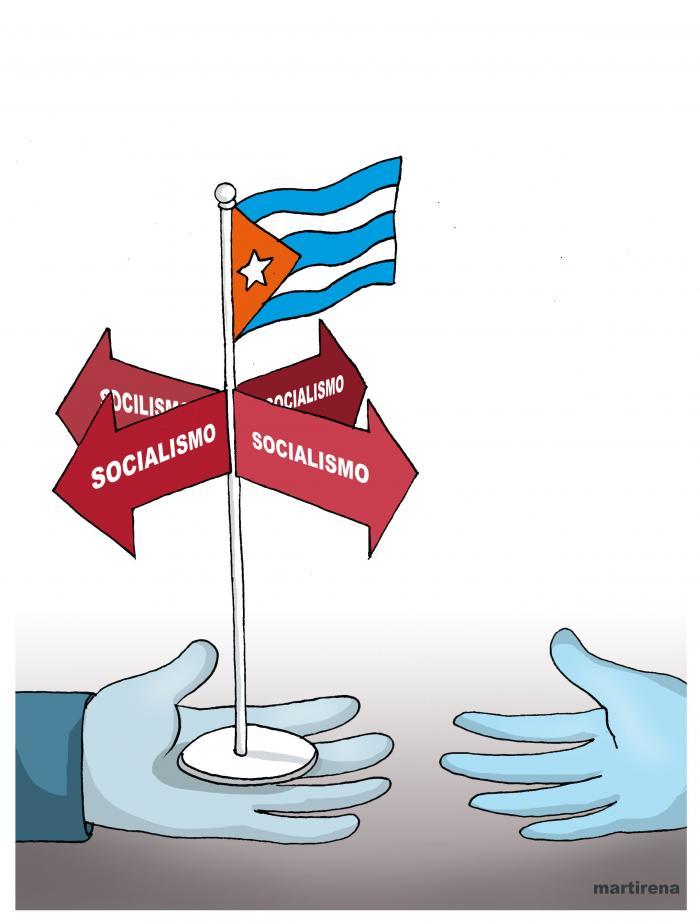
April again. Another 16th. And the same gathering at the corner of 23rd and 12th streets, the one that time has been unable to erase because it is etched in the people’s memory. There, Fidel said what many already felt: that the Revolution of Moncada, Granma, the Sierra, and the plains was socialist. And it wasn’t just rhetorical emotion. It was the affirmation of a fact: we were creating something new, something of our own, something that wasn’t found in any manual nor did it respond to any foreign slogan.
The fact is, our socialism was not imposed. That is a story repeated by those who cannot bear to see a small, blockaded, and sovereign country deciding its own destiny. Cuban socialism is the result of the endogenous development of our national consciousness. It was born here, on this island, out of the need to create something that was diametrically opposed to the years of colonialism.
Today, in the midst of the worst economic crisis in decades—with a tightened blockade, with hardships that hurt us all in our pockets and in our spirits—some might wonder if that decision was a mistake. I assure you that the world cannot sustain the levels of consumption imposed by capitalism. How many spare planets would it take to sustain the wastefulness promoted by a system where the one who consumes the most is worth the most? And we, despite the blockade and all, are saying from this island that there is another way. It is not perfect, it is not miraculous, but it is the only one that guarantees that whatever little or much we have is shared among everyone. It is possible to build another world order based on cooperation and solidarity.
The challenge: to dust off Marxism, to translate it into our own language—the one we use while waiting in line for bread, on the bus, on the street, or in the neighborhood. If our model were a failure, its survival would have been impossible in the face of the empire’s constant and increasingly harsh pressure. It is not enough to point to the enemy from outside—which is real—but we must also look in the mirror and acknowledge the wounds we ourselves have left open.
Certainly, we have much to fight against from this side, the revolutionary side, the one that never wavers in its determination to build a better Cuba. The suffocating bureaucracy, indolence, and the tendency to take the easy way out are lethal wounds that we must speak about openly. Not out of masochism, but because a socialism that does not engage in self-criticism is a socialism that falls asleep, that does not advance, and as we know: savage capitalism does not forgive such errors.
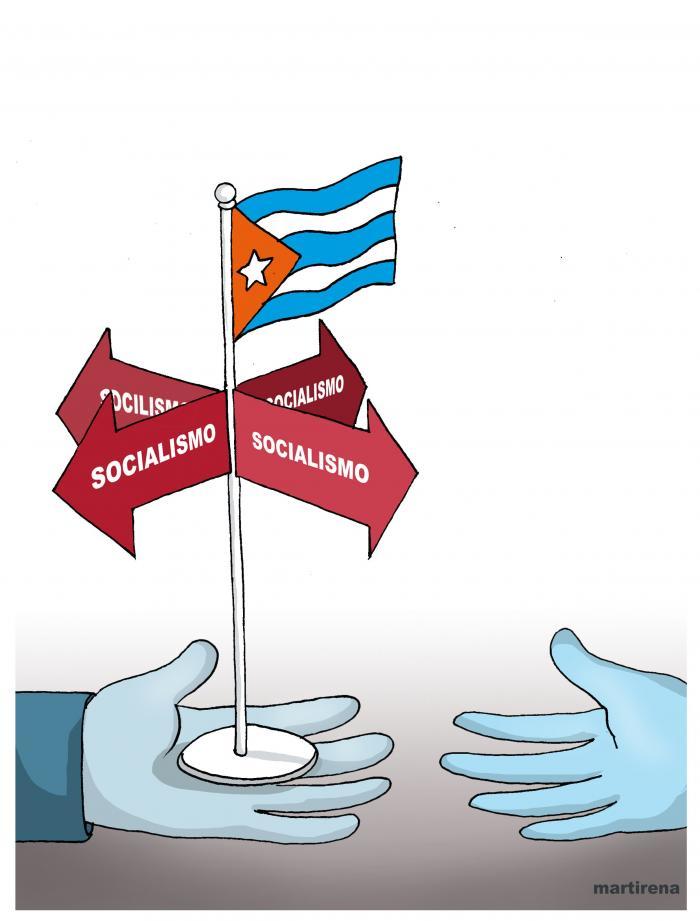
Today, Cuba faces a cultural hegemony that pushes us toward the restoration of a dependent, predatory capitalism—the kind that turns need into business and solidarity into weakness. Nevertheless, it firmly upholds the alternative of continuing to build its own, typically Cuban socialism, without renouncing prosperity and sustainability.
Building the irreversibility of socialism is not a slogan to put on a banner and forget. It is a mandate enshrined in the Constitution of the Republic, ratified by the people in 2019, but one we must earn every day in the factory, in the fields, in the school, in the doctor’s office, in the grocery store. Irreversibility is not a state of grace: it is a daily battle against apathy, against discouragement, against the false notion that one system is as good as another.
The challenge: to theorize more, to debate more about this Cuban socialism, and to put it into revolutionary practice. Not to be afraid of the word "communism," which for decades has been the target of the most vile enemy propaganda. To prove that our parents and grandparents were not wrong. And to do so with the same passion with which, on that April 16, a people, armed with nothing but dignity, decided that their future would not be called capitalism.
The author of these lines knew people personally whose lives changed after the fall of the Berlin Wall and the dismantling of socialism in the German Democratic Republic, a country far more developed than Cuba. People who are doing better or worse, but who know they don’t have the system they wanted, who understood it was impossible to take the good from opposing systems, who saw racism and discrimination return to their homeland; people who had to set aside their credentials—like a prosecutor facing trial, a doctor who cannot bring himself to view his patients as clients, a university rector who lost his doctorate, a dissident who saw no point in continuing his opposition because no one was listening anymore, or a man who feels like a stranger in his own country. We would have to see how much we would suffer, due to this idiosyncrasy of Cubans, if we let ourselves be robbed of what we have built.
Let’s not fool ourselves: this Caribbean island would not get rich, developed capitalism; no, we would get the kind found in Haiti, Central America, or Africa, where these stories could be many times worse.
That is why it is April once again. Once again, it is our rendezvous with a history that is both present and future. And this time, with more strength than ever, we continue to choose our socialism—perfectible but just and humane—the very same one proclaimed on that corner in Havana, defended at Bay of Pigs, and declared irrevocable years later. That socialism which the Constitution grants us the right to defend with arms if necessary and which, without a doubt, is our only option here, now, and always.