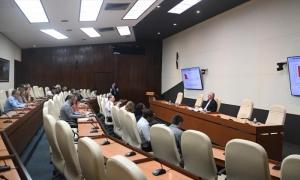




Science and innovation projects related to renewable energy sources and aimed at utilizing available resources and technologies were presented Tuesday afternoon at a meeting between the First Secretary of the Central Committee of the Communist Party and President of the Republic, Miguel Díaz-Canel Bermúdez, and experts and scientists on topics related to the energy transition.
Initiatives capable of providing efficient solutions in the short term, such as heat production, are some of the results of the joint work of the Ministry of Energy and Mines (Minem) and the Ministry of Higher Education (MES), based on the work of the National Group of Universities for Renewable Energy Sources and Energy Efficiency (GNUFRE, in Spanish).
Established in 2019 with the participation of seven universities, the GNUFRE was a response to the 2014 approval of the Policy for the Prospective Development of Renewable Energy Sources and the Efficient Use of Energy until 2030. This policy was preceded by the creation of the Government Commission for the Development of Renewable Energy Sources and the call for participation issued to the universities of Sancti Spíritus, Villa Clara, Havana, and CUJAE (Technical University of Havana), which were later joined by the universities of Oriente, Cienfuegos, and Matanzas.
Currently, the GNUFRE encompasses all higher education institutions with some capacity for energy utilization. It participates in supporting the expanded consultation process and the presentation of the draft Energy Transition Law and complementary regulations, and is part of the leadership of the energy transition project within the higher education system, which includes all universities. These initiatives are among other actions aimed at intensifying participation in various science and technology programs.

The exchange was moderated by Deputy Prime Minister Eduardo Martínez Díaz and included the participation of Deputy Prime Minister Inés María Chapman Waugh, the heads of the Ministry of Energy and Mines (Minem), Vicente La O Levy; the Ministry of Higher Education (MES), Walter Baluja García; and the Ministry of Science, Technology and Environment (CITMA), Armando Rodríguez Batista, among other figures, including directors of the country's universities, who participated via videoconference.

ON THE ROAD TO BIOGAS AND BIOMASS
At President Díaz-Canel's meeting this Tuesday with experts and scientists on energy transition issues, a proposal was presented to finalize and put into operation revolutionary biogas projects, replicable throughout the rest of the country, based on the potential offered by pig, livestock, and industrial waste.
The presentation was given by Dr. Manuel Alejandro Rubio Rodríguez, coordinator of GNUFRE and professor at the Marta Abreu Central University of Las Villas (UCLV). He began by discussing the Martí Project, the first biomethane production project for transportation, based on covered lagoon biodigesters.
Other proposals included the Managuaco biogas project, a network for domestic use of this fuel derived from livestock waste distributed via a Cuban biodigester; the La Pastora demonstration project, a wastewater treatment system converted to a Cuban hybrid biodigester with a rubber membrane; and the Heriberto Duquesne sugar mill biodigester recovery project.
The specialist then presented a proposal for discussion based on the use of forest biomass (wood chips and pellets), which includes the development of the value chain and market for solid biofuels, prioritizing their use in ovens, cooking, the production of construction materials, and the generation of process steam.

Based on the Bioenergy Atlas available in the country and the experience of using biomass burners in ovens, as is currently done in rice mills, work is underway, among other actions, on defining and developing regulations that include incentives to encourage the participation of potential stakeholders in this value chain.
The Sugarcane project, aimed at developing and implementing a new technological and business model for the sugar industry, has garnered particular attention. Rubio explained that this is a preliminary proposal for a technological model for the sector, taking into account Cuban and international experience.
The proposal, the expert argued, is based on the concept that a different kind of sugar industry can generate flexible and sustainable baseload electricity for the energy transition from surplus electricity.
This industry, he said, can be self-sufficient in terms of fuel, using biomethane and alcohol, and can also supply fuel for non-electrifiable motor transport. and it can also produce a portion of the animal feed needed to sovereignly increase meat production in the country.
After a debate that lasted nearly an hour, the First Secretary of the Central Committee of the Communist Party and President of the Republic, Miguel Díaz-Canel Bermúdez, emphasized the wealth of experience and well-established knowledge that exists; however, he insisted that greater integration is necessary to advance its widespread adoption.
The Head of State commented that today the two priorities are food and energy, and both are intimately related, he reflected, and therefore called on those participating in this joint project of the Ministry of Energy and Mines (Minem) and the Ministry of Higher Education (MES) to utilize renewable energy sources and integrate all these initiatives as quickly as possible.