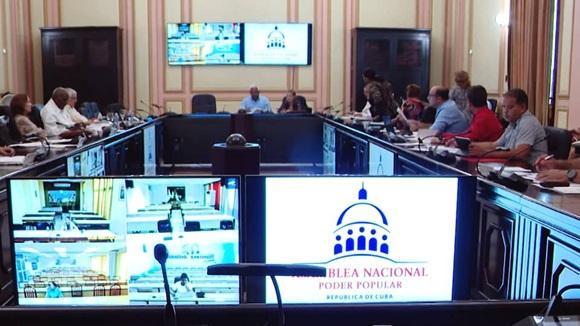



The Deputy Minister of Foreign Affairs of the Republic of Cuba, Carlos Fernández de Cossío, spoke this Tuesday morning about the key lessons of Fidel Castro's thinking, which, the diplomat asserted, have guided and continue to guide our country's actions on the international stage.
The address focused on three fundamental points; the first, "the defense of our sovereign rights without the slightest confusion or diminution, even in the face of extraordinary dangers," using the October Crisis as a prime example.
Secondly, the principle of not negotiating with the adversary, or with any government, Cuba's solidarity and internationalist commitments to various causes and peoples.
In this regard, Fernández de Cossío referred to the numerous instances of U.S. pressure throughout the history of the Revolution to curb Cuba's open solidarity with the Puerto Rican independence movement and its internationalist efforts in Africa.
"In exchange for the release of four U.S. prisoners serving sentences in Cuba for crimes committed by and of interest to the U.S. government, our country did not ask for bilateral concessions from the United States, nor for benefits for Cuba, but rather for the release of the Puerto Rican independence activists Lolita Lebrón, Rafael Cancel Miranda, Irvin Flores, and Andrés Figueroa," he recalled.
He also quoted Carlos Rafael Rodríguez in defense of Cuban internationalism: "There is no obligation we have assumed with any country, group, or government that we have not been able to honor. This should be clear to the United States."
The third point of the speech concerned the denunciation of the international economic order. It wasn't merely an intellectual endeavor, Fernández de Cossío emphasized, but rather another revolutionary struggle in the pursuit of justice for all on the planet.
He highlighted the decolonial vision of the Commander's approaches and the paths he suggested for a more equitable redistribution of resources, given the paradox that "never before has humanity possessed such formidable scientific and technological potential, such an extraordinary capacity for generating wealth and well-being, and never before has the world been so unequal and inequality so profound."
The diplomat said that Fidel Castro's teachings have guided and continue to guide Cuba's performance in forums such as the United Nations, the Non-Aligned Movement, the Group of 77 and China, regional organizations and mechanisms in Latin America and the Caribbean, and any forum where the struggle for justice and the aspiration for a better world allow us to contribute.
According to the Deputy Minister, beyond these three lines of action, Fidel Castro's work and teachings in foreign policy embraced, incorporated, and educated the Cuban people on some of the most complex issues on the international stage.
"We cannot forget the massive popular assemblies in Revolution Square, where hundreds of thousands of Cubans listened to and approved the First and Second Declarations of Havana; the massive solidarity with the people of Vietnam; the first medical brigades to Algeria; the blood donations for people in disaster situations; The creation of the Henry Reeve International Contingent and its decisive contribution to health in various parts of the world, including in the face of epidemics such as Ebola in West Africa and the fight against COVID-19 in more than 40 countries and territories.
“Thanks to the efforts of Cuban professors and teachers, tens of thousands of students from all over the world were trained in our schools and universities. Cuba’s internationalist endeavor in Africa was a massive and voluntary people’s epic, involving more than 350,000 combatants.”
Fidel’s ambition was to defend his country’s unquestionable right to enjoy full and absolute sovereignty, and together with the brave Cuban people, to try to contribute to bringing justice or putting an end to injustice in every corner of the planet, Fernández de Cossío concluded.