


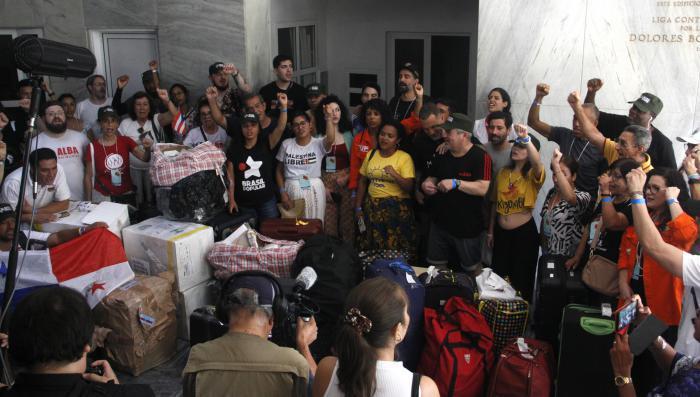
Around ten o'clock on Sunday morning, a group of delegates from the 4th Continental Assembly of the ALBA Movement visited the National Institute of Oncology and Radiobiology, the hospital in Cuba where the most complex treatments are performed on people with cancer.
They brought suitcases and bags full of medicines, creams, bandages, and sweets for the children. A donation that might not seem significant, but is nonetheless, given the scarcity of resources plaguing public health, caused by the economic and energy blockade imposed by the United States, and which doctors and nurses are grateful for because of what it means for their patients.
In a small conference room, the center's deputy director, Misleidiy Nápoles Morales, along with a group of directors and specialists, met with the donors. More than a formal ceremony, it was a conversation, an explanation of who would receive the aid.
"Cancer is a chronic disease that deteriorates the patient until it ends their life. For that reason, most of the time when the disease is diagnosed, the patient internalizes it as a death sentence," Nápoles Morales said as she spoke; you could see, from the faces of those listening, how their hearts ached.
"Our work here is to gain years against cancer, and try to ensure the best possible quality of life." Thirty years might seem like a good life expectancy to an adult, and even more so to an elderly person, but for a child or teenager, it's the chance to live.
"That's why it hurts us more than anyone when we don't have the resources to work, when we have to postpone surgeries and treatments due to lack of electricity, medicine, or spare parts for medical equipment."
"Our patients suffer because of interests they sometimes don't even understand, and we workers have to deal with it day after day. In the end, we suffer alongside them because our primary responsibility is to save lives, even under the worst conditions."
A Venezuelan woman asked to speak, unable to hold back her tears: "In situations like this, I can only feel solidarity and anger, because Cuban doctors have saved thousands of lives in my country and around the world, and seeing imperialism descend upon you with all its might can only awaken that: solidarity and anger. You can count on me for both, always."
A young Colombian man removed his cap before speaking, as if the moment demanded that small gesture of respect: "Many victims of paramilitarism in my country have received treatment in Cuba, because when our governments abandoned them, they found refuge for human dignity on this small island. You are proof that only the people can save the people and that love is repaid with love."
An Argentinian woman, proudly sporting a tattoo of Che Guevara on her shoulder, was the last to speak: "Many told us not to come to Cuba, that the country wasn’t the same, and here we are."
"Thank you for being the project of humanity we dreamed of. Where I come from, children with cancer die because the medications that can save them are in the warehouses of private clinics, only accessible to those who can afford them. That’s why it’s so important that you continue to exist, as a national project."
The donations were left in the designated office to be stored before being distributed to those who need them most. Before the visit ended, a group of nurses accompanied the donors to a room with three children so they could talk to them. The only instruction given was that once inside, no one could cry. They soon discovered how difficult it would be to comply with that rule.
The men and women who work in that hospital may not fully grasp how important their work is amidst the current conditions, always with a smile on their faces that erases any trace of sorrow. To those who see it from the outside, they are the last line of resistance against a silent genocide imposed by fascists in suits who care little or nothing for life.
ANOTHER CENTER THAT EDUCATES AND CARES
Also in the morning, another group of delegates visited the Víbora 2 Children's and Youth Shelter and spoke with its director, Danay Sánchez Hernández: "Right now we have eight children in the institution, and our work is to prepare them to integrate into society, but above all, to make them feel loved and important."
The children shared their toys with the visitors and posed for the journalists' cameras. They also demonstrated their skills and knowledge through educational activities led by specialists. Laughter and the insatiable curiosity so characteristic of their age were abundant.
On that small terrace, part of the ton of donations brought by the delegates was placed. A gift prepared with much love, as Tica Moreno, delegate from Brazil, told those present: "No one will stop the solidarity with the Cuban people; the aid will continue to arrive," she emphasized.
"It's no secret how much Cuban institutions value the protection, care, and education of our children. The sanctions imposed by the United States government and the oil embargo directly affect the well-being of our minors," acknowledged Sánchez Hernández.
While on social media there are those who echo the hate campaign against the delegates of the 4th Continental Assembly of ALBA Movement, they, in Cuba, in the streets, where it is really needed, have overcome the imperial blockade and have offered their friendly hand to the Cuban people.
Related News

Work continues on the gradual restoration of the National Electric System
The 2026 Budget Progress Report and the 2025 Budget Settlement were presented

"Cuba has never acted to harm the American people"
