



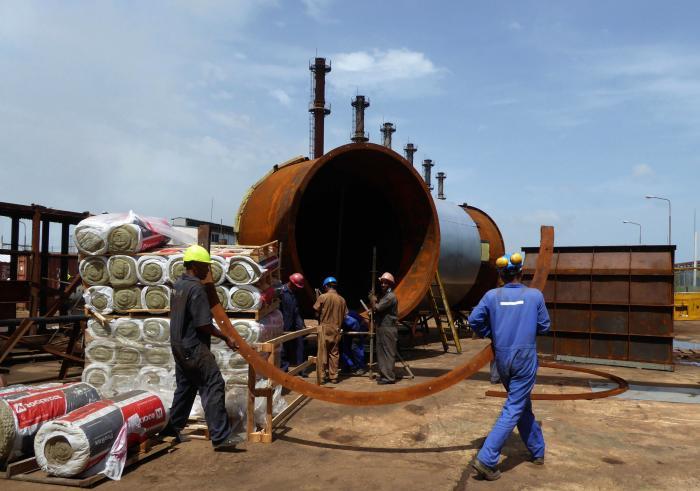
Of the 570 MW expected to be restored this year in thermal generation, 370 MW were completed in the first three months. Photo: Germán Veloz Placencia
“The 2026 plan once again focuses on restoring generation capacity using our own resources,” stated Minister of Energy and Mines Vicente de la O Levy on the television program Mesa Redonda.
“Many of the parts and components we use are not factory originals, but rather solutions developed in Cuba through processes of innovation, adaptation, and technological substitution,” he argued.
For this year, he explained, the plan calls for recovering 570 megawatts (MW) of generation through thermoelectric power. At the end of the first quarter, the interim goal was to add 365 MW, and 370 MW were ultimately achieved, representing an overachievement.
Among the factors that influenced this result, he mentioned the commissioning of Unit 2 at Santa Cruz del Norte following the completion of its maintenance, as well as the addition of Céspedes 4, although the latter experienced delays after a major malfunction was detected during synchronization with the National Electric System.
Edier Guzmán Pacheco, Director of Thermal Generation at Unión Eléctrica, explained the impacts and the recovery schedule for Unit 2 of the Lidio Ramón Pérez thermoelectric power plant in Felton, which is strategic due to its capacity to consume domestic crude oil.
Recalling the fire in the plant’s boiler, he explained that the incident affected a specific structure, which caused a significant limitation in generation.
“That affected us; it limited us by 250 MW, which is the power output of that unit. The fire affected a structure, and that structure damaged the rest of the boiler, making it impossible to reuse it,” he stated.
Given the extent of the damage, it was decided to undertake a complex reconstruction process. The new structure is being manufactured in Las Tunas, although full restoration involves highly complex internal components.
He emphasized that “the reconstruction of that unit has not stopped, and work on it has not ceased so that it can be integrated into the system, since it is a unit that consumes domestic crude oil and provides us with energy independence and sovereignty,” he asserted.