


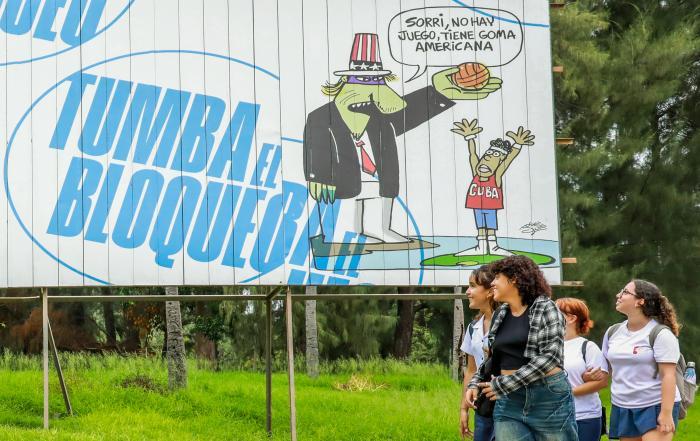
The U.S. government has added a new executive order to its arsenal of hostilities against Cuba. Given the nature of its scope, this order can be considered unprecedented in many ways, to the point that analysts and experts on the subject describe it as a new blockade imposed on top of the existing one.
Although it was released on May 1, May, undoubtedly with the full intention of somehow shaking off the helplessness caused by the overwhelming results of the parade and the “My Signature for the Homeland” movement, it is one of those documents that, due to the nature of the sanctions it proposes and the manner (by no means typical of documents of this kind) of avoiding mention of the possible recipients of these measures, is not drafted in a single day. It requires months of work to ensure the “legal” framework to support it.
They return to the thesis of the “unusual and extraordinary threat” as an untenable pretext to justify punitive actions, whose extraterritoriality violates the sovereignty of other states, not just that of Cuba, against which they have been attacking uninterruptedly for nearly seven decades.
They accuse us of having ties to “malicious actors hostile to the United States,” of “close ties with other major state sponsors of terrorism,” of persecuting and torturing “political opponents,” of being a breeding ground for foreign intelligence operations, and, in the height of hypocrisy, they claim that “Cuba’s corrupt regime continues to drive migration to the United States,” as if their blockade and their closure of legal channels for emigration were not the causes of that situation.
During his speech at the International Meeting of Solidarity with Cuba “For a World Without the Blockade: Active Solidarity on the Centennial of Fidel,” held on May 2 with comrades from other countries who also joined us on the historic day before, Political Bureau member and Minister of Foreign Affairs Bruno Rodríguez Parrilla made very clear some essential aspects for understanding the possible short-term effects of this new order.
In this case, for example, there is the fact that “for the first time, they are imposing secondary sanctions—that is, sanctions that can be applied against any individual, entity, company, etc.”—simply for engaging in activities related to Cuba, “even though their interests in the United States, in the U.S. economy, have no connection whatsoever to our country. This constitutes an extremely aggressive and unprecedented step in the extraterritorial application of the blockade against our homeland.”
And it seems unbelievable that, at this point, after so many years of blockade, the term “unprecedented” can still be used—a term that amounts to nothing more than the fact that the perennial and systematic aggression against Cuba is planned, calculated, and studied.
The order also contains broad, vague categories that are extremely concerning in that they reserve the right to define who is or is not included within them—an aspect reinforced by the fact that no list is issued, something the Cuban Minister of Foreign Affairs made abundantly clear.
“They do not feel obliged to publish the names of the individuals or entities designated or to be designated under this punitive measure, precisely to amplify the effect of intimidation and fear on everyone else.”
Logically, key sectors of the economy remain a direct target—namely energy, the military or defense, metals and mining, security, and finance—but this does not mean they are the only ones, because they target anyone who provides substantial aid, financial, material, or technological support. In other words, anyone can be subject to sanctions, and the result is to prevent everything from large-scale investment to individual aid—such as providing the medicine urgently needed by a sick child—from entering Cuba. Because the blockade and every new order, measure, or strategy that expands it and broadens its scope does nothing but intensify the suffering of a people whose collective punishment has been pursued by those sick with hatred and impotence.
And although our denunciation will always be firm, and our resistance a fact, this is a threat that goes far beyond the Cuban government; this is a threat openly directed at the world, without shame, without the slightest respect for the self-determination of sovereign nations. The Minister has also declared this with that same force.
“In the face of these acts, no State will be able to act in a sovereign, independent manner; it will not be able to exercise the sovereignty of its people; it will not be able to consider that the only sphere of application within its territory is its national laws; it will not be able to defend the concept that only its national courts or tribunals will have jurisdiction over its own affairs if they do not take a stand today in favor of justice, in favor of Cuba.”
They want immediate suffocation, regardless of whether it costs millions of lives, regardless of whether it jeopardizes the future of an entire nation. Let us hope that, in the face of such a heinous crime, the voice of impunity is not the one that is heard the loudest.