Fidel and unconventional warfare: An early warning about the assault on consciousness
 28 April 2026



Long before terms like fake news, post-truth, or cognitive warfare flooded public debates, the historic leader of the Cuban Revolution, Fidel Castro Ruz, accurately unraveled the mechanisms of domination that the great powers would deploy through information and communication technologies.
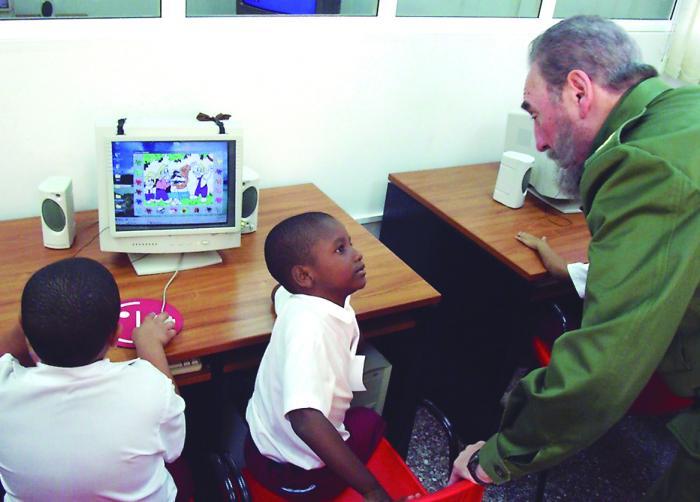
This was not a matter of opposing technological development; Fidel’s concern for its growth in Cuba is an undeniable fact—he promoted the first Cuban computer, founded the University of Information Sciences, created the Joven Club de Computación (Youth Computer Club), and so on.
It was a visionary warning: he foresaw that cyberspace would become the main battlefield of a silent war aimed at colonizing minds.
The Cuban leader conceived of the internet as contested territory. On the one hand, he recognized its emancipatory potential: "The internet is a revolutionary tool that allows us to receive and transmit ideas in both directions—something we must know how to use," he stated on February 3, 2012, at the presentation of the book Guerrillero del Tiempo.
However, years earlier, at the height of cyber control, he had already sounded an alarm that resonates strongly today: "The internet can be used with the worst intentions in the world, as envisioned by the CIA and the Pentagon."
He issued this warning in December 2006, when Washington announced the creation of the Air Force Special Command for Cyberspace. This duality defines the central tenet of his thinking: the network of networks is not the enemy, but rather the use that U.S. imperialism and its allies would make of it.
His most profound critique focused on the technique of mass psychological manipulation. In his speech on November 17, 2005, in the Aula Magna of the University of Havana, Fidel established a key distinction that explains the effectiveness of contemporary unconventional warfare:
"When they first emerged, the mass media took hold of people’s minds and ruled not only on the basis of lies, but also of conditioned reflexes. A lie is not the same as a conditioned reflex. A lie affects knowledge; a conditioned reflex affects the ability to think."
This thesis reveals that the adversary’s objective is not simply to misinform, but to nullify critical thinking through the repetition of slogans that become embedded in the collective subconscious.
In the same speech, Fidel illustrated the mechanism with a stark example: "Because they have already created reflexes in you: 'This is bad, this is bad; socialism is bad, socialism is bad,' and all the ignorant, all the poor, and all the exploited saying: ‘Socialism is bad.’ 'Communism is bad,' and all the poor, all the exploited, and all the illiterate repeating: 'Communism is bad.'"
The incessant repetition of these messages, amplified today by social media and algorithms, constitutes the essence of unconventional warfare and its brutal assault on consciousness.
ROBOTICS AND THE MILITARY-INDUSTRIAL COMPLEX: THE DEHUMANIZATION OF WAR
The Commander-in-Chief’s warning reached its peak when he incorporated the role of the military-industrial complex into his analysis. In his reflection "The Empire and the Robots," dated August 19, 2009, he denounced that while a billion people were starving, the United States was devoting 42% of global military spending to developing "technologies for killing."
The question he posed then remains strikingly relevant: "If robots in the hands of transnational corporations can replace imperial soldiers in wars of conquest, who will stop the transnational corporations in their search for markets for their devices?"
This dehumanization of war—the soldier replaced by the drone, the algorithm, or the robot—is intertwined with psychological warfare, as it turns destruction into a sterile and distant act, while public perception is manipulated to justify it.
For any doubt, consider the role played by Maven, the alliance between the Pentagon, Palantir, Claude, and Anthropic in the attacks on Venezuela and Iran.
"KNOWLEDGE IMPERIALISM" AS A COMPREHENSIVE STRATEGY
Now, Fidel’s denunciations of unconventional warfare converge into a comprehensive diagnosis: what he called "knowledge imperialism."
He refers to it as the "main battlefront of the imperialist war," as he maintained in repeated speeches. The ultimate goal is to break the sovereign will of the peoples without firing a single shot, replacing military invasion with cultural subversion and information manipulation.
In 2017, Army General Raúl Castro Ruz endorsed this view before the National Assembly, reiterating that the U.S. government’s massive investments sought to "refine the tools of the so-called 'unconventional war'" to provoke destabilization and capitalist restoration on the island.
In this way, Fidel’s early warning became state doctrine and an indispensable lens through which to understand the geopolitical tensions of the 21st century.
In an age when social media amplifies conditioned reflexes, algorithms segment misinformation, and drones replace soldiers, his words take on the urgency of a prophecy that was, above all, a call to resistance grounded in knowledge and truth.