



(Shorthand version - Presidency of the Republic)
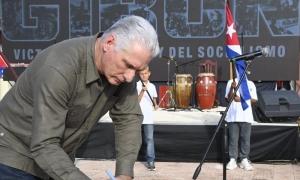
Dear sisters and brothers in solidarity with Cuba and with the just causes of the world;
Friends visiting us from different corners of the globe:
Solidarity cannot be blocked. Long live solidarity! (Shouts of: "Long live!")
One of the first things we must acknowledge—which stems from the feelings and emotions inherent to Cubans when we have gatherings like this, when we have the opportunity to share with those who visit us, giving us love, affection, friendship, and offering solidarity—is our gratitude for everything you do for us and our recognition of the courage and determination with which you express yourselves, because we know that to be here in Cuba and with Cuba in these times requires courage (Applause).
Many of you speak of how moved you are when you come to Cuba. We, too, are moved when you come to Cuba and when you show us this affection and solidarity.
I believe we can share solidarity, we can share ideals; we believe that a better world is possible, as Fidel taught us, precisely because we recognize that there can be another model, another possibility for those of us who inhabit this world so disordered and chaotic, and that is when a cause is defended, when a model is defended that is based on social justice and that puts people before the market and before profit.
When they say that we are an extraordinary and unusual threat to the United States—and we are certain that this is not the sentiment of the American people, that this is the pretext the U.S. government uses to attack us—one wonders: What is the threat? What is so extraordinary about that threat? What is unusual about that threat, when Cuba is a country of peace, when Cuba is a country that has served as the venue for the main peace dialogues in the Latin American and Caribbean region, when Cuba was the place where the Catholic Church and the Russian Orthodox Church came to meet to resolve the schism they had maintained for more than fifteen hundred years?
I try to answer that question for myself every day, but, as Bruno explains, there is no pretext whatsoever, no reason whatsoever that justifies a military aggression against Cuba. Well, perhaps that “extraordinary and unusual threat” is the Cuban people’s example of resistance and creativity (Applause).
When we speak of solidarity, I believe we are speaking of three elements that define the value of international solidarity:
First, there is the compassion of the people, because together we have learned to share something that Fidel taught us: that in solidarity, we do not give away what we have left over, but rather we give what we have so that we can share it with everyone.
The other value is that solidarity constitutes a strategic rear guard because it supports what we are doing; it supports the struggles of those of us who are seeking to confront genocidal aggressions such as the one imposed by the United States government against Cuba, and every donation, every international mobilization, every one of those actions you carry out in different cities around the world is a breath of fresh air that you give us in the face of the economic blockade, and it is also a light that illuminates the Cuban nation and people.
A third value of solidarity, which we all share, is that it is an expression of resistance against exclusion. It is an active denunciation of the aggression carried out by the United States government against Cuba; it is an active denunciation of Cuba’s inclusion on a list of countries that supposedly support terrorism.
The passion, courage, determination, and commitment with which you defend the Cuban people through solidarity show us and assure us that Cuba is not alone and that Cuba will never be alone as long as there are people like you in our world (Applause).
I believe that yesterday, together, we were all able to witness a magnificent demonstration of heroism, steadfastness, determination, conviction, militancy, and fighting spirit on the part of the Cuban people.
Yesterday, the Cuban people achieved two victories for our times: first, having secured more than 80% of signatures from the active Cuban population over the age of 17 in support of the Cuban Revolution; against the intensified blockade, against the energy blockade, against the threat of military aggression against Cuba. And it was a signature for the homeland, for the Revolution, and for socialism (Applause).
And the other victory was that magnificent demonstration of support for the Revolution, when the people marched en masse not only in Havana—you witnessed the magnitude of that march in Havana—but in every city across the country. What was the number of participants? More than 5 million people were in the streets yesterday defending Cuba (Applause).
And the fact is, this was not just any May Day. As many of you have said, this was May Day in the Centennial Year of Commander-in-Chief Fidel Castro Ruz (Applause and Shouts of: "Long live Fidel!")
And we can all share the conviction that our people, the Cuban people, and you, the friends in solidarity with that people—who are also part of this homeland and this people—paid the best possible tribute to the Commander-in-Chief in the Year of his Centennial on that May Day (Applause).
I believe it was a response from the people that made it very clear that in Cuba, Homeland is defended! (Applause and shouts of: "Homeland is defended!")
Someone asked me yesterday what was so extraordinary about this May Day. Well, it has to do with that commitment to the Commander-in-Chief, with the situation we are living through, with what we went out to express on that May Day. But I believe there is a very unique fact that you have not overlooked, and that is that yesterday in Cuba, new generations raised our historic flags.
The enemies of the Revolution have spent millions trying to prevent Cuban youth from continuing the work of the Revolution. The enemies of the Revolution predicted that there would be no support from the people and that this would be a parade or a demonstration with little popular participation, and, as we say in Cuba: they got their fingers caught in the door. And the young people came out to defend the Revolution. But the Cuban youth came out to defend the Revolution, as part of that people, with the conviction that they are the youth of the Commander-in-Chief’s Centennial (Applause).
Therefore, yesterday we did not witness a march that “is taking place despite the complex economic situation facing our country, as part of the intensification of the blockade.” Not at all! Yesterday was a march of a combative people and a people determined to stand against everything that affects the daily life and economy of our country. It was the combative speech of a dignified, brave, and determined people who said loud and clear that they have every right to choose their political system, to defend their political system, to live and to develop. And that is why those people, together with you, exclaimed yesterday: No to the blockade! (Applause.) And as we have always said: Let them lift the blockade so we can show them what we’re made of!
Let’s talk a little about the world. I believe you have described the immense scope of capitalism, and there is also an imperial crisis within the U.S. government.
There are other countries that, from a multilateralist perspective, offer alternative possibilities for the peoples and nations of the Global South. More and more voices are speaking out against imperial abuses.
Key representatives of the U.S. government are also facing a crisis of credibility among the American people.
When capitalism and the empire are in crisis, that is when the most ultra-conservative ideas, the ideas of the far right, resurface; that is why fascism is resurging right now; and the current U.S. government is a fascist government (Applause). That is why acts of genocide are being committed around the world, such as the genocide being committed against the Palestinian people, and the genocide being committed against the people of Lebanon; or why aggression and the language of war are being used to resolve international conflicts.

We are, in fact, in the midst of an ideological war, a cultural war, and a media war.
Why is this war that the empire is trying to impose ideological? Because they are trying to impose their hegemonic ideas on the basis of domination. They want to dominate the world; they want to dominate all of us; they want to dominate our peoples; they want to dominate our nations.
Why is it a cultural war? Because to do so, they must appropriate and dominate our minds, and that is why they seek to sever our peoples from their roots, their identity, and their culture. That is why they attack the culture and history of our peoples.
And it is also a media war, because they use that entire network of digital platforms and media outlets to promote supremacist values and xenophobia; to destroy the reputations of nations and leaders; to impose Western culture; to denigrate peoples and revolutionary processes, and they do so on the basis of perversity, using slander, lies, and fake news, weaving media narratives so that the repetition of the lie and the narrative of the lie become a truth accepted by many around the world. Look, this is how they have acted in recent times.
What was done against Venezuela? They began to construct a media narrative of a narco-state; they tried to politically and medially lynch the legitimate president of the Bolivarian Revolution, Nicolás Maduro. They then imposed a naval blockade on Venezuela and deployed the largest U.S. military presence in the Caribbean region in the last twenty years.
As part of that narrative, they have justified extrajudicial crimes against vessels—crimes for which it has never been proven whether or not those vessels were linked to drug trafficking, or whether the people on board were involved in drug trafficking.
And once they had created all the conditions with that media barrage, they attacked the Venezuelan nation, kidnapped and abducted a legitimate president and his wife to put them on trial in the United States. One must see how the Cartel of the Suns disappeared immediately after Maduro’s abduction, how the lie they had constructed had vanished, but the consequences remained.
That is how they wove the narrative that Iran was developing a nuclear energy program to obtain a nuclear bomb and that it was a threat to the entire world.
We have been watching the war in Iran for several weeks now, witnessing the heroic resistance of the Iranian people (Applause). And what we have not yet seen is an Iranian nuclear bomb, nor a threat from Iran to use nuclear bombs. Who is talking about using the nuclear bomb? The U.S. government.
And then there is the case of Cuba as well. They have mounted a massive campaign claiming that we are an unusual and extraordinary threat to the United States, that we violate human rights, that we are a failed state, that we are in economic collapse, that they are deeply concerned about the plight of the Cuban people—which is a complete irony and a fallacy. If they are so concerned, let them lift the blockade, because the main problems facing the Cuban people stem from the imposition of that blockade over such a long period of time.
Part of that campaign against Cuba also includes the pressure they have exerted on the governments of a group of countries, pressuring their leaders to sever the medical cooperation that Cuba offers in a spirit of solidarity.
At regional meetings, the U.S. government has tried to "charm" certain leaders of Latin American countries, and some have offered as a gift the severing of ties with Cuba or the curtailment of diplomatic relations with Cuba. Others, with tremendous cynicism and a lack of dignity, have curried favor with the emperor, asking him: "When are you going to resolve the Cuba issue?"
So, in the midst of that situation, just as Venezuela began to be blockaded in terms of energy in December, Cuba stopped receiving oil. We’re talking about December. Then, in January, came the Executive Order of January 29; consequently, we went four months without receiving fuel until a fuel ship arrived from Russia, which allowed us, over the last two weeks, to turn around the country’s electricity situation; but that oil is running out these days, and we don’t know when more fuel will arrive in Cuba.
And, as if that weren’t enough, yesterday—as a May Day "gift"—it seems May Day got under their skin! As they say here, it seems the Cuban people’s massive show of resolve stung them, so they issued another Executive Order titled "Imposition of Sanctions on Those Responsible for Repression in Cuba and Threats to U.S. National Security and Foreign Policy." They used the same pretext as the previous Executive Order.
This is a measure—and Bruno explained it in greater detail than I will—that is structured around three fundamental pillars designed to collapse the Cuban economy and force what they aspire to as regime change.
First, it imposes expanded sectoral sanctions by blocking any U.S. property owned by individuals or entities operating in the sectors—note which sectors they chose—: energy, defense, mining, and financial services on the island.
Therefore, they are attacking our vital sources of income, which have already been attacked and have been severely impacted over more than sixty years of the blockade; then, the blockade was intensified starting in the second half of 2019, when Trump implemented 240 measures to tighten the blockade; in January 2020, when they included us on the list of countries that allegedly support terrorism, and then how all those measures have been maintained throughout this time, first by the Biden administration, then by the second term of the Trump administration, and now intensified with the energy blockade and again with this Executive Order.
The second fundamental pillar of this measure is that it establishes global financial persecution by threatening banks in third countries with cutting off their access to the U.S. financial system if they conduct transactions with Cuban entities. Notice the level of internationalization they have given to this measure, which further intensifies the blockade against Cuba.
And, thirdly, it decrees the immediate application of the sanctions, eliminating any prior adjustment period and thus denying the possibility of a timely legal appeal.
Simply put, sisters and brothers, from the perspective of international relations, this Executive Order is a case of direct and unilateral interference by the United States; it is an unacceptable act of meddling in the internal affairs of another nation. It is a clear attempt to impose a political model through economic coercion, using domestic law to dictate the policies of other nations to the detriment of multilateralism.
This policy not only seeks “regime change,” but also constitutes an act of regional destabilization by forcing the international community to make an impossible choice between its relationship with Cuba and access to the U.S. market and financial system. The world must either choose to participate in the U.S. financial and economic system or choose Cuba.
And I ask: How long will the world continue to tolerate this abuse? How long will the world stand by while innocent children and an innocent people are killed, as in Gaza, as in Lebanon, or as in Iran? How long will the world tolerate this policy of maximum pressure by the United States against the heroic Cuban people? Because the world must be aware that what is done against Cuba, what is done against Palestine, what is done against Iran, will eventually be done to anyone (Applause).
And that is why we say with a full sense of responsibility—and someone said it here—that whoever stands with Cuba at this moment stands for all time, because in Cuba the dignity of the peoples is being defended (Applause).
In Cuba, the sovereignty and independence of the peoples are being defended. In Cuba, the right of the peoples to self-determination is being defended (Applause). And in Cuba, the conviction is being defended that a just cause defended by a heroic people is not abandoned. Therefore, let no one expect that there will be surrender in Cuba! (Applause and shouts of: "Cuba is not alone! Cuba is not alone! Cuba is not alone! Cuba is not alone!")
All these contextual elements we are sharing with you have undoubtedly complicated our situation. And as you have experienced, as you have shared with the Cuban people, today we face many additional constraints on top of those we were already enduring. One must ask how a country’s economy can be sustained, how a country’s services can be maintained when it is denied access to fuel.
We are facing, as a country, as a people, a multidimensional aggression from the most powerful nation in the world.
And here the problem is a cumulative effect, because there are analyses being conducted and discussions about Cuba’s current situation. No, no, Cuba’s situation is the accumulation of problems from more than sixty years of the blockade, a blockade that has intensified since 2019, the effects of COVID-19, and the blockade now intensified even further by these two executive orders.
This is a collective punishment they want to impose on us and a total suffocation they want to impose on us, to provoke a social uprising and bring about a regime change. But Cuba is not sitting idly by (Shouts of: “They won’t be able to!”).
They won’t be able to, they won’t be able to! (Applause.)
We are not sitting idly by. Ever since the country’s leadership analyzed that Trump could win the election and be joined by the others who make up his administration, we knew that a greater threat was looming over Cuba, and we have been working on a whole set of ideas, a whole set of plans, a whole set of programs that we have now, with even greater reason, ratified, refined, updated, and are developing.
In the face of this multidimensional aggression, we have set three fundamental priorities, and we want to share them with you so that you are aware and have all the facts regarding what Cuba is doing.
First, there is the imminence of military aggression. And that is not something we want or desire. Cuba is a country of peace. Cuba defends peace. But the fact is that the U.S. government talks about war every day, and talks about threats every day, and every day the threatening rhetoric toward Cuba escalates; but the Cuban people are not afraid (Applause).
And do you know why they are not afraid? Because when one is prepared to give one’s life for a just cause—which in this case means being prepared to give one’s life for our Revolution, being prepared to fight to the bitter end for our Revolution—and when there are so many of us in this country who are prepared to do that, there can be no fear. You made the decision of your life to the very end, and the fear is gone. And the people demonstrated that yesterday with their signatures and their participation (Applause).
But the 32 Cuban fighters who fell in Venezuela demonstrated this with tremendous heroism, setting an example for our times (Applause and shouts of: "Cuba and Venezuela, one flag!").
Those Cuban fighters faced elite forces of the U.S. Army that outmatched them technologically and outnumbered them. The U.S. government and its military had planned for the operation to kidnap the President of Venezuela to be over in minutes, but things got complicated when our brave fighters confronted that elite U.S. force and fought for more than 45 minutes under those conditions (Applause).
Imagine what would happen in a military attack on Cuba, where the example of those 32 would be multiplied by millions of Cubans (Applause). And we say this with full responsibility; we are not speaking this way because we want war. We do not want war! We have always maintained that bilateral differences with the U.S. government can be resolved through dialogue; but there must be a willingness, there must be a serious commitment to finding areas of cooperation that allow us to understand one another and move away from confrontation. But I also reaffirm here what we have said on other occasions: we do not fear war. And here there will be neither surprise nor defeat! (Applause.)
And that is why, as our top priority, we have been developing a plan in recent months to enhance the readiness and preparedness for defense in the event of war for all our people.
Our defense strategy is a wholly defensive strategy; it is not intended to attack anyone. It stems from our country’s guerrilla experience, from the experience of our struggles—how the mambises fought, how the rebels fought in the Sierra Maestra; from the combat experiences we had when we went to Africa to contribute modestly to the liberation of African countries and to eliminate apartheid in South Africa. It stems from our convictions.
It was a doctrine developed by Fidel, enriched by the Army General, which emerged at another moment as complex as this one, when the administration then in charge of the United States had also raised the possibility of a direct attack against Cuba. And in that defensive doctrine, every Cuban man and woman has a rifle, every Cuban man and woman has a position in the defense and a mission to fulfill in defense of the homeland, the revolution, and socialism (Applause).
So, the second priority has to do with the fact that they want to strangle us; they want to strangle us economically. Well, we discussed this with the people at the end of last year, in December, and in the first weeks of January of this year; together, at the grassroots level, we discussed a Government Program for economic and social development under current conditions. Therefore, our entire people offered their opinions, criticized, and made proposals, and at the end of this entire process of popular consultation, we have achieved a more robust program for economic and social development, precisely because it was enriched by that popular participation. It includes a whole set of transformations that must be made to our Economic and Social Model, and we must also carry them out with agility, without bureaucracy, and with the greatest possible diligence.
I would say that, although there are several aspects, we could group them into three fundamental pillars: Economic transformation, which has to do with how we achieve macroeconomic stabilization, how we boost domestic production, and how we achieve higher levels of exports.
There is another pillar, which is sovereignty and sustainability, and here we are considering two fundamental programs: the food production program to achieve the country’s food sovereignty, being aware that we will not eat what we import; we will eat what we are capable of producing within the country.
And you might say to me: but are you crazy? Now that you have less fuel, that you have fewer resources, how are you going to achieve food sovereignty? Well, with the effort and talent of the Cuban people, all of us working together, aware that we will eat what we are capable of producing, applying agroecology (Applause). And in the face of a shortage of products and fertilizers, we are applying agroecology and developing an agricultural and food production program that is more environmentally friendly and sustainable under our conditions.
And the other major program—also crucial for the country’s energy sustainability—is the energy program, which is built on a fundamental transformation of the country’s energy mix, a process we began last year. Last year, we were able to invest over 1,000 megawatts in solar farms, which allowed us to jump, in a single year, from 3% penetration of renewable energy sources in electricity generation to 10%; in other words, we grew by 7% that year.
We are striving, despite adversity, to achieve similar growth this year as well, as part of a program aimed at achieving energy self-sufficiency by 2050 using our own resources. They cannot block our sun, they cannot block Cuba’s air currents (Applause), they cannot block our ocean currents, they cannot block our rivers. We are using biogas, promoting the use of biogas, and the use of biomass.
Our Brazilian friends have strongly urged us to explore the issue of biofuels, and we are also analyzing this.
As you know, when there was a widespread belief that Cuban crude oil could not be refined, our scientists found the solution, and we now have the technology developed in Cuba to refine Cuban crude oil and produce the necessary derivatives. Now, what do we have to do? Increase the production of that domestic crude so that we have domestic crude not only for electricity generation, but also to meet the economy’s needs for fuel and derivatives.
Of course, all these processes will take a long time, because this cannot be resolved overnight amid these adverse conditions and increasingly harsh coercive measures.
And the third strategic pillar is that everything we do must be done without implementing shock policies. It is based on social justice, and every measure we must implement to overcome this situation must first consider who it might disadvantage, to prevent inequalities from growing and, on the contrary, to mitigate them, ensuring that for every person, family, or community in a vulnerable situation, there is a tailored response to prevent their vulnerability from increasing. And that is social justice, and that is socialism, and that is what we defend in Cuba (Applause).
Therefore, I believe and dream—and we all dream—because remember that in Cuba, due to this policy of maximum pressure and the blockade imposed for so many years, no matter how great the work of the Revolution is, we have not been able to realize all our dreams; we have unfulfilled dreams, we have unfulfilled projects. Some programs for the country’s economic development and their social impact have also been stalled. But we continue to dream and we continue to act, we continue to fight and we continue to work, and we continue to achieve results even under the most difficult circumstances.
And we leave these points, because we believe that one of the fundamental roles that solidarity can play—that you can play—is the mobilization of public opinion in a situation like this, above all, because of the contribution you can make in persuading and spreading the truth about Cuba at a time of fierce media siege, manipulation, lies, and economic coercion, and also in the face of the danger of military aggression.
Working in this way during difficult times, how does one view Cuba’s future? We will have a future with a country lit by our own energy sources; we will have a country lit, but without waste (Applause).
We will have a more productive Cuba, operating efficiently (Applause).
And we will continue to have a just Cuba, with opportunities and possibilities for everyone (Applause).
We will continue to show solidarity; we will continue to support just causes around the world; we will continue to support the Palestinian cause, the cause of the Lebanese people, the Bolivarian Revolution, the release of President Maduro and his wife Cilia (Applause), the cause of the Sahrawi people, the cause of Puerto Rico (Applause), and the cause of the Iranian people (Applause).
We will support the cause of those who led the Gaza flotilla (Applause), of those who have supported Cuba with humanitarian and solidarity aid convoys (Applause).
And we will fight alongside you for the release of Thiago and any other militant comrade or fighter who has been unjustly imprisoned (Applause).
We are convinced that the true strength of a nation lies in its people, in its citizens, and in the workers who are building a dignified future. Today, that strength in our country is growing thanks to you, proving that international solidarity is the most powerful weapon against global selfishness. The heroism, resistance, creativity, dignity, and history of the Cuban people, together with you and your solidarity, will bring us victory. And of that we have no doubt! (Applause.)
But when you show us such solidarity, you also place an enormous responsibility on us, because we know we cannot let you down. Therefore, rest assured that the Cuban people are committed to remaining a beacon of hope in the Caribbean for all those around the world who want to make it a better place. We will not fail you, because to fail you would be to fail the hope of all the humble people on this planet.
Long live peace! (Shouts of: "Long live!")
Down with war! (Shouts of: "Down with it!")
Down with the blockade! (Shouts of: "Down with it!")
Long live the workers of the world! (Shouts of: "Long live!")
Long live internationalist solidarity! (Shouts of: "Long live!")
Cuba is not alone! (Shouts of: "Cuba is not alone!")
Always onward to victory! (Ovation.)