


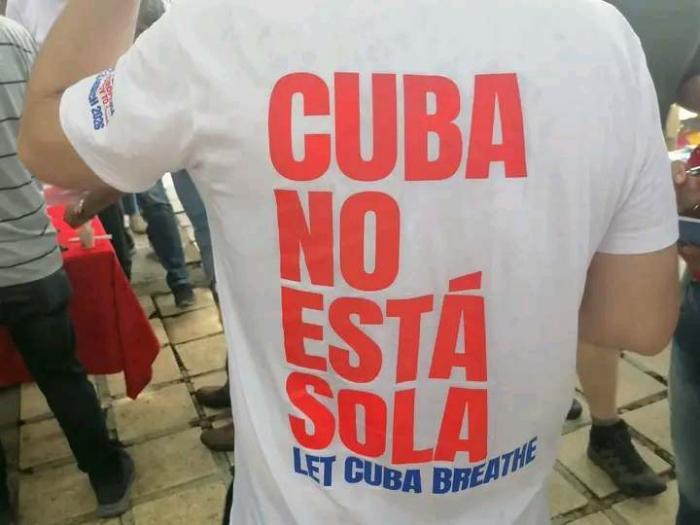
SANTIAGO DE CUBA.—Members of the second May Day international convoy—a movement composed of supporters from Italy, France, the United States, Mexico, and Cubans living abroad—began their itinerary, which will take them to points of interest in the provinces of Granma, Santiago de Cuba, and Guantánamo.
"We have come to reaffirm our commitment to the noble Cuban people, who are now under constant threat," stated Michele Curto, President of the Italian Agency for Cultural and Economic Exchange with our country.
At the University of Medical Sciences in the Hero City, they met with faculty and students. "Your visit shows that we are not alone in this battle and that solidarity is always capable of breaking the blockade," said Dr. Abel Tobías Suárez Olivares, Rector of the prestigious institution, who recalled his stay in the Italian city of Turin as part of the Cuban medical brigade that provided services there during the most difficult moments of the COVID-19 pandemic in Europe.
The gathering turned into a warm exchange of hugs and memories, as those who had served as translators for the Cuban doctors in the red zone were present, including soprano Ileana Núñez, who has lived in the European nation for decades and acted as the liaison between Dr. Suárez Olivares and the patients.
The Convoy, from each of the nations, arranged and organized a shipment of solidarity aid destined for health and education centers, containing medicines and medical equipment, school supplies, and solar panels.
"We deeply appreciate this gesture, which goes beyond the material and touches our souls," said Juan Carlos Vaillant Despaigne, delegate of the Cuban Institute of Friendship with the Peoples in Santiago.
Donations were delivered on Thursday to the University of Medical Sciences in Santiago and the Antonio Vegues César South Children’s Hospital.
They described the visit to the historic Santa Ifigenia Cemetery as essential, where they honored our National Hero José Martí.
Carlos Manuel de Céspedes and Mariana Grajales Cuello—the Father and Mother of the Homeland—were also honored, and Commander-in-Chief Fidel Castro Ruz received special thanks for forging bonds of friendship with the rest of the world’s nations.
CONNECTING WITH CUBA AND ITS PEOPLE
On a Girón bus, the brigade members headed to the municipalities of Songo-La Maya and Segundo Frente, "to get to know Cuba and its people more closely—those who suffer most acutely from the blockade," said a Mexican who is visiting the largest of the Antilles once again.
In the town of Matahambre, which was severely affected by Hurricane Melissa in October of last year, photovoltaic solar panels were delivered to keep the Family Doctor and Nurse Clinic operational, while they also spent time with students and teachers at the elementary school, which received teaching materials, as well as sports equipment for the Basic Secondary School.
Accompanied by his brigade colleagues, Michele Curto, who is also director of the joint venture BioCubaCafé, spoke with local coffee growers, who cultivate the aromatic bean using agroecological practices and have benefited from the new mechanisms approved to boost this traditional and exportable sector.
“There are many more of us who love and defend Cuba; you are not alone, and we will prevail,” Curto assured during the meeting.
At the Porfirio Valiente Polyclinic in Alto Songo, the delegation delivered donations and observed firsthand how medical care is provided under current conditions—marked by the shortages imposed by the U.S. blockade—“but which does not lack the most important thing: the powerful human capital, so professional and shaped by the Revolution,” said a doctor specializing in comprehensive general medicine.
In the municipality of Segundo Frente, the convoy arrived at the Emilio Bárcenas Rural Hospital, inaugurated on March 11, 1961, which serves the population of the mountainous municipality with urgent care, emergency services, and inpatient wards. This health center received a donation containing medications and consumables.
The tour concluded with a meeting with agricultural producers from the municipality, who denounced the effects of the intensified blockade on the sector, which prevents them from acquiring machinery and fertilizers.