
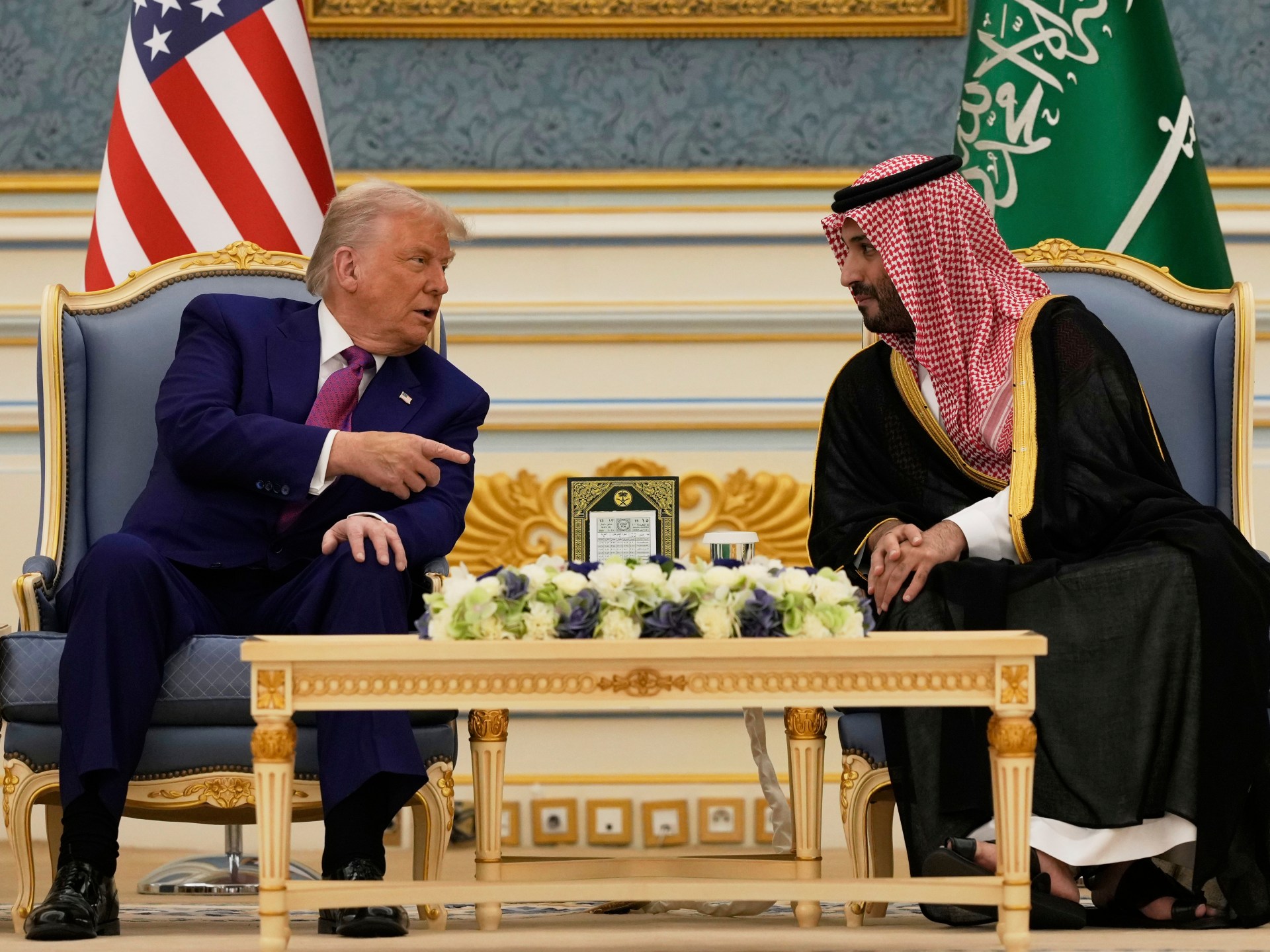

United States President Donald Trump agreed to a 30-year nuclear deal with Saudi Arabia on Wednesday that would see Washington transfer nuclear technology to the Gulf kingdom.
This has drawn concerns that if the deal comes to fruition, it could spark a nuclear arms race across the Middle East amid reports that Riyadh would be able to enrich its own uranium, a necessary step in acquiring nuclear weapons.
- list 1 of 4What are ‘civilian’ sites in international law and where have US, Iran hit?
- list 2 of 4Proposed US-Saudi nuclear energy deal: What we know so far
- list 3 of 4US and Saudi Arabia announce nuclear cooperation deal
- list 4 of 4Can the US and Iran reach a lasting deal to end the conflict?
end of list
US officials have stressed the proposed deal would serve civilian nuclear purposes, although exact details of the agreement have not been made public.
It has now been tabled in the US Congress for a review, but is expected to survive resistance from Democrats.
Here’s why some are concerned about the agreement:

Could this spur a nuclear arms race in the region?
Analysts have raised concerns about whether the proposed deal could lead to Saudi Arabia seeking to develop military-grade uranium, which the US Energy Department has not yet confirmed.
Some analysts have warned this could open the door to spurring an arms race with other regional powers.
Saudi Arabia has long voiced its intention to use nuclear energy for power generation, but in 2018, de facto leader Mohammad bin Salman told CBS that Riyadh would “without a doubt” develop a nuclear weapon if Iran did the same.
US Secretary of State Marco Rubio insisted on Thursday that the deal would not lead to nuclear proliferation, as US contractors would handle the project, allowing Washington to monitor it. US nuclear reactor designer Westinghouse is believed to be a major contractor.
Advertisement
Former Israeli Defence Minister Avigdor Liberman said in a post on X on Wednesday that Israel must oppose the deal with “all our might.”
“We must all understand that Saudi Arabia’s civilian nuclear programme will end in nuclear weapons and lead to a mad arms race across the entire Middle East,” he posted.
Israel, which developed a nuclear arsenal in the 1960s, has long sought to stop Arab countries and other regional countries from gaining their own nuclear weapons.
Is there a risk of nuclear reactors being attacked in strikes?
Some others have also raised concerns over possible nuclear leaks amid the tensions in the Middle East.
Iran’s Bushehr nuclear power plant, for example, has seen some of its outer facilities hit in the US and Israel’s war on Iran. Iran too has hit the perimeter of the United Arab Emirates’ Barakah nuclear power plant in a drone strike.
None of these strikes hit the nuclear plants’ reactors, but analysts say allowing more such facilities in the Middle East when tensions are so high is a mistake.
Damage to a reactor’s core could release highly radioactive gases, causing immediate catastrophic damage within a 20- to 30-kilometre (12- to 18-mile) radius.
Nuclear accidents at Japan’s Fukushima nuclear plant in 2011 and Chornobyl in Ukraine in the former Soviet Union in 1986 are cautionary stories.
Could Saudi Arabia have access to sensitive material?
That’s unclear for now.
Highly enriched uranium and spent nuclear reactor fuel are key components of nuclear bombs.
According to US media, the agreement includes a clause providing for a “black box” uranium enrichment facility that would be situated in Saudi Arabia but run by US companies.
A joint study by the two countries, set to last two years, will determine whether such a facility is needed, or if Saudi Arabia should import commercial-grade low-enriched uranium.
“That’s really the concern,” Matthew Kroenig, a fellow with the Atlantic Council, told Al Jazeera, saying there’s been no such arrangement anywhere else in the world.
“What does the US really mean by a ‘black box’? So will the US bring its engineers there full time, forever? Realistically, the Saudis will be involved, they will learn the tech, and they could kick out the US in the future,” Kroenig said.
Washington could be seeking to model Moscow’s agreement with Turkiye and Egypt, where Russian contractors manage active nuclear power plants, including the needed uranium and the highly radioactive spent fuel from the reactors.
The difference, Kroenig pointed out, is that Russia does not enrich the uranium in those cases.
Advertisement
On the other hand, the UAE, which runs a civilian nuclear programme that has been held up as a gold standard for non-proliferation, imports all of its low-enriched uranium from France, the United Kingdom and Russia among other countries.
Kroenig suggested that the US could be using the two-year study as a negotiating tactic, noting that the same claims of impact studies have been used to stall South Korea’s requests to enrich its own uranium.
“The deal doesn’t immediately speak about uranium enrichment, so my hope is that this is a negotiating tactic and that after two years the US will say ‘oh no, this doesn’t make sense right now'”, he said.
Related News

Moment of terror as powerful earthquake shakes airport in Colombia
US military says F-35B jet fighter crashes in California, pilot safe
VIDEO: World Cup Day 17: Messi breaks record; DR Congo and Algeria advance