



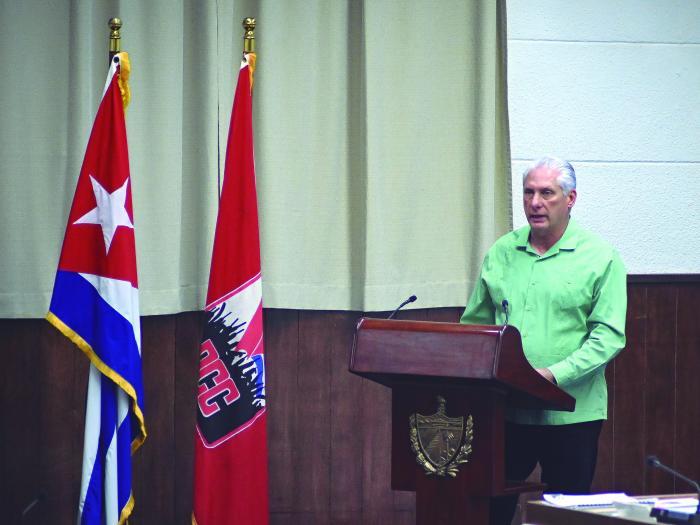
Comrades, members of the Party’s Central Committee;
Distinguished guests;
Compatriots:
This extraordinary plenary session is taking place at a decisive moment for Cuba. As proud heirs to the legacy of the Commander-in-Chief, we Cuban revolutionaries today face challenges of enormous magnitude that demand unity, ideological steadfastness, courage, boldness, and creative resilience.
We are guided by our leader, a prominent member of the vanguard of the Centennial Generation and a zealous guardian of the continuity of the socialist Revolution—which he played a decisive role in building from its foundations to the present day—Army General Raúl Castro Ruz, Hero of the Republic of Cuba, who has taught us every day the sacred value of unity.
The context is extraordinarily complex and challenging due to the relentless aggression of the intensified economic, commercial, and financial blockade imposed by the United States government and the criminal intent behind the hostile actions of the current administration: first, the inclusion of Cuba on the infamous and spurious list of countries that allegedly sponsor terrorism, and other equally false accusations that seek to discredit the government’s authority and administration, while depriving the country of any source of foreign exchange.
This blockade has been further intensified by the Executive Orders of January 29 and May 1st, which reinforce the genocidal energy blockade and, through secondary sanctions, internationalize the blockade, taking financial, energy, and investment persecution to extremes of maximum pressure.
At the same time, political and ideological subversion is intensifying through media disinformation on social media to undermine the Revolution’s credibility—among both Cubans and foreigners—fostering social disorientation in a national and international context marked by profound transformations in the socioeconomic structure and global geopolitics, as a consequence of the unlimited powers of a hegemonic imperialist policy that seeks to shatter multilateralism, fuels neo-fascist movements, and exacerbates global tensions, constantly threatening international peace and security and attempting to break the indispensable unity of leftist forces.
The silent genocide being waged against Cuba is causing immeasurable damage and terrible hardships in our daily lives as a people, while its perpetrators brazenly lie to the world by denying the energy blockade and claiming that we are blocking the entry of million-dollar donations—donations they tout extensively but have delivered hardly anything of what was promised.
Cuba is resisting heroically and creatively, but for far too long it has suffered a barbaric, undeserved, and unbearable punishment, to which is now added the threat of military aggression as a new weapon against our collective resistance.
Cuba faces a cruel blockade and real, daily financial persecution that drives up the cost of every drop of fuel, every medicine, every food item, every part, and every piece of technology the country needs.
Reality demands urgent and necessary changes. And when life for the people becomes so difficult, the primary duty of the Communist Party and the revolutionary government is not to explain the crisis better, but to change whatever needs to be changed to overcome it.
What is required is a comprehensive and agile economic agenda, executable in the short term, that combines macroeconomic stabilization, incentives to stimulate and promote productive openness, legal certainty, the attraction of investment, intensive use of technology, and targeted and effective social protection.
Let us recall that at the closing of the 11th Plenary Session, we stated that the postponement of the Congress did not preclude the possibility of making the necessary changes, modifications, and adjustments, taking into account the powers of Party and government structures—such as the Plenary Sessions of the Central Committee when it comes to resolutions adopted by Party congresses.
To this end, intensive work has been carried out, based on the informative report and debate from the ANEC Congress, the public consultation on the Economic and Social Program for 2026, the opinions of economists and experts, the debates and contributions made by the Economic Commission of the Party’s Central Committee, the Economic and Social Policy Guidelines approved and updated at the 6th, 7th, and 8th Party Congresses, the proposals of the 11th Plenary Session of the Central Committee, and the work carried out by the commissions that have been preparing the documents for the postponed 9th Party Congress—for reasons that are well known—regarding the update of the Conceptualization of the Economic and Social Model, the Guidelines, and the National Plan for Economic and Social Development through 2030.
In addition, a study has been conducted on the experiences of socialist construction in other countries, such as China and Vietnam, and artificial intelligence has also been utilized to further the search for references and evaluate the proposals in relation to our current laws and regulations.
We are facing the enormous challenge of continuing to advance the process of socialist construction, defending the Revolution and its achievements, and perfecting our society, under the conditions of a country subjected to the cruelest, most genocidal, and longest-lasting economic, financial, energy, and commercial blockade imposed by the world’s most powerful nation. And to overcome this, the legacy we have is that of our Commander-in-Chief, Fidel Castro Ruz (Applause).
No one in the history of humanity has ever faced the challenge of socialism under the conditions that this country, this nation, and this people are currently facing! We will undoubtedly overcome this challenge through unity, courage, popular participation, and full conviction in our ability to achieve victory.
The transformations we are proposing are intended to advance the defense of socialism, to support and expand social justice, and to create economic wealth and distribute it equitably. Without wealth, there is nothing to distribute; we would be speaking of social justice in the abstract. Social justice as conceived by the Revolution—with its humanistic mission to help the most disadvantaged, generally through free welfare programs and projects—does not cost the people anything, but it does cost the State. And to carry it out, to deepen it, to sustain it, and to maintain it, the State needs wealth—and we must produce that wealth ourselves. If there is no wealth, there is no social justice, and everything else is a fairy tale—everything else is a fairy tale! Either we produce under these conditions, create wealth, and then distribute it with social justice and equity—not egalitarianism. That is the challenge!
We need to unleash the productive forces, to have more production rather than more restrictions, because it has been proven that control without supply merely drives operations into the informal market.
Equality and integration among economic actors are necessary in accordance with the National Plan for Economic and Social Development through 2030 and the territorial and local development strategies involving state-owned enterprises, MSMEs, cooperatives, agricultural producers, foreign and Cuban investors, residents and non-residents alike: all must act and contribute to the country’s socioeconomic development under clear rules.
We must export and produce to attract and bring in foreign currency and make productive use of it. Every unit of foreign currency that enters the country must be channeled to finance production, imports, investment, wages, and infrastructure.
Legal certainty must be guaranteed: contracts, usufruct rights, leases, concessions, surface rights, and licenses must offer temporal stability and protection against arbitrary changes. Without legal certainty, no one will invest, and no one will take risks.
We must promote digitalization with traceability: electronic invoicing, digital payments, public registries, and interoperable data as a foundation for reducing tax evasion and corruption.
Social protection must be prioritized: replacing inefficient blanket subsidies with direct support for vulnerable people. We must always ensure that each action does not increase social inequalities; on the contrary, they should be gradually reduced until they disappear.
We must act with selective and intelligent openness: attracting technology, financing, markets, and external knowledge, while protecting strategic sectors through regulation, not through stagnation.
A gradual and experimental approach is necessary: reform should be implemented in phases and through verifiable pilot programs, maintaining government leadership and adjusting course based on evidence to address and minimize potential economic and social costs.
Also essential are political unity to ensure the consistency and credibility of the measures; clear and precise communication of the decisions to be implemented, to gain support for the transformations; and the adoption of compensatory mechanisms to mitigate economic and social impacts.
We must work with agility, consistency, and quality—and above all, with control. What has been approved must be implemented properly.
In this scenario, it is necessary to make progress on at least five fronts simultaneously:
Macroeconomic stabilization and the recovery of foreign revenue.
The transformation of the Economic and Social Model.
The stimulation and recovery of the agricultural sector.
The strengthening of accounting and cost management.
Anticipating and mitigating the social costs associated with the necessary transformations of the Economic and Social Model.
And these five aspects are very well developed in the report presented by ANEC at its last congress.
The Commander-in-Chief taught us that in times of crisis we could not give up on either development or critical thinking, that no obstacle is insurmountable, and that there is always an opportunity to grow. And along that path, the Army General showed us that it is possible, that it was possible, and that it will always be possible.
The people understand the causes of many of the difficulties we face, but they also need concrete answers, timely decisions, and results that are felt in their daily lives.
There are obstacles that do not come from outside or from blockades. There is sluggishness, bureaucracy, regulations that hold back those who want to produce, and decisions we have put off. What depends on us, we must change ourselves—and we must change it now.
We owe our homeland to the resistance, but today resistance alone is not enough. This time demands that we transform, produce more, remove more barriers, listen more, make better decisions, and be accountable.
What we intend to set in motion is an emergency economic and social agenda, comprising measures that are part of our Government Program and policies approved by the Party, along with decisions that can no longer wait. Some will not enjoy unanimous consensus, but they cannot be postponed. And each will have a specific person in charge, a defined deadline, a metric to measure its implementation, and public accountability to the nation.
What works will be expanded. What does not work will be corrected without delay. Anyone with a responsibility will have to be held accountable for it, and when someone cannot meet the demands of this moment, they must responsibly make way for someone who can do it better.
We will face this process as the challenge of the generations that today share the defense of the Homeland, the Revolution, and Socialism.
Regarding the Economic Management System, I want to emphasize that the most important point is that, if we adopt these transformations, central planning would not serve to manage the economy, but rather to create an appropriate institutional and regulatory environment so that enterprises and workers are encouraged to produce goods and provide quality services efficiently, as well as to introduce innovations into their management for these purposes.
And we must definitely ensure that the Plan is built from the ground up with the participation of workers.
We will continue restructuring the government apparatus, the state, the Party, and our institutions. We will integrate structures where necessary, review duplicated functions, reduce unnecessary steps, and continuously optimize the way the country is governed and served. These structures must be more dynamic, more proactive, and less bureaucratic.
One of the most important and urgent tasks is to boost the country’s development from the ground up, starting with the municipalities.
We cannot delay any further in empowering municipal governments and ensuring they have and exercise all possible authority to develop.
No economic change will be sufficient if socialist state-owned enterprises—which will remain the fundamental pillar of the economy—do not have the genuine capacity to manage, innovate, and be accountable for their results.
It is necessary to reform the management of state-owned enterprises based on real autonomy, economic and financial evaluation, the separation of state and business functions, and the application of the "comply or explain" principle to prevent regulations from becoming an obstacle when a more beneficial and demonstrable solution exists.
To that end, we will move forward in two directions: greater real autonomy for enterprises and more professional management of state assets through the National Institute of Business Assets, which is tasked with representing the owner of the means of production, evaluating results, demanding efficiency, and better separating the business function from the regulatory function of the ministries.
Autonomy does not mean a lack of control; it implies a framework of accountability. It means being able to make timely decisions, form better partnerships, invest more effectively, pay better wages, and be accountable for results to the people and to the State.
We need to strengthen state-owned enterprises, not replace them with administrative mechanisms that paralyze them. To this end, we must complete the separation between state and business functions, evaluate performance using economic and financial tools, and grant real autonomy to manage material, financial, and human resources—with subsequent oversight, transparency, and accountability.
There is no sovereignty with empty plates. The Cuban people’s food will be treated for what it is: a matter of national security.
And idle land in Cuba must be eliminated. Every piece of land that is currently overgrown with marabou—when it should be producing food—will require a clear solution: either it is put to productive use or it is handed over to those willing to do so.
We will expand the granting of land in usufruct to those who are willing and able to produce: producers, cooperatives, micro, small, and medium-sized enterprises (MSMEs), and other forms of association—without ever renouncing national sovereignty or regressing to the dependent country we left behind with the Revolution.
We will recognize the right of those who work the land to invest in what they need to make it productive, and we will allow those who commit to real results to import seeds, fertilizer, parts, and equipment directly. But one principle must be clear: that land will continue to belong to the people; and if it does not produce, if it does not serve the country, if it does not fulfill its social function, it will have to pass into the hands of those who can indeed make it productive.
We cannot continue to demand that Cuban farmers produce more food with fewer tools and at prices below their costs; they must have effective mechanisms for direct access to foreign currency, such as selling to exporters—as is the case with tourism—or on the foreign exchange market.
We must make the land an opportunity rather than a burden; ensure that those who sow see the fruits of their labor; enable those who produce to live better lives; and provide those who invest in the countryside with security, support, and a future.
Cuba needs its farmers, their work, and their trust. When the Cuban countryside becomes a path to prosperity for those who work it, the country will be stronger, more just, and more sovereign.
With regard to foreign trade, exports, logistics, and value chains, we must authorize direct imports and exports for state-owned and non-state-owned enterprises—whether they are productive, export-oriented, or import-substituting—while maintaining technical and fiscal requirements but eliminating mandatory intermediation.
Regarding debt renegotiation, we must carry out a debt-for-assets swap process, focused primarily on exchanging national assets for debt, without permanently relinquishing ownership of those assets. Through this mechanism, we can secure financing and other benefits without losing ownership rights over the assets.
We must also explore other mechanisms, such as "debt-for-nature" or "debt-for-social-development" swaps, the issuance of bonds tied to the Sustainable Development Goals, and others.
We will comprehensively review the list of activities prohibited to the private sector, guided by a clear principle: to replace, whenever possible, prohibitions with responsible regulation. The country needs to establish legal pathways for these activities, with clear rules and appropriate controls.
We will also make the scope of the corporate purpose of MSMEs and other economic actors more flexible and significantly alleviate the bureaucratic burden currently faced by many entrepreneurs; furthermore, we must streamline the creation of economic partnerships between state and non-state management models.
Foreign investment is also trapped in a web of obstacles that hinder its necessary growth. We must not only tell foreign investors where to invest, but also allow them to take the initiative to invest in the economic sector of their choice, as well as to directly hire their workers without state intermediaries at all times.
We must authorize foreign direct investment in the national private sector, including MSMEs, with clear rules on ownership, repatriation, reinvestment, and dispute resolution.
We must facilitate investment models with different modalities and involving all stakeholders on the part of Cubans living in Cuba. And to Cubans living abroad who wish to invest, donate, import technology, open a market, or launch a project in their homeland, we will offer a clear, stable, and respectful framework, without them being viewed with suspicion for wanting to help their own people or contribute to the development of the land where they were born. To anyone who wants to build a future with Cuba, without seeking to impose anything on it, we say with our hearts on our sleeves: this is your home, and our door is open to you, because at this moment, this homeland cannot afford to lose a single good Cuban (Applause).
A power outage isn’t just a matter of megawatts or a generation shortfall. A power outage is the child who couldn’t study for a test, the food that went bad in the refrigerator, the elderly person who spends the night awake, restless, and sweltering. It’s the hospital operating at full capacity, the doctor’s office that can’t store medication, the worker who loses a day’s pay, and the business that has to close. That is why energy is not a technical issue; it is a human, economic, and national issue.
We will accelerate the integration of solar energy into the national economy, as we have been doing. To achieve this, we will facilitate the direct entry of foreign companies that supply panels, batteries, inverters, and related solutions, reducing the number of intermediaries that drive up costs for the population and for the country.
Import tariffs on solar technologies, storage systems, and energy-saving equipment have already been eliminated. Now we will also move forward with eliminating taxes on their sale and on services related to their installation and maintenance.
In addition, we will create credit and financing mechanisms so that these solutions are not accessible only to a few, but can gradually reach households, micro, small, and medium-sized enterprises (MSMEs), medical clinics, educational centers, nursing homes, and other essential services for the population. And in this effort, our Cuban companies and technicians—both state-owned and private—will be at the center, installing, maintaining, repairing, integrating, and creating jobs. Cuban companies can specialize in the installation, integration, operation, and support of these technologies.
We will promote electric transportation powered by renewable energy sources. Any electric vehicle intended for public, private, or light-duty freight transport that demonstrates it operates entirely or primarily on solar energy will be eligible for special incentives, tariff exemptions, elimination of sales taxes, and facilitation of imports of chargers, batteries, parts, and related solutions.
We will also promote the installation of solar panels throughout the country with foreign, private, cooperative, and state investment, prioritizing urban routes, tourist hubs, productive zones, and essential services. Along with this, we will establish an expedited process for granting licenses for transportation operators, electric taxis, or associated mobility services, under clear rules, technical oversight, road safety standards, and transparent pricing.
The top priority, above all else, is the people who cannot wait for the economy to improve, because there are hardships that know no deadlines. True social justice is not built on artificial prices that eventually lead to shortages, long lines, low wages, and an illegal market.
Social justice is built on real foundations: incomes with purchasing power, direct protection for those who need it most, and a national economy capable of producing more. There are no shortcuts; these are not new ideas, but decisions that the country discussed and approved years ago. The mistake was not in proposing them, but in postponing them—and that period of delay must come to an end.
The basic food basket will be guaranteed to retirees, families with chronically ill children, and vulnerable populations. Targeted programs will be developed to promote social transformation in the poorest neighborhoods. The state-owned and private business sectors must be given a greater role and incentives to get involved in solving prioritized local problems, such as soup kitchens, sanitation, and shelters for children without family support, among others. These decisions will entail new, concrete tasks: delivering pension payments to retirees near their homes so they do not have to wait in line for hours under the sun; sponsoring soup kitchens, nursing homes, senior centers, and children’s centers; creating solidarity quotas and cost-based pricing for those who truly need it; and digitizing everything so that it is clear who contributes, who receives, and what results are achieved.
For years, we operated under a system of wage controls, price regulations, and a government that subsidized a huge portion of the country’s economic life. That formula had its rationale, its context, its results, and its time; but it no longer addresses the complex reality we face today. The prices families face have become far too disconnected from the income of workers and retirees, and we cannot continue to act as if that gap did not exist.
We will also open new avenues for secure access to medications.
Regarding fiscal, tax, monetary, and financial restructuring policies, we propose that the primary objective for reducing the fiscal deficit lies in increasing production—which is the basis for tax revenue—and cutting unnecessary budget expenditures. That is why we will also correct a policy that failed to deliver the expected results.
Price caps, in practice, failed to curb inflation. They often led to product shortages, a shift toward the black market, higher prices, lower tax revenue, and an impossible race between actual prices and administrative decisions that were always late or remained rigid in the face of changing economic realities, thereby limiting all those who wish to conduct their economic activities legally and transparently. For this reason, we will not continue to impose blanket price caps, as the Prime Minister explained. We must correct distortions in the tax system that currently drive up the costs of production chains and ultimately get passed on to the final price.
We will move toward a creditable value-added tax (VAT) progressively supported by electronic invoicing to avoid cascading taxation. But these decisions can only be implemented alongside more direct and effective social protection, with a shift from subsidizing products to subsidizing people, and with efforts to restore the purchasing power of wages and pensions. It is not a matter of leaving anyone to fend for themselves in the market; it is a matter of providing better protection, increasing production, regulating intelligently, and managing with realism.
We need a financial system that supports the economy, serves the needs of the various economic actors, reduces lines, facilitates payments, ensures transparency in transactions, and turns savings, credit, and investment into concrete tools for development.
We must thoroughly modernize the country’s banking and financial system. To do so, Cuba needs banks that are more agile, more digital, closer to the people, and more useful to those who produce, export, import, invest, or start businesses.
We will open up opportunities—under strict regulation—for private and foreign financial institutions; new mechanisms for credit, productive financing, the development of financial markets, and payment services, in which state, cooperative, and private actors can participate. The goal is to ensure that collecting a pension, receiving a remittance from abroad, paying for a service, applying for a loan, financing a harvest, purchasing equipment, or moving money to support production is not an obstacle course.
We will allow offshore accounts, foreign-currency payments between companies, and auditable international transactions for entities that import, export, or provide global services.
This is not about weakening the role of the state, but rather about expanding and modernizing the country’s capacity to finance production, support those who generate goods and services, regulate the flow of money, and provide better service to our people.
We will turn digital transformation, software, and artificial intelligence into cross-cutting tools to develop agriculture, the energy sector, healthcare, education, foreign trade, banking, e-commerce, logistics, tourism, and tax enforcement.
Specific proposals related to software, artificial intelligence, the knowledge economy, and the digital economy must be presented as cross-cutting infrastructure to boost national productivity. This is not merely about exporting software, but about digitizing payments, taxes, foreign trade, agriculture, healthcare, energy, logistics, government, and statistics.
With regard to tourism and the real estate sector, new business models must be implemented, with the participation of all economic actors. We must develop a productive, regulated real estate market that includes: leasing of idle state-owned properties; rental of buildings, commercial spaces, warehouses, offices, tourist facilities, workshops, and industrial spaces; concessions; rights of use for real estate; and transparent bidding processes open to state, private, cooperative, or mixed-ownership entities.
We have discussed fuel imports and all the opportunities that have been opened up to the private sector, but now the goal is to achieve this with reasonable, transparent, and non-exploitative profit margins.
As for vehicle imports, we must eliminate all import barriers, prioritize the import of electric vehicles, and, of course, develop solar panel manufacturing facilities.
I know there is concern—and rightly so—about the partial dollarization of the economy, inflation, and the lack of many products priced in local currency. We are not going to ignore this problem. The business models we are authorizing in foreign currency must directly and verifiably contribute to an increase in foreign exchange revenue that allows for the sustainability of offerings in local currency.
We must impose stricter requirements on the use of digital payment platforms. We must expand approvals for wholesale and retail trade, eliminating intermediaries, and, without a doubt, we must implement electronic invoicing.
We must eliminate wage barriers that prevent the retention of talent and a highly skilled workforce in the productive, export, technology, energy, and agro-industrial sectors, and allow for variable compensation in CUP and foreign currency linked to verifiable results in exports, import savings, increased productivity, innovation, energy availability, or foreign sales.
With regard to digital government, public data, and smart monitoring, we must implement mandatory and phased electronic invoicing for medium and large taxpayers; then move on to micro, small, and medium-sized enterprises (MSMEs) and self-employed workers, using simple tools adapted to actual connectivity.
We must modernize the National Statistical System and the ONEI through digital data collection from companies and entities, publication via public service applications using artificial intelligence, and the protection of sensitive data.
We must use artificial intelligence to simplify procedures, process scanned documents, detect errors, validate files, authenticate documents, and reduce administrative burdens.
We must improve the quality of services provided to the public by designing new approaches to each issue.
And we must seriously address a problem that affects the daily lives of millions of Cubans: solid waste collection. We will launch local projects to improve the collection, treatment, and disposal of solid waste, in which—responsibly—those who place the greatest burden on the system must also contribute more to sustaining it.
But this solution will not be solely state-led; it will incorporate foreign investment into the non-state sector, the business system, communities, and creative initiatives that help restore cleanliness, order, and health to our cities and communities.
Comrades:
Cuba does not need further delays; it needs solutions. It is not a matter of creating more offices or holding more meetings, but of achieving concrete results.
To govern is to solve problems, remove obstacles, provide support, and ensure that decisions translate into real improvements; because creating in Cuba, investing in Cuba, working in Cuba, and staying in Cuba also depend on the country’s ability to blaze new trails, organize intelligently, and support those who want to contribute.
Alongside economic opportunities, we will also promote concrete spaces where young people can take action within their communities.
The Community Youth Network must be a pathway for young people to find places to receive training, find employment, serve their community, and turn an idea into a real project. This network must coordinate useful initiatives in neighborhoods: revitalizing public spaces, supporting vulnerable people, cultural and sports activities, training in trades and technologies, community communication, productive projects, local employment, and support for at-risk youth.
This is not about creating yet another structure or bringing young people together merely to receive guidance; it is about giving them skills, tools, knowledge, responsibilities, and real opportunities to transform the places where they live—because staying in Cuba must also mean having a place where they can be useful, grow, learn, lead, and build a future starting from their neighborhood, school, workplace, and municipality.
We know our country; we know where the obstacles lie, where corruption lurks, where there is excessive red tape, and where a sense of shame and dignity is lacking.
Every measure we announce will have designated leaders, deadlines, and performance indicators. We will report on what is progressing, what is not being met, and what needs to be corrected.
There will be matters that, to protect them from those who wish to sabotage them, we will have to handle with discretion. Martí has already taught us that some things must remain hidden in order to be achieved; but discretion will never be an excuse to hide anything from the people.
As a people, we are not going to come together merely to resist; we are going to come together to create, to produce, to decide, to hold others accountable, to prosper, and to transform, because what we are starting today is not something a government does— this is something we all do together—or it won’t be done at all: with the farmer who returns to the fields to plant, with the small and medium-sized business that dares to take risks, with the technician who installs the first solar panel, with the teacher, with the doctor, with the young person who decides to stay and invest in their homeland, with the Cuban living abroad who reaches out, with you, with me, with everyone.
We will not deny the problems; we will not defend bureaucracy; we will not close the door on talent; we will not abandon the vulnerable; and we will never allow the suffering of this people—caused by the perverse imperialist blockade—to be used against the sovereignty of our homeland (Applause).
Nothing will be impossible if we embrace the challenge as an opportunity and history as inspiration!
Céspedes, Agramonte, Maceo, Gómez, Martí, Mella, Villena, Guiteras, Che, Camilo, Almeida, Fidel, and Raúl—all our heroes—faced moments that were just as difficult, or even more so, for their time, than those faced today by the new revolutionary generation, and all emerged from those challenges with honor and glory—even those who fell in combat without living to see victory—because they bequeathed to us lessons in courage that endure to this day, as was demonstrated on January 3 of this year when 32 Cuban combatants fell while confronting elite troops vastly superior in numbers and resources.
No revolution has had it easy, and ours has had the audacity to survive six decades of a blockade, genocidal laws, hybrid warfare, and a series of unilateral coercive measures that no other nation has endured—nor could it endure—for so long.
On the centennial of Commander-in-Chief Fidel Castro’s birth and the 95th birthday of Army General Raúl Castro Ruz, the best tribute we can pay to the admirable work of our two historic leaders is to defend it and preserve its essence of social justice, amid the storm of predatory wars, threats of invasion, and processes of neocolonization that, like the Seven-League Giant, are sweeping across the sky, devouring worlds in these times.
We are all called to action, and together we will prevail.
Long live Free Cuba! (Shouts of: "Long live!")
Long live the heroic Cuban people! (Shouts of: "Long live!")
Long live the sovereignty of the Cuban nation! (Shouts of: "Long live!")
Socialism or Death!
Fatherland or Death!
We will prevail! (Shouts of: "We will prevail!")
(Applause.)
Related News
Maceo and Che Guevara: The rebellion of never surrendering

Hermanos Martínez Tamayo Pre-University Institute: A Distinctive, Innovative, and Demandi...

A center for science and soul is born
