



Before dawn, in many Cuban homes, the day has already begun. However, its rhythm is dictated not by the clock, but by electricity. "If there's power, we have to take advantage of it," says Rosa María Suárez Montalbán as she stokes the charcoal. The smoke rises slowly, and with it, her routine begins. Making coffee, preparing lunch early, dinner... everything depends on a service that the country cannot currently maintain reliably, although daily efforts to do so persist, following the executive orders of January 29th and May 1st, which act as a collective punishment.
A SIP OF COFFEE
Rosa María, a true Bayamo native and 71-year-old retiree, begins each morning by grappling with a sack of charcoal. She holds it with hands calloused from a time when simply turning a switch was enough to make liquefied gas work its magic.
"This charcoal is bad. It burns in a flash. I have to keep a close eye on it," she murmurs as she piles the blackened pieces on a small, makeshift stove fashioned from the lids of a preddure cooker.
The smoke irritates her eyes, but Rosa María fans the charcoal persistently. Finally, the charcoal gives way, and she places a soot-covered coffeepot on it. There's nothing like starting the day with a cup of coffee, but to take that first sip from that steaming mug, Rosa María must first light the charcoal, tend it carefully, and not waste a single ember.
"If only we had a reliable liquefied gas service…" she sighs. The sentence fades into silence. She knows it's not the fault of those distributing the pellets, nor of the trucks that haven't arrived at the sales point for months.
"I know it's because of the blockade, because of the long arm of the U.S. government, because of that Trump who gives us no respite. When will they leave us in peace?"
"They keep making it harder for us. We've been without electricity for almost 44 hours and have had service for barely two; the little fuel we have is only enough for hospitals and some vital services; not even water. My son-in-law had to make several trips by bicycle to secure a tank..."
"I tell myself, 'Rosa María, stay calm... we'll get through this.'"
YES, IT IS POSSIBLE TO OVERCOME
Elvira Quintana Arbolea, an octogenarian from Cienfuegos, faces, like so many Cubans, the long hours of blackouts. She says that the usual solution is to use a charcoal stove she's kept for years. "You can't even tell if it's good anymore, not even by weighing it, like before."
The elderly woman also doesn't understand why there are Cubans in other countries who rejoice in these hardships. Even so, she appreciates the solidarity Cuba receives amidst the shortages, and recalls the island's history of aid to numerous peoples around the world.
The energy situation is just as, if not more, complicated in the municipalities far from the provincial capital. In Lajas, Alberto Hidalgo Sánchez said that, on occasion, they have been without power for more than 50 hours. At his house, they cook with charcoal and firewood, mainly the latter, because of the price of the former. "It's overwhelming," he said. "It would be a lie to say it's easy for us."
Besides having to find food, which is also becoming more expensive, now we have to figure out how to cook it.
He opined that "to endure the US punishment, we have to hope that the situation will change, because the American people cannot tolerate these abusive criminals in power, like Marco Rubio, for much longer."
Alberto challenges those who believe that annexation would solve everything: "Get informed, look at the blackouts in Puerto Rico, the chaos in Libya. If they invade, they will attack the thermoelectric plants, and building one will take at least five years. We must resist and win. If any people can do it, it is the Cuban people," he declared.
A DAY IN THE MIDST
Estela Carrazana, a native of Granma province, recounted the obstacles life throws her way, as if to test her mettle.
"I’m retired, but I had to go back to work to earn a little money. We manage, but everything costs more."
Last year, the ophthalmologist gave her bad news: she needed cataract surgery.
Estela returned home pale, her heart pounding. She showed her husband the list of supplies she needed for the operation, because most of them are scarce in healthcare facilities: five syringes, goggles, four pairs of proper gloves—no disposable ones—chlordiazepoxide… "which was very difficult to find."
"I had the surgery, thank God," she says now, her eyes clear. "But tell me, how long will we have to deal with this pressure? They’re limiting us down to the smallest things." The Cuban doctor knows what he's doing and is willing, but he can't do much without supplies and medicine. This blockade is suffocating us.
THE WORK
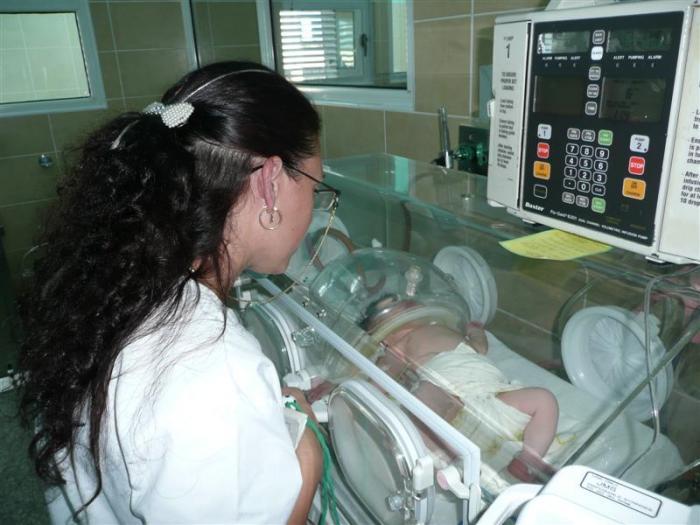
It's barely five in the morning and Rujaine García Linares is already up. After an endless night of mosquitoes and power outages, she knows she can't afford to stay in bed any longer, because she has to get everything ready at home before heading to her job in the Neonatal Intensive Care Unit at the Mariana Grajales Hospital in Santa Clara.
With a candle in her hand, she walks through the kitchen and what little remains in the refrigerator after the nearly 40-hour power outage the day before, which forced her to cook almost everything she had left to feed her two children and her mother, an elderly woman nearing 85.
"I think the most practical thing is to boil some eggs and cook a little rice. I have to be at work early today because the ward is really busy with a lot of seriously ill children," she tells herself and takes on another difficult task: lighting the charcoal.
Having completed her task, she sets up the cauldrons one after the other to get the cooking done as quickly as possible before leaving home.
After giving her mother the necessary instructions, at seven in the morning Rujaine sets off for the bus terminal to see if luck is on her side and some kind driver will give her a ride to the hospital, because she can't afford to pay for a tricycle every day.
Once there, the other battle begins, for her, the most important: to ensure that none of the children admitted lose their lives, due to the lack of medicine and fuel that the country suffers because of the imperialist blockade that seeks to bring the Cuban people to their knees.
There, Rujaine is transformed. She forgets her problems, the lack of resources, and other hardships that surround her. She knows that outside there is a family suffering and waiting for good news about their loved one. She also knows that neither the children nor their families are to blame for the critical situation currently facing the Cuban healthcare system, due to the stubbornness of a U.S. government that is committing genocide against the Cuban population.
With this conviction, this woman from Santa Clara, who each day juggles the roles of mother, daughter, and nurse, fulfills her duty at home, at work, and even in her community, where she shares what little she has with her neighbors, many of whom are even more vulnerable than she is.
When these adversities are just a bad memory, a monument should be erected to the Cuban woman, the pillar of the family, the silent architect of each day overcome.
As night falls, exhaustion adds to the darkness that envelops the neighborhoods, the buzzing of mosquitoes, and, if she's lucky, the hum of a rechargeable fan. "Sleeping like this is difficult, but tomorrow we have to get up," Rosa María remarks. And in that phrase is condensed a persistence that we have cultivated for generations.
In the midst of hardship, Cubans do not give up on moving forward. And in that way of shouldering life's burdens, another certainty is evident: moving forward here is difficult, requires great fortitude, and demands more than one sacrifice, but yes, we must continue, and we will continue.
When the history of these times is written, it will speak of a noble and courageous people, and of a despicable and cowardly enemy that tried, in a thousand ways, to break their will.


