

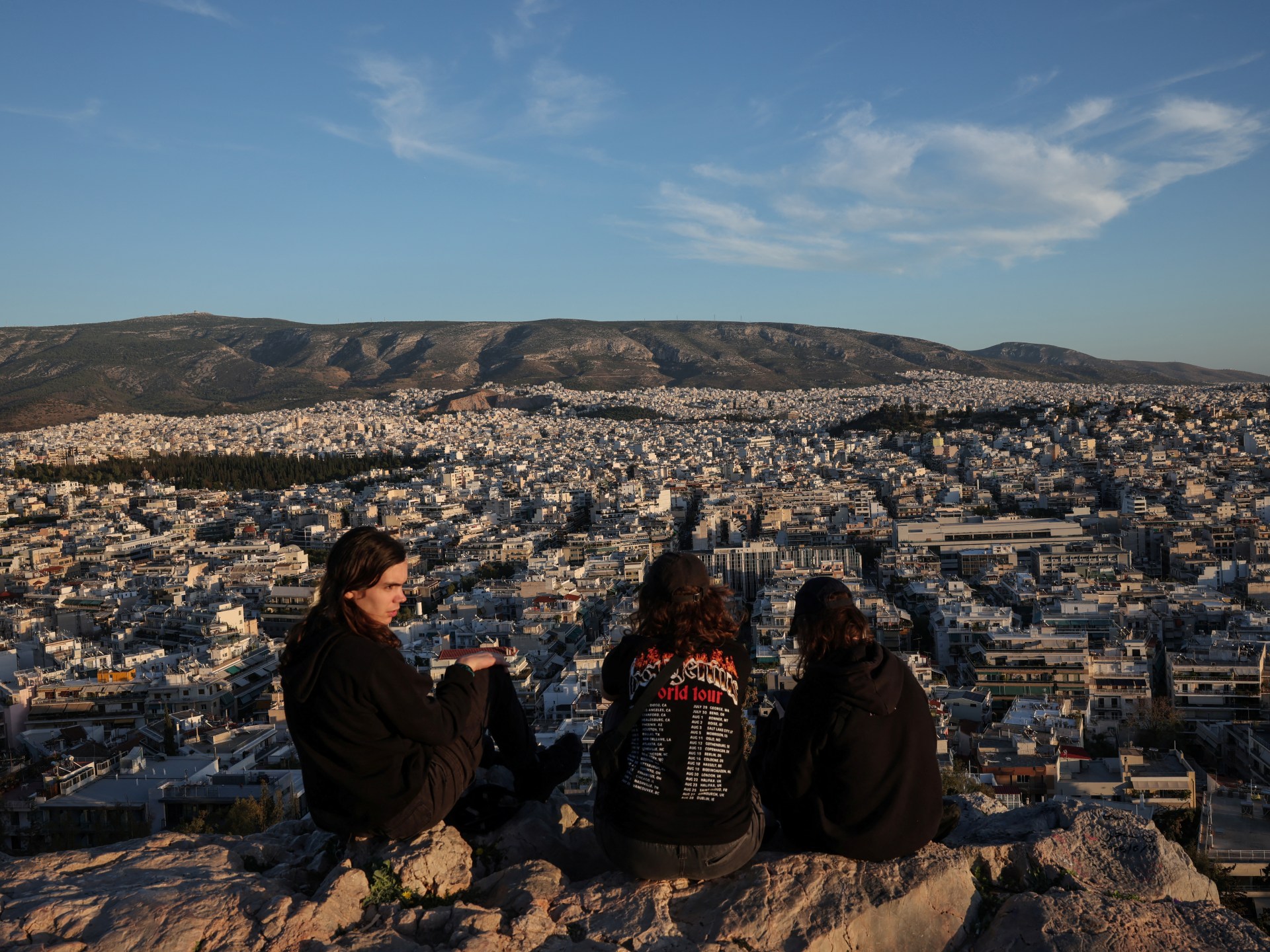

Athens, Greece – When the conservative New Democracy party came to power in Greece in 2019, it promised a work-driven economy that would grow by 4 percent a year and elevate living standards after a decade of austerity.
In an appeal to the productive, non-state economy, Kyriakos Mitsotakis became prime minister, asking Greeks to “work together to build a new compact of trust based on meritocracy, industriousness, security, justice, opportunities for everyone”.
- list 1 of 4Blood, Sweat and Sugar
- list 2 of 4Photos: Afghan villagers turn to gold-panning to sustain livelihoods
- list 3 of 4Soaring fuel prices in Pakistan threaten economic and political crises
- list 4 of 4On May Day, Gaza’s workers find whatever source of income they can
end of list
Five years later, Greeks had the second-lowest annual salaries in the European Union after Bulgaria, according to Eurostat, the EU statistical agency.
Every other Eastern European country that had become a free-market democracy in 1991 and an EU member in 2004, almost a quarter-century after Greece, has leapfrogged ahead of it.
From 2019 to 2024, “Bulgaria rose 11 points whereas we rose 3 points,” said Yiorgos Christopoulos, spokesman for the General Confederation of Workers in Greece (GSEE), the country’s private sector umbrella union. “If this goes on, Bulgaria, too, will overtake us in the next two to three years,” he told Al Jazeera.
GSEE’s latest report found that during these five years, Greek living standards rose from 65.5 percent of the EU average to just 68.5 percent, despite the fact that the economy has grown at almost twice the EU rate since the COVID-19 pandemic in 2020.
What went wrong?
When New Democracy was re-elected in 2023, it promised to restore living standards and made good on those promises.
Minimum wage was recently restored to 920 euros ($1,080) a month, from the 580 euros ($680) to which it had been slashed amid the post-2009 global financial crisis. By next year, it is to rise to 950 euros ($1,114).
Advertisement
Average monthly wages, too, have risen to 1,516 euros ($1,777), fulfilling New Democracy’s promise a year early.
New Democracy also came through on promises of tax cuts. This year, all income tax brackets were slashed by two points, and by a further two points for each dependent child.
Workers under 25 pay no tax until they earn more than 20,000 euros ($23,450).
Mitsotakis took a moment to congratulate his government on its performance since 2019 at last September’s Thessaloniki International Fair, where he announced these measures.
“It’s not coincidence that the country of austerity now has one of the highest growth rates in Europe, with unemployment at 8 percent, down from 18 percent, 500,000 new jobs, public debt 30 points lower, while salaries increase and taxes fall.”
But in real terms, Greek incomes have fallen by a third in the past 15 years, EU statistics show.
“There’s a greater increase in inflation than in salaries, so we have a fall in purchasing power,” explained Efi Achtsioglou, who was labour minister under the left-wing Syriza government in 2016-19. “In our country, inflation is much higher than the EU average, and our salaries are lower than the EU average in real terms,” she told Al Jazeera.
‘Few workers covered by collective bargaining’
Normally, labour unions and employers’ unions would sit with the government every year to agree on sectoral wage rises roughly in line with inflation. This has not happened since New Democracy came to power.
“I think what has led to this situation is that you have very few workers now covered by collective wage bargaining agreements – below 20 percent, when EU directives say it has to be above 80 percent,” said Achtsioglou.
“We had more collective wage agreements in 2018, so after the crisis, instead of getting better, things got worse,” she said, referring to the post-2009 global financial crisis, which saw Greece slash its minimum wage in February 2012.
Since Greece is still a small-enterprise economy – roughly 90 percent of employment comes from companies with 10 or fewer employees – it is especially important to have collective agreements, Achtsioglou pointed out.
Work deaths soar
Greece also has a much worse track record on worker safety than the government lets on, says GSEE.
According to official statistics submitted by the labour ministry, Greece had 51 work-related deaths in 2023. The Federation of Workers’ Unions in Technical Enterprises (OSETEE), a GSEE offshoot, tallied the number at 179.
Last year set a record at 201, and OSETEE has recorded 47 in the first four months of this year.
Advertisement
“Large categories of workers aren’t included [in government figures], such as maritime professions, security bodies, quarries, the armed forces … freelance workers, who are 20 percent of the workforce, and anyone uninsured by social security,” said Andreas Stoimenidis, head of OSETEE.
Government statistics also do not count hospital or traffic deaths as being related to work, he said.
“Last summer, a worker was killed after setting up a concert and was driving to set up another. He had a car crash because he was working unbelievable hours,” said Achtsioglou. “The ministry did not record that as a work accident but as a simple traffic accident.”
Last year, New Democracy passed legislation allowing an employee to work up to 13 hours a day for a single employer as part of its steady deregulation of labour. That, said Achtsioglou, was a recipe for more deaths.
“Statistics show that accidents happen towards the end of work shifts,” she said.
The International Labour Organization agreed that Greece was under-reporting deaths in its 2025 tally.
There may also be an unconsciously racist element to some of these deaths, say migration experts.
A quarter of last year’s tally took place in construction, another quarter in agriculture, and another 15 in tourism – making them the first, second and fourth most lethal professions.
All three industries employ a high proportion of migrant labour, and Greece has said it is actively seeking to recruit another 200,000 foreign workers in them.
“One could reasonably wonder whether safety rules are being followed, and whether there is an unconscious bias towards immigrant workers when it comes to safety,” said Lefteris Papagiannakis, head of the Greek Council for Refugees, a legal aid group. “There is now a body of statistics at our disposal so it’s not something we can’t properly investigate,” he told Al Jazeera.
Related News
South American migrants deported to DRC say facing pressure to return home
Burkina Faso dissolves more than 100 NGOs and civil society groups
Have US-Iran talks failed? Why no deal yet doesn’t mean diplomacy is dead