
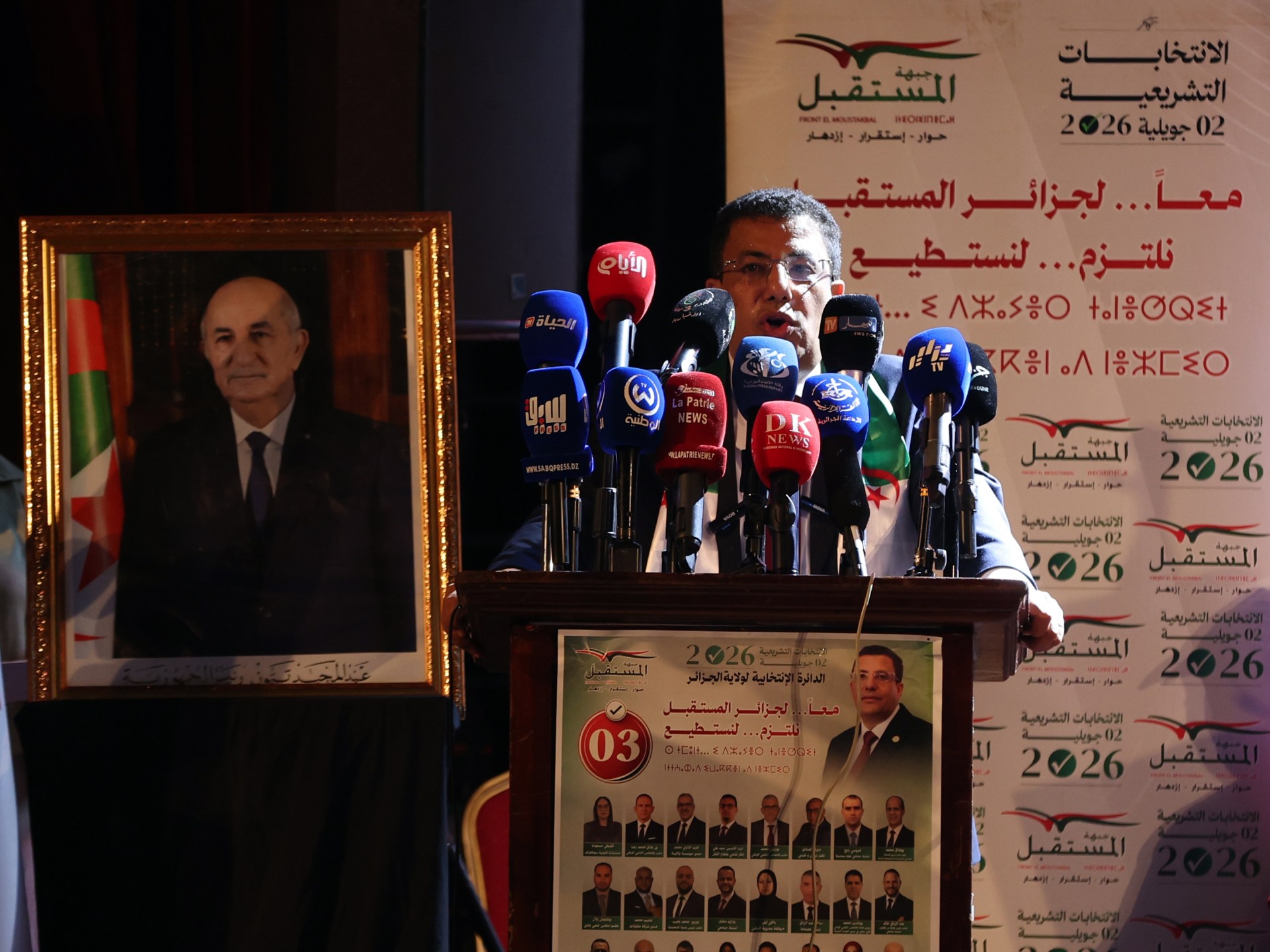

Algiers, Algeria – As Algerians prepare to vote on Wednesday to elect a new parliament, the central question is not which parties will emerge strongest, but whether citizens will bother to turn out at all.
Years after the Hirak protest movement forced a rupture in Algeria’s political order, the campaign has unfolded in an atmosphere marked less by competition than by widespread disengagement and mistrust.
The outgoing parliament, elected in 2021, recorded a turnout of just 23 percent, the lowest in any legislative election since independence in 1962.
That vote followed the Hirak protests that began in 2019 and led to the resignation of former President Abdelaziz Bouteflika, ushering in Abdelmadjid Tebboune’s presidency. Since then, observers say, a tightening political and civic space has further eroded confidence in formal politics.
In the run-up to the campaign, controversy about candidate eligibility deepened that sense of disengagement. According to Karim Khalfane, interim head of the national elections authority ANIE, more than 3,700 prospective candidates were barred from running, while approximately 10,000 were approved. Authorities say many of those excluded were linked to business interests or what the law describes as “suspicious activities”.
The legal basis is Article 200 of Algeria’s electoral law, introduced under amendments adopted in April 2026 to prevent “dirty money” from influencing elections. Critics argue its broad wording grants authorities wide discretion over who can stand.
Advertisement
The Islamist Movement of Society for Peace (MSP) has described its use as “arbitrary,” saying disqualifications were issued “without clear legal evidence or any final court judgment”. Louisa Hanoune, secretary-general of the Workers’ Party, called it “elastic, overly vague, and open to all readings and interpretations”.
Among those affected were candidates from established parties including the National Liberation Front (FLN), the National Democratic Rally (RND) and the MSP itself, resulting in the exclusion of numerous incumbent lawmakers.
Party dynamics
The current parliament is more fragmented than previous legislatures, reflecting the weakening dominance of the FLN and the rise of smaller parties and independents. Analysts say this fragmentation reflects a managed political field rather than renewed pluralism.

“In the absence of polling institutes and concrete data, we can’t know for sure. However, I do think that the ruling establishment might give the lion’s share of parliament seats back to the FLN,” said Nouri Dris, a sociology professor at the University of Sétif. He added that parties dominant in the immediate post-2019 period, including the RND and El Bina, appear to be losing favour.
Observers also note the irony that the outgoing parliament passed legislation that ultimately barred many of its own members from standing again.
Opposition return
The Socialist Forces Front (FFS), which boycotted the 2021 vote, has returned to the contest, fielding 30 candidate lists in an attempt to regain parliamentary representation. Party official Rachid Chaibi said participation remains essential despite limited expectations.
“It’s an opportunity for us to give meaning to parliamentary action. It is important to occupy this space and make full use of the constitutional powers available,” he said.
President Abdelmadjid Tebboune’s second term is set to end in 2029, and the Constitution prevents him from running again. For Dris, the composition of the new parliament is unlikely to significantly alter the political balance before that transition.
“The establishment wants representatives that do not even question ministers,” he said. “Parliament has been transformed from a legislative body and oversight institution into little more than a platform for conveying citizens’ concerns.”
Advertisement
Campaign mood
On the campaign trail, enthusiasm has been notably muted. The official campaign period began on June 9, and candidates have struggled to draw attention in a climate where political messaging competes with everyday concerns, seasonal travel, and the dominance of sport and entertainment in public life.
Some commentators point to the difficulty of mobilising voters during the summer period, when many Algerians are on holiday and political engagement tends to decline. Others argue the issue runs deeper than timing.
“Low turnout was already an issue before 2019, but since the Hirak we are witnessing catastrophic numbers,” said Abdelmoumene Khelil, former secretary-general of the Algerian League for the Defence of Human Rights.
The organisation, founded in 1985, was active during the Hirak protests and later says it was effectively forced to cease operations in 2023, alongside several other civil society groups. During the same period, hundreds of people were arrested for participating in demonstrations or expressing dissent online.
Khelil told Al Jazeera that the erosion of participation is not incidental but structural: “It is a consequence of restricting the political and media field.”
Related News
Guyana reports ferry disaster death toll rises to 41
Trump signs new executive orders seeking to limit birthright citizenship
Syrian authorities arrest ex-officer accused of chemical weapons crimes