
Commander Ramiro, protagonist of the extraordinary work that is the Revolution
 24 June 2026


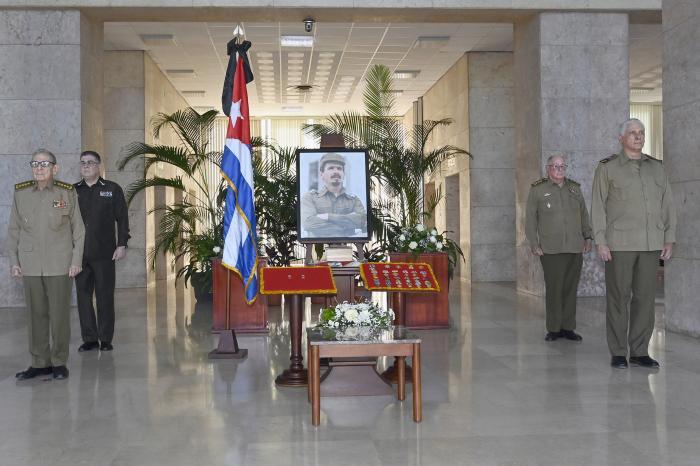
This Tuesday morning, Army General Raúl Castro Ruz, leader of the Cuban Revolution, arrived at the headquarters of the Ministry of the Revolutionary Armed Forces to pay the first tribute to Commander of the Revolution Ramiro Valdés Menéndez, his comrade from the Moncada Barracks, the Granma, the Sierra Maestra, and all the work done after the triumph.
Alongside Raúl, in the first honor guard for a man who dedicated his life to the defense of the Homeland, stood the First Secretary of the Central Committee of the Communist Party and President of the Republic, Miguel Díaz-Canel Bermúdez; and the Ministers of the Revolutionary Armed Forces (FAR), Army Corps General Álvaro López Miera, and of the Interior, Army Corps General Lázaro Alberto Álvarez Casas, both members of the Political Bureau.
Shortly before, the urn containing the ashes of the upright revolutionary, a man of absolute loyalty to Fidel and Raúl, and, as he himself said, deeply in love with the Revolution, had been placed in the center of the hall.
On one side were the two stars that recognize him as a Hero of the Republic of Cuba and of Labor; on the other, the numerous distinctions and decorations he earned for his exceptional service record. There, very close to the urn, folded into a triangle, stood the Cuban flag that he had brought from Bolivia with Che Guevara's remains and from which he was never separated again.
Another flag, adorned with a black ribbon as a sign of mourning, and five floral tributes on behalf of the Army General, President Díaz-Canel, the Association of Combatants of the Cuban Revolution, the people of Cuba, and the family, also stood guard over the Hero who disliked speaking in the first person or being the protagonist of something that, he said, "we have all done very naturally, from the moment duty called us."
At the conclusion of the honor guard, Raúl and Díaz-Canel laid white roses to seal the tribute, followed by the Ministers of the Armed Forces and the Ministry of the Interior. Then came the heartfelt embrace of the Army General and the President for Commander Ramiro's family, for Alicia, his life partner, for his children, and for all those present, proud of the rebel, the guerrilla fighter, the humble man who dedicated himself entirely to building the new Cuba that was born in 1959.
Regarding Ramiro, whom he always considered a brother in arms, since together they defended the same ideas and principles, the Army General said, just as he was being awarded the Honorary Title of Hero of Labor: "He had the merit and the honor, which the rest of us did not have, of being the second-in-command of the column that Che Guevara led to Las Villas."
True to that history and to his last wishes, this Thursday, the Commander of the Revolution will be reunited with the Heroic Guerrilla to rest in the Mausoleum of the Las Villas Front, in the Ernesto Che Guevara Sculpture Complex, in the city of Santa Clara.
One cannot achieve immortality without attracting attention, as Commander Ramiro would have preferred. Today, as Cuba honors him, we must speak of his dedication and commitment, and of his feats, to which we must always return to understand all the qualities of a revolutionary.
Commander Ramiro did not seek the limelight, but he was and will continue to be a protagonist of the extraordinary work that is the Revolution, which, as he affirmed, "was not born to die, but to continue through time."
Related News

President Díaz-Canel visits Recycling Business Group units in Havana

Santa Clara Sculpture Complex prepares for tribute to Commander of the Revolution, Ramiro ...

"Reality demands urgent and necessary changes"
