


It is impossible to understand who Raúl Castro Ruz is without considering his absolute faith in what the Revolution can achieve, his conviction in the greatness of the society his generation began to build, and his unwavering commitment to making it more prosperous through the efforts of all present, and without his affection, loyalty, and admiration for Fidel.
To speak of Army General Raúl Castro is to know that he is a sensitive and tenacious man who, with every word, calls us to strengthen our understanding of Cuban history; to renew ourselves; to avoid complacency; to be consistent with our words; "to never lie; to be reflective and not let ourselves be carried away by exaggerated enthusiasm that could make us lose sight of the objective."
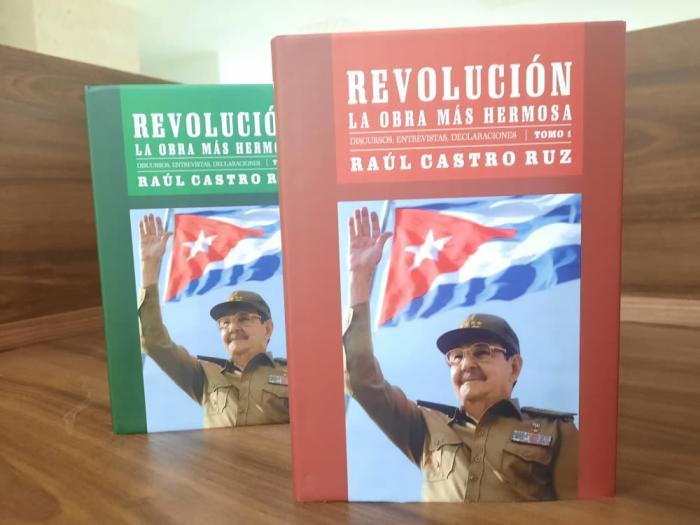
And this is precisely evident in the book Revolución, la obra más hermosa (Revolution, the Most Beautiful Work), published by Ediciones Celia, which contains speeches, interviews, and statements by the Army General, who will soon celebrate his 95th birthday.
For Belkis Duménigo García, editorial director of the Office of Historical Affairs, reading this book—two volumes containing 138 public addresses—is to revisit key moments of the Revolution over the last decade, as the author addresses the most significant issues on both the national and international stage.
"We encounter his efforts toward Latin American and Caribbean integration; his commitment to respecting sovereignty, dignity, and non-interference as the foundations of our foreign policy; his dedication to defining the political and economic model that would govern the nation's life; his unwavering fight against indiscipline and illegal activities; and his self-critical evaluation of our conduct," says Belkis.
Likewise, “there are allusions to the United States’ foreign policy as the world’s policeman, and its relations with the Island. He expresses support for the reestablishment of respectful relations and examines the consequences of the infamous blockade on our lives. With proverbial Cuban flair, he emphasizes in his speech of September 27, 2006:
“We cannot forget for a moment that we are dealing with a very powerful enemy, capable of resorting to any means to achieve its goal of erasing the Revolution from the face of the earth (...) they have even appointed the Yankee interventor, a certain McCarry, as if nothing had changed in this world since they thwarted our independence in 1898 and imposed several interventors upon us.”
Anyone who picks up this book will rediscover Raúl: not the military man, not the President, but the human being who is moved when he speaks of Fidel, who lingers on the name of a fallen combatant, who calls Chávez "My Brother," and refers to the young men of Moncada as the boys of then and forever.