


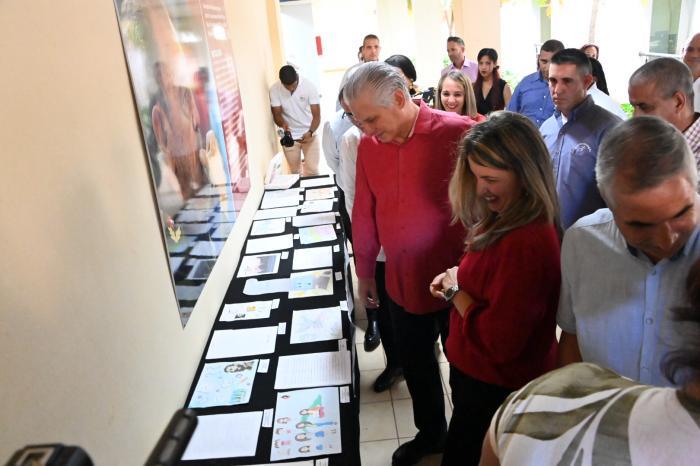
A universe ready for change, intelligent, which today even welcomes children and adolescents in a new type of school, and which remains faithful to the founding ideas of Commander-in-Chief Fidel Castro Ruz. That is what the Cuban University of Computer Sciences (UCI) is today, where the President of the Republic of Cuba, Miguel Díaz-Canel Bermúdez, arrived this Wednesday morning.
After engaging in several dialogues and touring a unique school and laboratories where talent is flourishing, the dignitary reflected before a group of young people: “Amidst so much bad news arriving daily regarding the pressures of U.S. policy against Cuba, waking up here today at the UC)—with the little school, with the new school model, and now with this development you (the young people) are experiencing—fills one with happiness and, above all, with confidence that, even in the most complex situation, we will overcome it.”
“And if we can overcome this situation, what won’t we be able to do in the future, in other kinds of situations?” the Head of State reasoned, before recalling that what they had seen this Wednesday morning was part of creative resistance, “which isn’t just about enduring,” but also about developing while experiencing the act of resistance: “This expresses a will, a priority for all of you, and a talent.”
“Congratulations, and we have high hopes for you,” said the First Secretary of the Central Committee of the Communist Party of Cuba, during a visit in which he was accompanied by Deputy Prime Minister Eduardo Martínez Díaz; the Ministers of Education and Higher Education, Naima Ariatne Trujillo Barreto and Walter Baluja García; and the Rector of the University of Computer Sciences (UCI), Raydel Montesino Perurena.

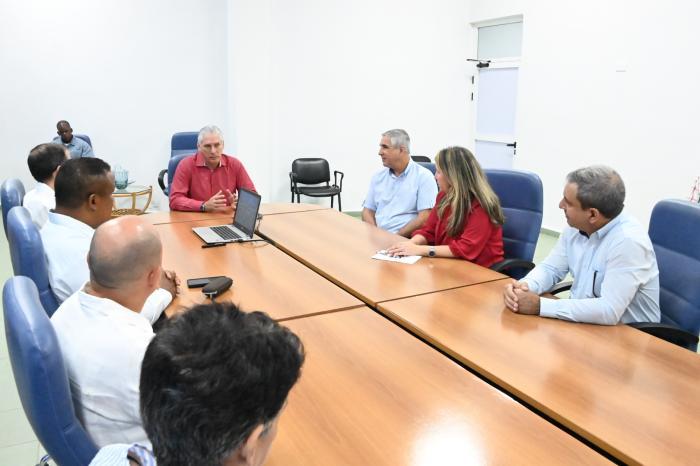
The first part of the tour took place in a central UCI building, where Rector Montesino explained that “our mission has always been to contribute to the digital transformation of Cuba in many ways.” The first task, he said, “is to train undergraduate and graduate professionals” while conducting scientific research. The Rector also referred to software development as an activity that is part of the UCI model and has an international reach.
The Rector recalled that UCI began with one-degree program and now offers four undergraduate programs—three bachelor's degrees and one associate's degree. He stated that "in 23 years, we have already had more than 18,000 graduates," and emphasized the impact that UCI graduates have had on the country's digital
transformation.
The university offers programs in Computer Science Engineering, Bioinformatics Engineering, Cybersecurity Engineering, and Network Administration (a specialization, Montesino said, "that the country desperately needs").
Among other ideas, the Rector stated that they have "proposed to accelerate doctoral training considerably." He said that UCI has six faculties and seven development centers, and 2,554 undergraduate students—a number, he noted, that they are in a position to increase. Regarding the current energy crisis, I have emphasized that UCI's principle is to leave no students behind.
On this point, the Rector, who is also a professor, referred to efforts to achieve some in-person instruction and commented on adjustments to the curriculum. This year, he affirmed, 554 students will be able to graduate—one hundred more than last year.
According to the Rector, the transportation situation has been the biggest challenge for UCI. However, there are experiences there that demonstrate how a flexible and bold mindset can prevail amidst great difficulties.
The result is an institution that remains true, in practice, to the words of its founder, Fidel: “This University must be characterized,” the Commander-in-Chief had declared, and the words appear on a wall of the UCI, “by the great variety of different ways of teaching, of preparing… an experimental teaching center, a teaching-production center.”
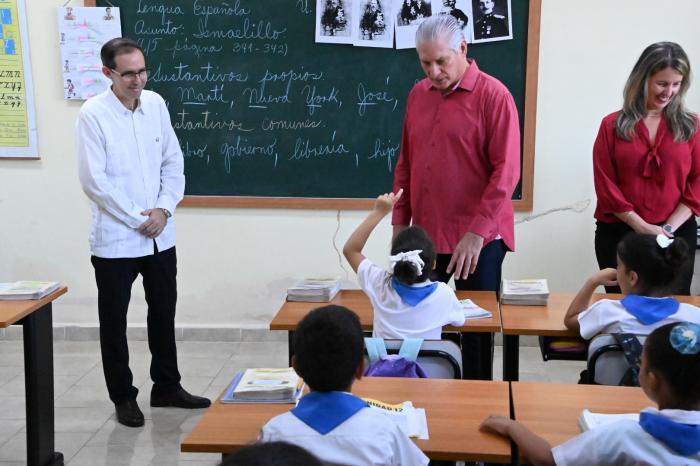
The UCI has given shelter to a beautiful experiment: children and adolescents study there; there, the university atmosphere inspires these new generations who benefit while acquiring knowledge such as English, Art Education, and other subjects in the world of the Exact Sciences.
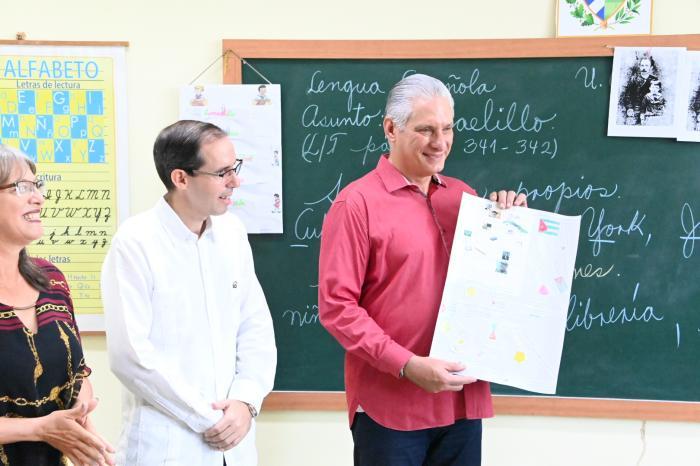
Surrounded by very young children who were expressing gratitude and love, President Díaz-Canel Bermúdez asked if the students felt comfortable there. "We second-grade pioneers love you very much," said one child. As he said goodbye, the dignitary told the children, “Thank you very much, and I wish you success in your studies. Prepare yourselves well so that you can be of service to the country.”
As the visit was leaving, a child said, “Goodbye, Minister…” He was addressing Naima Ariatne Trujillo Barreto, whom he had obviously met on other occasions. It was the Minister herself who shared with reporters the details of the unique school that was established at the University of Caracas (UCI) when times became very difficult due to the intensified blockade, leaving many children unable to attend their usual schools.
“It’s an experience,” she said, “that is unique in the country right now. When the time came to decentralize enrollment, the children who live at the UCI, with their parents who are teachers and staff here, were in different schools in the La Lisa district (of Caracas), with no way to get there. We have between 17,000 and 23,000 children and teenagers who have…” "They remained thus, very distant." "Here, then, was the exclusive opportunity to have a university faculty," the minister explained; and she detailed that "we were then able to establish what we call 'Pioneers Project.uci.cu,' which is now a whole school, in which it was approved that children progress through the grades, from preschool to ninth grade, and can even be evaluated."
Naima spoke of classrooms where "there might be children from three different schools"; of a "unique faculty, but one with enormous potential." In her view, the important thing is "having taken advantage of the potential that was here."
The head teacher recalled that "the children and teenagers, when they arrived, came from different backgrounds and remembered their teachers," who, incidentally, have maintained a connection with the new school: "The municipality of La Lisa, the methodologists there, the provincial education department, and colleagues from the Ministry of Education have focused on documenting this pedagogical experience." Naima often tells the Rector that a university is rather quiet, but at UCI "there's a buzz of children, there are teenagers we've guided, they hold their morning assemblies; in other words, there's been a lot of heart behind this experience."
Perhaps, she told reporters, "we can't replicate a school like this at every university in Cuba, but we can certainly utilize its potential in other places." The head of the department emphasized: "We don't know how long this situation imposed on us could last—referring to the situation created by the fierce blockade—and look how long it's been going on and everyone is going to finish their degree. That's one of the biggest victories we've had at this stage, in this place."
It's no wonder President Díaz-Canel Bermúdez said this Wednesday at the UCI that the experience of the new school "is a model to defend and replicate"; it's evidence that "we are not standing still. I wish we had this in all universities."
CUBAN TALENT

The Software Export Laboratories were the last stop on the UCI tour. In one of the facilities, Dr. Reynaldo Rosado Roselló explained to the president that the university has a large and important productive workforce.
There, he detailed, there are more than 600 software development specialists. This workforce is made up of students, professors, and specialists dedicated to this type of work. Roselló later stated, in a separate conversation with reporters, that this "workforce is ready to continue contributing to the country's digital transformation." He further told the press that they, who had already been contributing to software exports, have intensified this activity in the most recent phase. And that this has allowed for an increase in export revenue.
"In a model where the country wins, the institution wins, and the people win," explained the Doctor of Science, who told reporters that, "everyone involved in software exports is paid in foreign currency, working from here, from the University."
Reynaldo spoke during the meeting with the Head of State about the strength of a recently established company, only about three years old, but already generating revenues exceeding 150 million pesos in national currency, and which last year brought in over half a million pesos in foreign currency: "And this is the path we have," he told reporters, "to catalyze, to transfer all the knowledge, and to complete the commercialization cycle with everything generated in software development at the institution." Toward the end of his remarks, Reynaldo reflected: "I believe that if there is one area in which the UCI should be more aggressive today and achieve superior results, it is in software exports. And that is what we are focused on right now: transforming software exports. We believe we have the necessary conditions and that the numbers can grow, because Fidel envisioned the UCI to train professionals, to contribute to the country's digital transformation, and also to become a significant source of foreign currency." During the visit, President Díaz-Canel told professors and students, "Now, your contributions are crucial to our goal of advancing Artificial Intelligence (AI) in the country and bringing AI to all aspects of life." He shared his aspiration: "That the UCI become the first 'Smart University' in the country; and we must accelerate this process."
At the end of the tour, the president approached a plaque that read: “On this spot, on December 12, 2002, the historic leader of the Cuban Revolution, Fidel Castro Ruz, addressed the workers and students of the UCI. That day he said: ‘This is a newly founded school.’”
Someone explained to reporters that classes at UCI began on September 23, 2002, but Fidel, although he had visited the construction sites, had not been at the university with the students. Therefore, the date of his first visit to UCI was December 12, 2002, which was later considered the founding date of the institution.
When the Commander-in-Chief spoke with the students, he called them “the troops of the future”; and that phrase gave rise to a motto that has marked the institution to this day, always loyal to one strategy: “Connected to the future, connected to the Revolution.”