


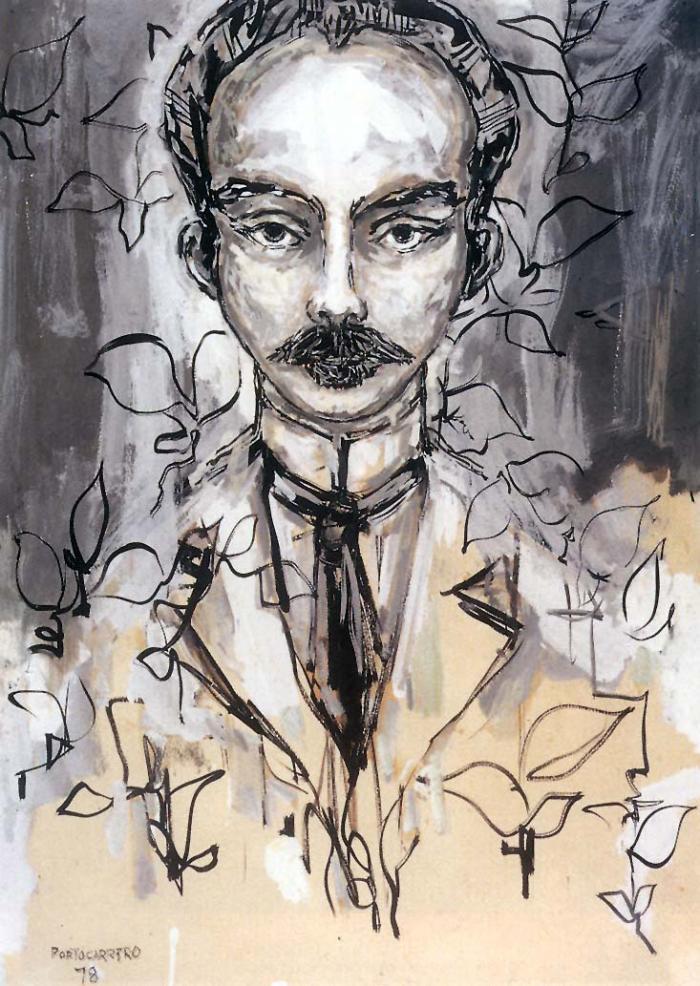
José Martí gallops on horseback. He carries no words; he has already left the necessary ones in letters, speeches, and verses. "For me, it is time," he had written. The history of Cuba has not aged in books and archival documents; it is alive, because its enemies persist, alive and threatening. In his last letters, he explained his reasons. To Henríquez y Carvajal he said: "Free Antilles will save the independence of our America, and the already doubtful and wounded honor of English America, and perhaps accelerate and stabilize the balance of the world." And to Mercado, clearly and directly, he announced that he was risking his life to "prevent, in time, with the independence of Cuba, the United States from extending throughout the Antilles and falling, with that added strength, upon our lands of America," and a few lines later he reiterated his purpose: "to prevent the opening in Cuba, through annexation to the imperialists there and the Spanish, of the path that must be blocked, and which we are blocking with our blood, of the annexation of the peoples of Our America to the turbulent and brutal North that despises them."
Cuba's independence was linked to that of Our America, but also to that of its oppressors, because a people that oppresses another cannot be free; and also, "to the balance of the world." It is not that history repeats itself, but rather that the cycle Martí foresaw has not yet concluded. The 20th century is not a short one, if we understand it to extend beyond the limits of the calendar: it is the century of imperialism, which began in 1898 with the Cuban War and is now in its death throes, in the first half of the 21st. Its fundamental contradiction, as Che Guevara observed, was between exploited nations and exploiting nations.
Cuba appears at the extremes of this long historical process, due to its geographical position, its tradition of resistance against colonialism and neocolonialism, and, above all, its victory, sustained for almost seven decades. Based on its location and the elongated shape of its main island, Cuba has been described as a key in the gateway to the Americas, and it is, in another essential sense: it can open or close paths for Humanity.
"For me, the homeland will never be triumph, but agony and duty,"declared José Martí. What does this concept mean in Martí’s work? In his dramatic poem Abdala, written when he was just 16, the first clues appear: Homeland is more than a place, "it is not the ridiculous love for the land / Nor for the grass our feet tread"; the young Martí defines it in its opposite: "It is the invincible hatred for those who oppress it, / It is the eternal resentment toward those who attack it," precisely because he already understands it as the affective sphere in which human dignity germinates. In 1871 he would say it emphatically: "I would prefer (…) that the first law of our republic be the Cuban people’s devotion to the full dignity of humankind."
Therefore, upon returning to Cuba in 1878, he rejected the peace treaty that renounced independence: "They think I am returning to my homeland! My homeland lies in so many open graves, in so much lost glory, in so much honor lost and sold! I no longer have a homeland —until I conquer it." He thus defended the possibility (the necessity) of a united America in the face of any outrage against human dignity. In 1876, in Mexico, he asserted his right to speak out about the ills of the neighboring country: "Conscience is the citizenship of the universe," he declared. And to the Dominican Henríquez y Carvajal, he would say in the aforementioned letter: "Why should I speak to you of Santo Domingo? Is that something different from Cuba? Are you not Cuban, and are there those who are better than you? And Gómez, isn’t he Cuban? And what am I, and who assigns me land?"
More than a place, Homeland is the national or regional space where a collective project is built: to found, to make Homeland, is to assert in the specific human dignity and justice that makes us all equal.
"Homeland is humanity, it is that portion of humanity that we see most closely and in which we were born; and it should not be allowed that with the deception of the holy name useless monarchies, bloated religions or shameless and starving politics be defended," Martí wrote. "Nor should man refuse to fulfill his duty of humanity, in the portion of it that is closest to him, just because these sins are often given the name of homeland."
The struggle for Cuban independence coincides, historically, with the birth of U.S. imperialism. Two projects close in time and geography, yet opposed in their aspirations. This is the historical challenge that defines Cuba's history. Martí foresaw this, and in his writings, indirectly, he cautioned Cubans and Latin Americans dazzled by the idea of North American prosperity. The alternative project of a homeland for Our America that Martí envisioned was different. As early as 1871, in his Notebook, he wrote: "American laws have given the North a high degree of prosperity, and have also raised it to the highest degree of corruption. They have turned it into a commodity to make it prosperous. Cursed be prosperity at such a cost!" His view of the United States evolved, but his rejection and fear only deepened.
The cycle seems to be drawing to a close. It is, however, the most dangerous moment. We have conquered the Fatherland, imperfect but luminous, ours, and we will know how to defend it. As yesterday, it is the Fatherland or Death. Martí returns at a gallop on his white steed, revolver in hand, facing the sun. The fervent adolescent he was and always will be, repeats Abdala's verses:
Neither laurel nor crowns are needed
He who breathes courage. For they threaten
Free Nubia, and a tyrant wants
To subdue her as a vile slave to his dominion.
Let us rush to the fight, and let our blood
Prove to the conqueror that it is shed
By breasts that are altars of Nubia,
By arms that are her forts and walls!
Related News

The Major still rides across his plains, on his Island
Cuban Foreign Minister denounces the repercussions of a military aggression against the is...
The National Electric System continues to operate under extreme pressure