



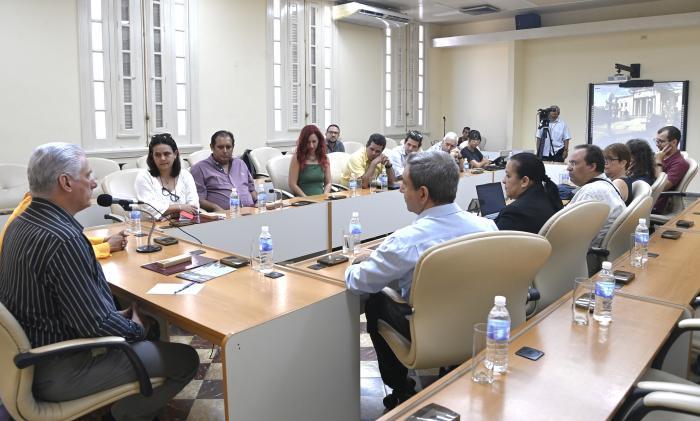
A sample of the numerous research projects being carried out by the University of Havana that contribute to the use of Artificial Intelligence (AI) for the benefit of the country's various economic and social sectors was presented to the First Secretary of the Central Committee of the Communist Party and President of the Republic, Miguel Díaz-Canel Bermúdez.
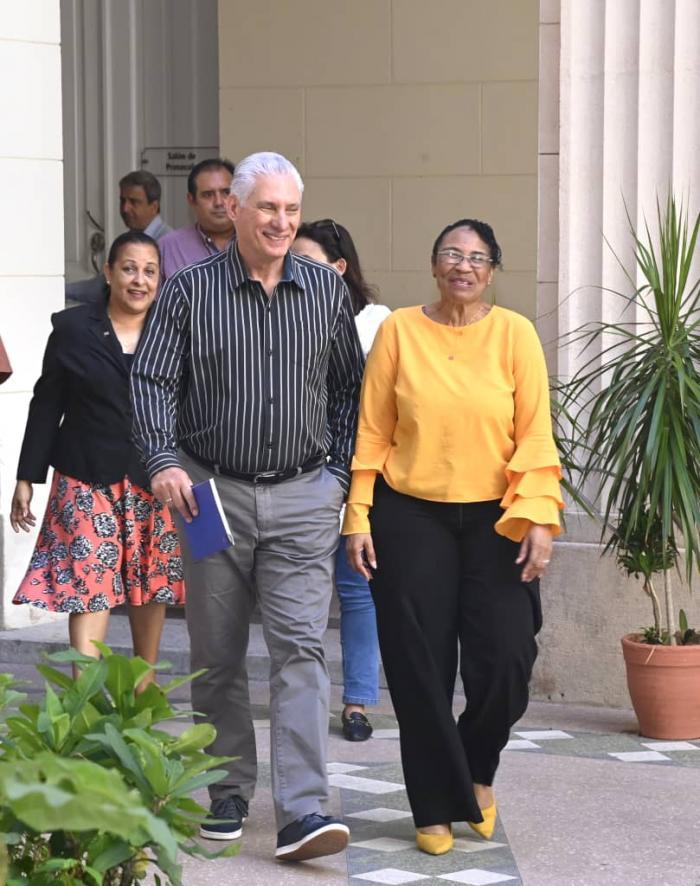
The Head of State visited the university this Wednesday morning, where he met with professors from several of its faculties, most of them young, who have accumulated extensive research and results in the development of AI. Concrete solutions contributed by the Faculties of Physics and Mathematics and Computer Science were analyzed.
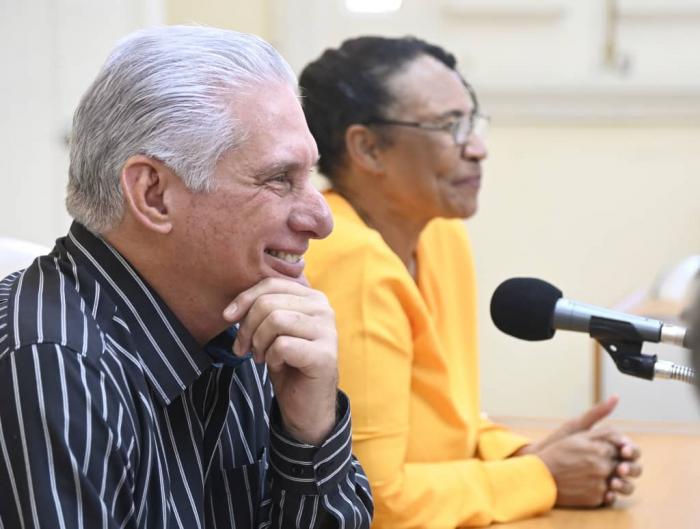
Díaz-Canel explained to them that the visit is part of the systematic monitoring that the country's leadership gives - as part of the Government Management System based on Science and Innovation - to the digital transformation and the use of Artificial Intelligence to solve problems in society, "a society that must become increasingly modern and digitized," he stated.
CONCRETE CONTRIBUTIONS FROM PHYSICS
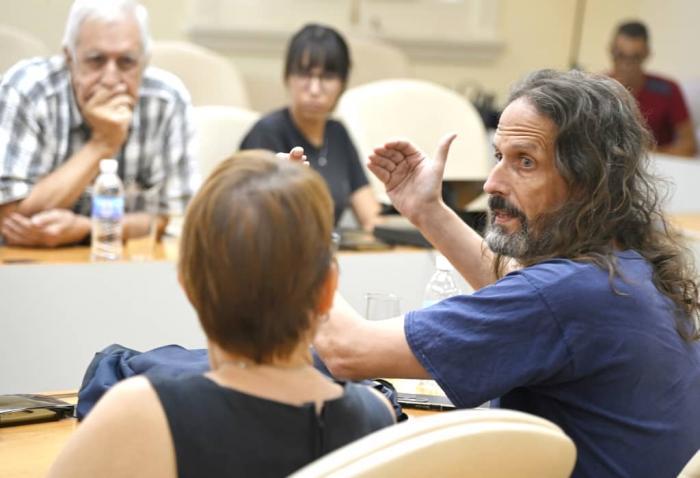
Dr. Milton García Bonato, a researcher at the Center for Complex Systems in the Physics Faculty of the University of Havana, presented a summary of the work of a team that, over three decades, has accumulated numerous successes in the field of AI; that is, long before it achieved its current popularity thanks to the large-scale programming languages used on the internet.
With the attendance of the Ministers of Higher Education and Communications, Walter Baluja García and Mayra Arevich Marín, respectively, and the Rector of the University of Havana, Miriam Nicado García, the scientist elaborated on the characteristics of the AI models they have developed, such as the one designed for analyzing people's mobility.
He recalled that this model allowed, for example, for a precise understanding of mobility patterns and the effectiveness of the restrictive measures adopted during the COVID-19 pandemic. At the same time, it is a tool that allows for the planning and organization of transportation based on people's departure and return points in a large city.
During the exchange, solutions that the Physics Faculty of the University of Havana (UH) has made available to the health sector, such as developments in telemedicine, and to the economy, were presented.
In a separate interview with the press, Dr. Milton García Bonato emphasized that "the Physics Faculty at UH has long studied complex systems, and AI is essentially about that: how we use existing data, which shows very complex relationships, to generate models that predict and help in decision-making."
"In our universities," he affirmed, "we have every intention of transforming things, that is, of applying academic results to what the country needs today, such as the efficient use and conservation of resources and the generation of solutions."
"The country," García Bonato reiterated, "can count on us. The solutions exist, and many have been published in prestigious journals. Therefore, we are talking about established science."
CONCRETE MATHEMATICS
During the exchange between the First Secretary of the Central Committee of the Party and President of the Republic, Miguel Díaz-Canel Bermúdez, and professors from the University of Havana dedicated to research and the generation of results in the field of AI, Dr. Suilan Estévez Velarde, Dean of the Faculty of Mathematics and Computer Science, presented the faculty's contribution to the digital transformation process through the use of AI.
It was, in his words, a summary, "a little bit of everything we are doing," a small sample of "all the potential that the Cuban university has to solve problems that the country has."
Among other results, she detailed the tools aimed at AI-assisted citizen participation, science platforms, project management systems, and logistics and process optimization.
She paid special attention to the institution's Cryptography Institute, data analytics, and support for decision-making and medical image processing, biomedicine, and other areas, including language models, and within them, the uniquely Cuban CeciLIA.
From education to health, among whose most iconic examples are the predictions made during the COVID-19 pandemic based on both AI and mathematical models, which continue to be used today for other diseases, the Faculty of Mathematics and Computer Science at the University of Havana has also developed applications to support decision-making for specific diseases, such as those related to the skin.
Other contributions, the scientist added, are more industry-oriented, such as the use of predictive AI in the software industry; The application of generative AI and other technologies also widely used today, such as blockchain, are very useful within the Cuban company.
Answering questions from the press at the end of the meeting, Dr. C. Estévez Velarde pointed out that these results can greatly help companies "to modernize what we have and improve both efficiency and cost savings, even creating new products and technologies that strengthen us both internally and for new exports. These are potentials that we are creating from the university, but that can strengthen the entire country."
However, the researcher added, "one of the biggest challenges we have today is the relationship between the university and industry, that conversation which is not always easy between two such different environments as business and academia, in terms of timing, the way we communicate, and the types of projects, so that both sides understand the need to train personnel from both sides so that projects don't just remain shelved as theses within academia, but become concrete realities."
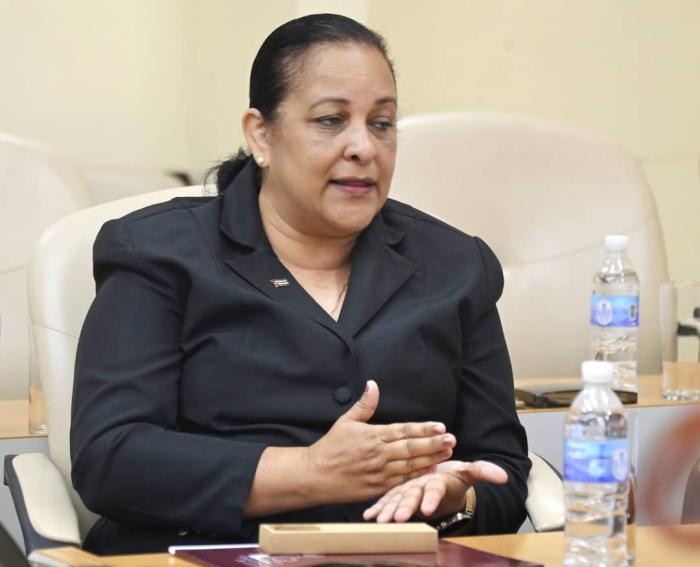
In an assessment of the meeting between the First Secretary of the Central Committee of the Communist Party and President of the Republic, Miguel Díaz-Canel Bermúdez, and researchers from the University of Havana, the university's rector, Dr. Miriam Nicado García, noted that "it was a very fruitful exchange."
She reflected that they were able to explain how the University of Havana has been developing projects based on the application of artificial intelligence in strategic sectors such as health, energy, transportation, and other areas of knowledge, the economy, and society.
It was a meeting, she noted, where there was also agreement that, in order to "continue applying science and technology, and especially AI, in the country's various processes, it is important to continue strengthening universities, their faculty, and the teaching of these tools at all educational levels," as well as continuing to train new PhDs, specialists, and master's degree holders in these areas, which are strategic for Cuba's development.
Related News

The people, together with Raúl, made history once again
In them, work becomes their Homeland

Efforts to restore thermal power generation capacity continue unabated
