



Faced with this policy of pressure, we reaffirm the legitimacy of the Cuban people to defend their social project, demand the immediate lifting of all unilateral coercive measures, and call upon the international community to reject any form of economic warfare that uses energy and communication as instruments of collective punishment.
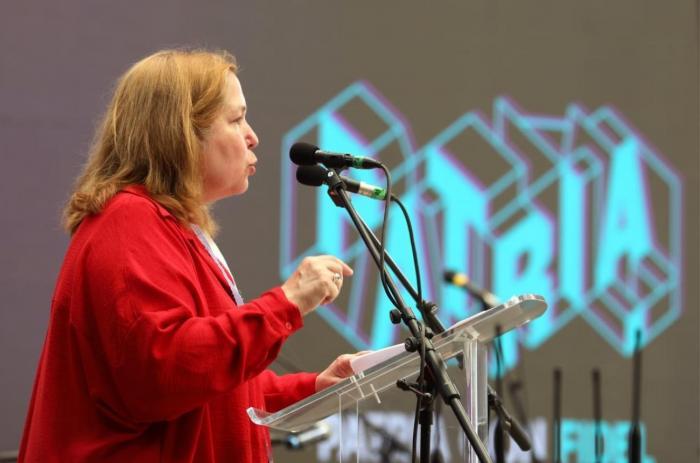
The participants in the 5th International Patria Colloquium, held from April 16 to 18, 2026, in Havana, Cuba, with the attendance of 154 international guests and more than 3,000 national participants, gathered for an event dedicated to the Fidel Castro's centennial and the 65th anniversary of the Bay of Pigs Invasion, reaffirm the profoundly political, historical, and strategic nature of this meeting, which pays tribute to the first great defeat of imperialism in the Americas and to the enduring relevance of the emancipatory ideals of the Cuban Revolution.
In this context, we declare:
That digital communication has become one of the main arenas of political, cultural, technological, and geopolitical struggle in the contemporary world, where not only narratives but also power relations, models of society, and civilizational projects are at stake.
We denounce the growing concentration of informational and technological power in a small number of transnational corporations that control critical infrastructure, data flows, advertising systems, cloud services, semiconductor value chains, digital platforms, recommendation algorithms, and, increasingly, the development and deployment of artificial intelligence.
We warn that this concentration threatens the sovereignty of nations, weakens cultural diversity, erodes informational pluralism, and fosters new forms of economic, cognitive, and political subordination, shaping an architecture of domination that transcends national borders.
We express our profound alarm at the rise of industrialized disinformation, hate speech, influence operations, and algorithmic manipulation as systematic instruments of destabilization, foreign interference, and social fragmentation, which directly affect the cohesion of our societies.
We condemn the use of digital technologies, artificial intelligence, automated surveillance systems, and algorithmic architectures in the development of military aggressions, occupations, blockades, and psychological warfare campaigns, with particular concern for their use in conflicts such as those affecting Palestine, Lebanon, and Iran, where military operations are combined with strategies of information domination.
We uphold the inalienable right of peoples to build technological sovereignty, develop their own communication capabilities, promote democratic digital ecosystems, and establish regulatory frameworks oriented toward the public interest, social justice, and the protection of collective rights.
We agree to strengthen the Patria Colloquium as a permanent platform for collaboration among journalists, media outlets, activists, social movements, researchers, technology developers, and public officials from the Global South, with the aim of coordinating efforts and sharing capabilities.
We are committed to fostering an international cooperation network focused on training, applied research, coordinated content production, and rapid response capabilities against manipulation, disinformation, and hate campaigns, understanding that the communications battle demands organization, collective intelligence, and sustained action.
We support the development of open, auditable, transparent, multilingual, and culturally situated technologies and artificial intelligence, geared toward education, health, science, culture, public administration, and empowering communication in service to the people.
We call upon international organizations, academic networks, popular movements, and states committed to peace to build a common agenda for a new international information and communications order, one that places truth, justice, human dignity, and the self-determination of peoples at its center.
The 5th International Patria Colloquium firmly and categorically condemns the United States' sustained policy of aggression against Cuba, expressed in the intensification of the economic, commercial, and financial blockade, as well as in the imposition of an energy embargo designed to stifle the country's development and directly affect the daily lives of its people.
We denounce these actions as violations of international law and the principles of sovereignty and self-determination, while also warning of their extraterritorial and coercive nature, aimed at obstructing access to fuel, technology, and markets.
Faced with this policy of pressure, we reaffirm the legitimacy of the Cuban people to defend their social project, demand the immediate lifting of all unilateral coercive measures, and call on the international community to reject any form of economic warfare that uses energy and communication as instruments of collective punishment.