
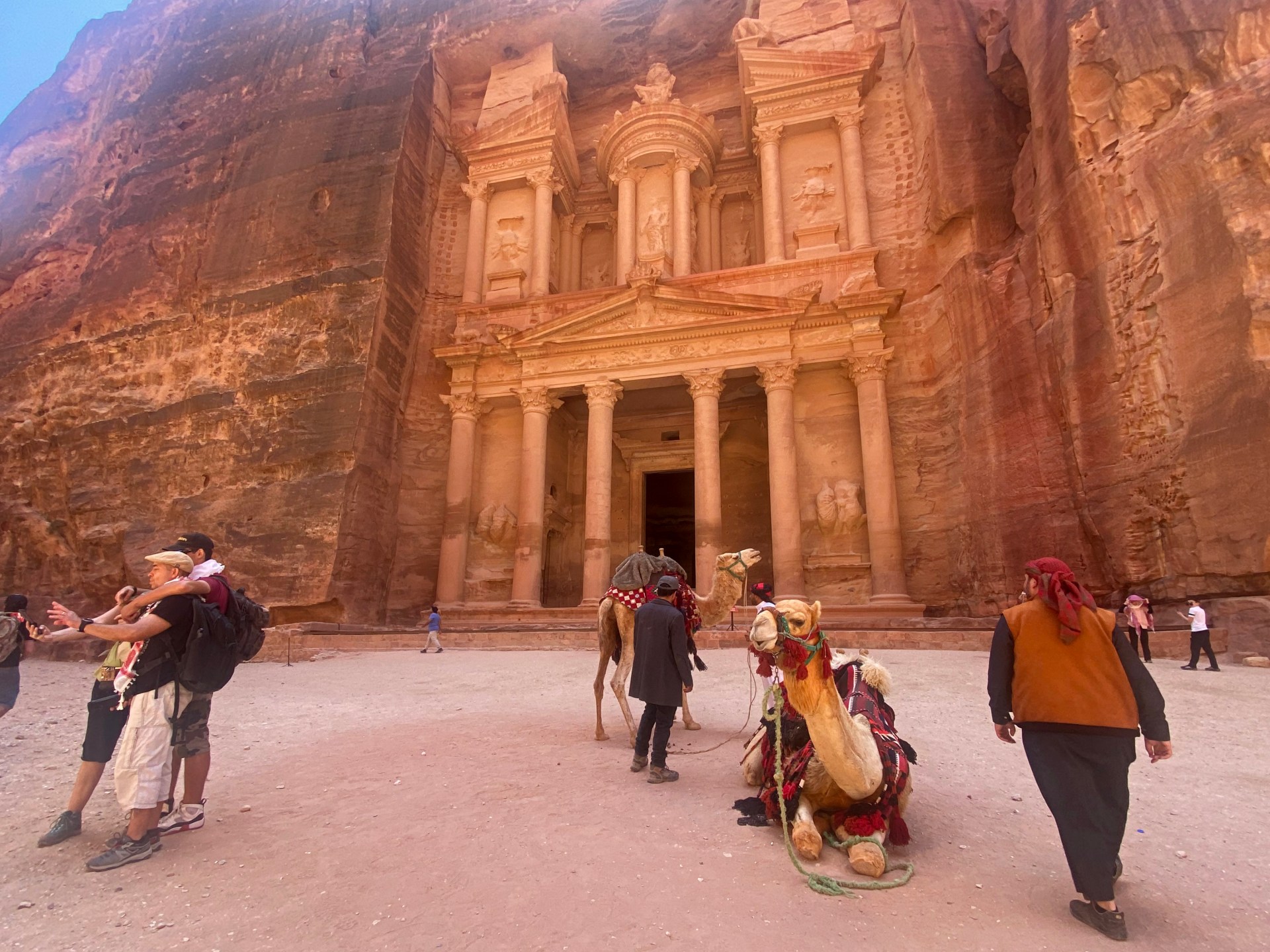

Ukrainian tourist Ruslana Novak and her friend had Jordan’s ancient city of Petra largely to themselves as they stood before its vast facade carved into pink sandstone.
Since the United States and Israel’s war on Iran began in late February, the famed Rose City has been largely deserted, its usual crowds of foreign tourists all but gone.
“Of course, we heard about the war … It is not a problem because I am from Ukraine, and we know about war,” Novak, an insurance agent, told the AFP news agency.
“This country is surrounded by countries that have war, but Jordan is … very calm,” she said, describing it as safe and beautiful.
At the site’s entrance, souvenir seller Khalid al-Saidat and his colleagues lingered in front of their stalls, cigarettes hanging from their lips. The donkeys and horses that usually transport tourists through the valley also stood idle.
The scene, he said, reflected “the collapse of tourism” in Jordan.
“The war in Gaza had led to an 80 to 90 percent drop in tourism”, while the Iran conflict had reduced the number of foreign visitors to “almost zero”.
“We open every day without knowing whether we’ll earn enough to live on,” he added.
Tourism accounts for 14 percent of Jordan’s gross domestic product, according to official figures, with 60,000 people directly employed in the sector and another 300,000 dependent on it. Last year, more than seven million visitors generated $7.8bn in revenue.
Beyond Petra, Jordan is home to other major attractions, including the lunar landscapes of Wadi Rum, the Dead Sea and the famed archaeological site of Jerash.
Advertisement
The year had started strongly, “with 112,000 foreign visitors in the first two months, which is very good”, said Adnan al-Sawair, chairman of the board of commissioners of the Petra tourism authority.
“But everything changed with the war,” he said. The impact was immediate, with visitor numbers to Petra in March and April dropping to between 28,000 and 30,000.
Cancellations have been so severe that some hotels are considering closing.
Authorities have launched a scheme to encourage domestic tourism, but its impact remains “negligible”, Sawair said, as the sector depends above all on foreign tour groups.
Since the start of the war, debris from drones and missiles has fallen on the kingdom, which does not host any foreign military bases but does have limited contingents from several countries under collective defence and cooperation agreements.
Jordan’s army said 281 Iranian missiles and drones had been fired at the country from the war’s onset until the beginning of the April ceasefire, most of them intercepted.
Before the war, booking calendars at travel agencies were almost full, according to the national association. They then emptied abruptly, causing a crisis for 1,400 licensed guides.
Faced with the lack of customers, souvenir seller Ibrahim al-Atmeh packed up his wares earlier than usual.
“We were hoping for an excellent spring season, but … our hopes are gone,” the 31-year-old said.
Related News
Greek Orthodox Church sounds alarm over attacks on Christians in Jerusalem
What are OPEC and OPEC +, and why has the UAE quit?

Austrian police arrest man after discovery of rat poison in baby food