

The United States and Iran have traded attacks for a second day, straining their fragile ceasefire further after US President Donald Trump said the truce was “over”.
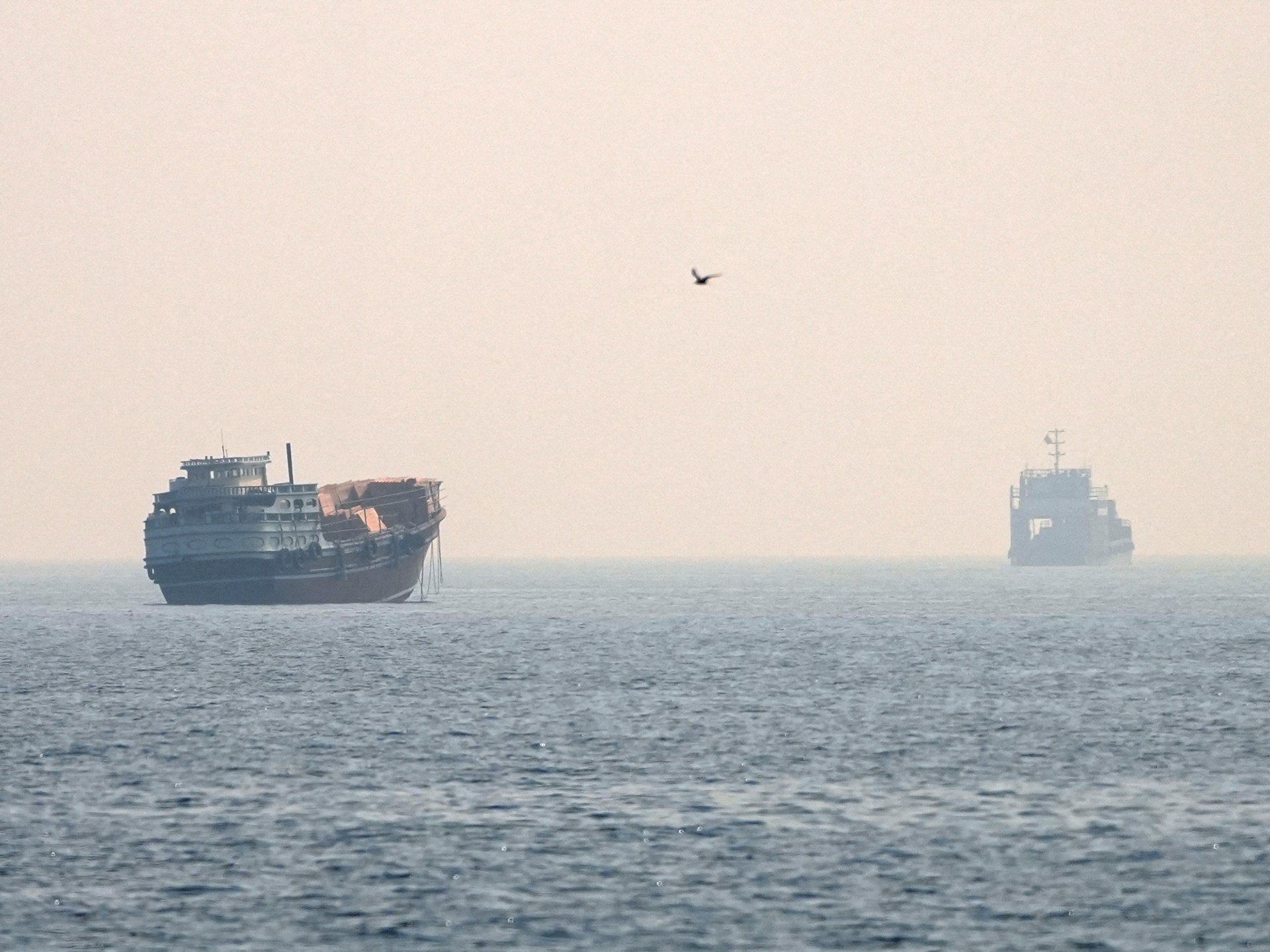
The US military said late on Wednesday that the attacks were aimed at Iran’s “ability to threaten the freedom of navigation in the Strait of Hormuz”.
- list 1 of 3Trump says ceasefire ‘over’, re-ups threats after US and Iran trade attacks
- list 2 of 3Iran signals defiance as Trump fumes over Strait of Hormuz strikes
- list 3 of 3Trump’s Iran strike comments shake markets, Brent crude hits two-week high
end of list
The US struck approximately 90 military targets, including missile and drone storage as well as logistics sites along Iran’s coastline, said the Central Command (CENTCOM), which oversees US military operations in the Middle East.
In a post on his Truth Social platform, Trump called the US attacks “retribution for yesterday’s bombing of ships by Iran. If it happens again, it will get much worse!”
The latest attacks come a day after the US said it hit more than 80 targets in Iran in response to Iranian attacks on commercial vessels in the Strait of Hormuz.
Iran’s Islamic Revolutionary Guard Corps (IRGC) said on Thursday it carried out attacks on “key infrastructure and facilities” at bases used by the US military in Arifjan and Ali Al Salem in Kuwait, and Juffair and Sheikh Isa in Bahrain in response to the latest US bombardment.
The Iranian army later said its forces targeted a Patriot missile system in Kuwait, a satellite antenna in Qatar and US military fuel depots in Bahrain.
Kuwait’s Ministry of Defence said it was intercepting missiles and drones, while Qatar issued an “elevated security threat” alert.
The renewed fighting threatens to undermine a memorandum of understanding (MoU) the two sides agreed last month to extend an April ceasefire and gradually reopen the Strait of Hormuz to shipping.
Advertisement
The attacks come a day after Trump said the ceasefire with Iran was “over” and criticised the Iranian leadership. However, he left the door open to more talks and suggested that any strikes would end quickly.
Speaking to reporters on board Air Force One as he travelled back to the US after attending the NATO summit in Turkiye, Trump said the Iranian side had “called a little while ago” and that they wanted “to make a deal so badly”.
US attacks across Iran
US strikes hit a railway bridge in Iran’s northeast, according to several official media, and the news agency IRNA reported strikes on a military base in coastal Bushehr, which hosts the nation’s only civilian nuclear power plant.
The Iranian railway (IRIR) said the train service on the Tehran-Mashhad line had been temporarily suspended as a result.
It said technical teams were on site to repair the damaged section so that the rail service could resume as soon as possible, adding that buses had been arranged to transport affected passengers.
Warplanes hovered over Iran’s Kish Island, and explosions rocked the port cities of Bandar Abbas, Konarak and Chabahar, part of which lost electricity, IRNA reported.
At least three people were killed in an attack on the outskirts of Ahvaz, capital of the southwestern province of Khuzestan, IRNA reported, citing the deputy governor of the region.
At least one firefighter was killed in an attack on an airport facility in Iranshahr, IRNA reported.
Iran’s Health Ministry said at least 14 people were killed and 78 others injured over the past two days.
Calls for diplomacy
In mid-June, the US and Iran signed an MoU to extend their ceasefire. It also led to the lifting of the US naval blockade of Iran and the gradual reopening of the Strait of Hormuz.
The MoU came following mediation by Pakistan and Qatar, which served as a launch point for 60 days of talks on more intractable issues, including the future of Iran’s nuclear programme, the administration of the Strait of Hormuz and access to billions of dollars in frozen Iranian funds.
Since US-Israeli strikes triggered war in February, Tehran has effectively blocked the strait, threatening to hit vessels that deviate from its authorised route.
Reporting from Tehran, Al Jazeera’s Resul Serdar Atas said the US and Iran are “stuck in an equation – almost a deadlock” over the Strait of Hormuz.
“For the Americans, they say that Iran will not have control over the Strait of Hormuz. For the Iranians, control of the strait is indispensable.”
Advertisement
He said Iran sees control over the strait as the “ultimate deterrent, and if it gives that up, then it loses its negotiating position” with the US.
The US hopes that by targeting infrastructure that affects Iran’s ability to control the strait, including maritime traffic control centres, it will be forced to “return to the MoU”, Scott Uehlinger, a former senior CIA officer, told Al Jazeera.
United Nations chief Antonio Guterres called “on all parties to exercise maximum restraint”, as did Pakistan.
Qatari Prime Minister Sheikh Mohammed bin Abdulrahman bin Jassim Al Thani told Iranian Foreign Minister Abbas Araghchi in a phone call on Thursday that Iran and the US should commit to diplomacy.
Sheikh Mohammed, who is also the foreign minister, said Washington and Tehran should implement the MoU to end the war.
Iran said the two officials had spoken over the phone and “underscored the importance of using diplomatic means to resolve regional issues”.
Related News

Who will win the 2026 FIFA World Cup? Here’s what AI predicts
Reform UK’s Farage failed to disclose funds from convicted criminal: Report
Will UNESCO’s heritage listing halt Israeli plans for West Bank’s Sebastia?