

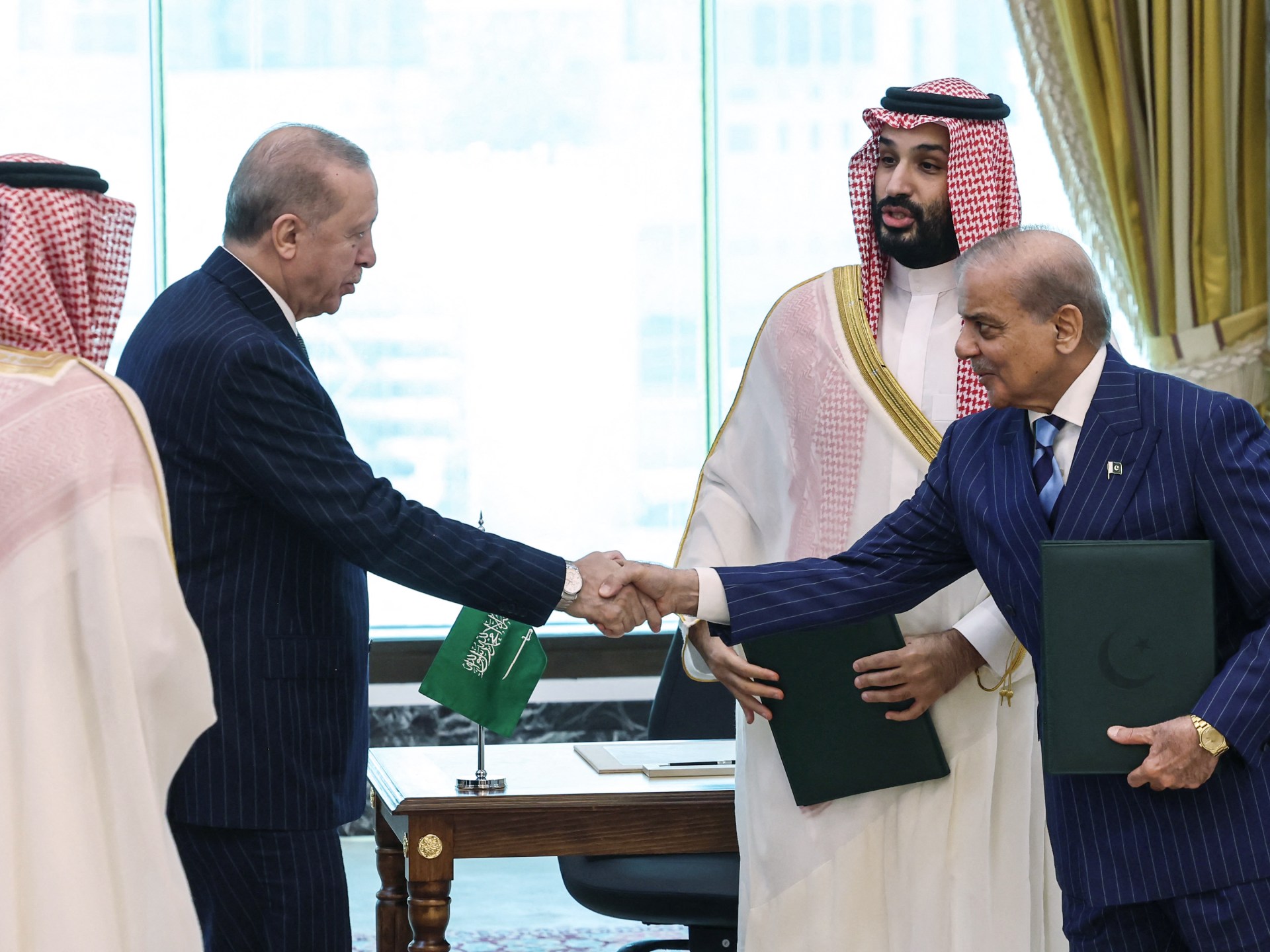

Turkiye, Saudi Arabia and Pakistan will group senior ministers, hold joint exercises and deepen defence industry cooperation under a military pact signed between the regional powers last week, Turkiye’s defence ministry says.
The three countries on August 7 signed the Mecca Joint Defence Agreement on August 7, which stipulates that an armed attack against any member would be regarded as an attack on all, similar to NATO’s Article 5 collective defence clause.
- list 1 of 4What are Saudi Arabia, Turkiye and Pakistan’s joint military capabilities?
- list 2 of 4Where does Iran stand on Saudi-Pakistan-Turkiye pact?
- list 3 of 4Which other countries could join the Turkiye-Saudi-Pakistan defence pact?
- list 4 of 4The Mecca pact is not just another regional alliance
end of list
At a weekly briefing in Ankara on Thursday, the Turkish defence ministry said the pact’s fundamental goal was to ensure defence and military ties were put on a “more institutional and sustainable” footing.
“Under the accord, strategic political and military mechanisms plan to be established involving the Defence Ministers, Foreign Ministers, and Chiefs of General Staff/Armed Forces Commanders, and that coordination among the three countries will be conducted at the highest level,” it said.
The ministry added that joint military exercises involving land, naval and air forces, as well as air defence and unmanned systems were planned, in addition to deeper defence industry cooperation.
“The aim is to provide not only product and system supply, but also joint development and production, technology cooperation, and sustainable maintenance and logistics support,” it said, adding that unmanned and autonomous systems, electronic warfare and artificial intelligence capabilities would be prioritised.
Turkiye, which has NATO’s second-largest army, has said the pact with nuclear-armed Pakistan and top oil exporter Saudi Arabia was open to expansion — with Egypt as a potential candidate — and did not seek to replace any existing alliances.
Advertisement
The ministry also said Turkiye was participating in meetings in Jeddah aimed at establishing an international coalition to protect Red Sea shipping.
On developments in the Middle East, ministry spokesperson Rear Admiral Zeki Akturk said lasting peace and stability in the region would be possible if Israel ends its occupation and attacks in Gaza and Lebanon.
He said Israel continues attacks that have deepened the humanitarian crisis in Gaza, as also reflected in United Nations reports.
“Israel’s rejection of the 15-point Gaza Plan has been another indication that it is pursuing a policy of regional expansionism. On the other hand, despite the framework agreement that was signed, Israel similarly continues its attacks and military activities in southern Lebanon,” Akturk said, referring to the plan proposed by the United States.
“We once again emphasise that it is essential for the international community to take a more determined and stronger stance against Israel’s actions by upholding international law and humanitarian values in order to establish peace and stability in the region,” he said.
Related News

‘Not welcome’: How Sweden’s far right took over Stockholm Central Station

Israel accused of using kites as pretext to justify escalating Gaza attacks
Where water conflicts pose the biggest threat in 2026