Díaz-Canel Visits New Headquarters of ISDi and the Science and Technology Interface Society of CUJAE

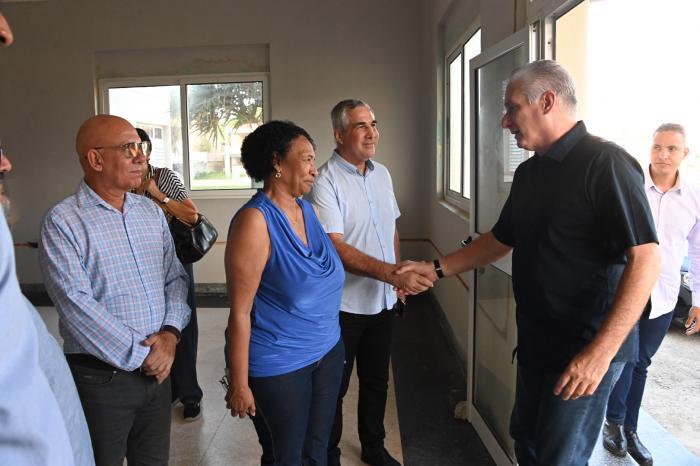
"Now you add your soul and your design." With these words, and predicting that the center of higher learning will be beautiful and functional, the First Secretary of the Central Committee of the Communist Party of Cuba and President of the Republic, Miguel Díaz-Canel Bermúdez, described what will soon be the headquarters of the Higher Institute of Design (ISDI) of the University of Havana.
The Head of State shared this statement Thursday morning with Dr. Sergio Luis Peña Martínez, dean of the Institute, as he entered the building where, as the professor explained, they have undertaken "an enormous amount of work" recently to ensure that Cuba's future designers have their own school.
Another idea expressed by the dignitary while touring the Art Deco building located in the Havana municipality of Playa, very close to the sea, was that it would be beneficial to attract recent ISDI graduates to contribute to the development and refinement of what will be, from the start of this new academic year, the space from which new generations of designers will emerge.
"I am very happy," said Díaz-Canel Bermúdez at the end of a visit in which he was accompanied by, among other leaders, Deputy Prime Minister Eduardo Martínez Díaz and the Rector of the University of Havana, Miriam Nicado García.
In the warm embrace given by the Cuban President to Dean Sergio Luis Peña, as a farewell, one could sense the optimism born from everything seen there: light, architectural strength, open spaces, areas for multiple uses, and where design enthusiasts will realize many ideas.
Once the dignitary's visit concluded, the Dean of ISDI spoke with the press team of the Presidency of the Republic of Cuba. To the reporters, Sergio Luis Peña Martínez said: "The University of Design is going to have a new home, a completely rejuvenated and renovated space. In this difficult period, the resources, the efforts, and the will have emerged so that the School of Design can finally have its own space." The professor shared his opinion that it is a space that "gains in coherence, quality, and design"; and emphasized that it is "a project that we are truly pushing forward with great care and intention." He also shared a thought-provoking truth: "You can't learn to make beautiful and useful things in a space that isn't beautiful, that doesn't have, as its philosophy or focus, the concept of being a well-conceived space. "The dean made explicit the motivation behind the hard work in preparing the building: “What we are trying to do here is to ensure that design students, and all of Cuba, have a School of Design as they deserve, as design deserves."
It is a project that, as the dean explained, has been carried out by several groups of contractors and primarily managed by a company of the Ministry of Construction, which has ensured the involvement of different work crews.
Although the construction, and especially the finishing touches, have not yet been completed, the dean told reporters: "We expect to have some level of in-person classes here by the start of the semester." He said this because some classrooms could open in September, and because the facilities would be progressively expanded, adding "the laboratories, the theaters, and the other areas that complement the functions of the space."
Sergio Luis Peña Martínez is convinced that "what gives life to a university are the students." That's why he also spoke of bringing these young people on board, so that they can "participate in the restoration, in the construction, and in making this what it should be as a School of Design." He also stated that the professors of this institution, which will accommodate some 500 students across its four-year program, have a significant task ahead of them.
THE CHALLENGE OF REINVENTING ONESELF AND BEING COMPETITIVE

"Now you have to take advantage of all the powers granted to businesses," President Díaz-Canel urged the directors and key figures of CETA S.A. (Science and Technology Interface Society of the Technological University of Havana “José Antonio Echeverría”), the second stop on his tour of Havana’s Playa municipality this Thursday morning.
This organization has many strengths, and its president, Danae Pigueiras Otero, explained various details to the Head of State, who—accompanied by Deputy Prime Minister Eduardo Martínez Díaz and other officials—exchanged ideas about the company, whose purpose is to serve as a link between the productive and service sectors and the world of knowledge.
In a conversation with journalists, Danae emphasized that this connection aims to “transfer the results of science and innovation generated in the country’s universities to the productive and service sectors.” and seeks "to contribute to the economic and social development of the country, and, in the same way, to transfer to the University all the needs that this productive sector has today."
CETA S.A. It was founded on August 5th, 2020. "I believe that at this moment," its President stated, "the company has achieved significant consolidation and has made significant progress in both engineering and architecture, as well as in internationalization and exports."
"And today we find ourselves immersed in this process related to all the economic transformations taking place (throughout Cuba), in which we must also participate, not only as objects of these transformations, because we are a company, but also because of the contribution that universities and this type of company can make to the rest of the productive sector in implementing these transformations, so that they can be effective, so that they can truly benefit a company."
Among CETA S.A.'s work priorities, Danae Pigueiras Otero, in her exchange with reporters, referred to export activity: "That is, this is something we consider one of the fundamental elements of our company. I believe it is one of the things the country needs most, and we are working on it very intentionally."
During the Head of State's visit, Danae spoke about partnerships. Later, speaking with journalists, she returned to that premise: "Almost all provinces and universities already have their interface societies. Therefore, that is our primary network of partnerships. We have the Chamber of Commerce of the Republic of Cuba, which, of course, plays a fundamental role for businesses. And we have the universities. The universities are our reason for being."
At another point in the dialogue with the press, the executive emphasized another definition: "We have our own capabilities, and we have developed them through management." In her view, the main values lie in "managing efficiently" and in "integrating science into solving the problems that businesses face."
Referring to the horizon of opportunities presented by the economic and social transformations that Cuba has undertaken, the director shared her perception that, among other advantages, it is important to distinguish, within these changes, the opportunity to "bring these transformations to the productive and service sector, and for the productive and service sector to see us as an ally in the application of these transformations."


Related News
Eternal prominence for Cuban women
State Council approves four new decree-laws and evaluates how to contribute to economic an...
At the heart of our Resistance: Women