
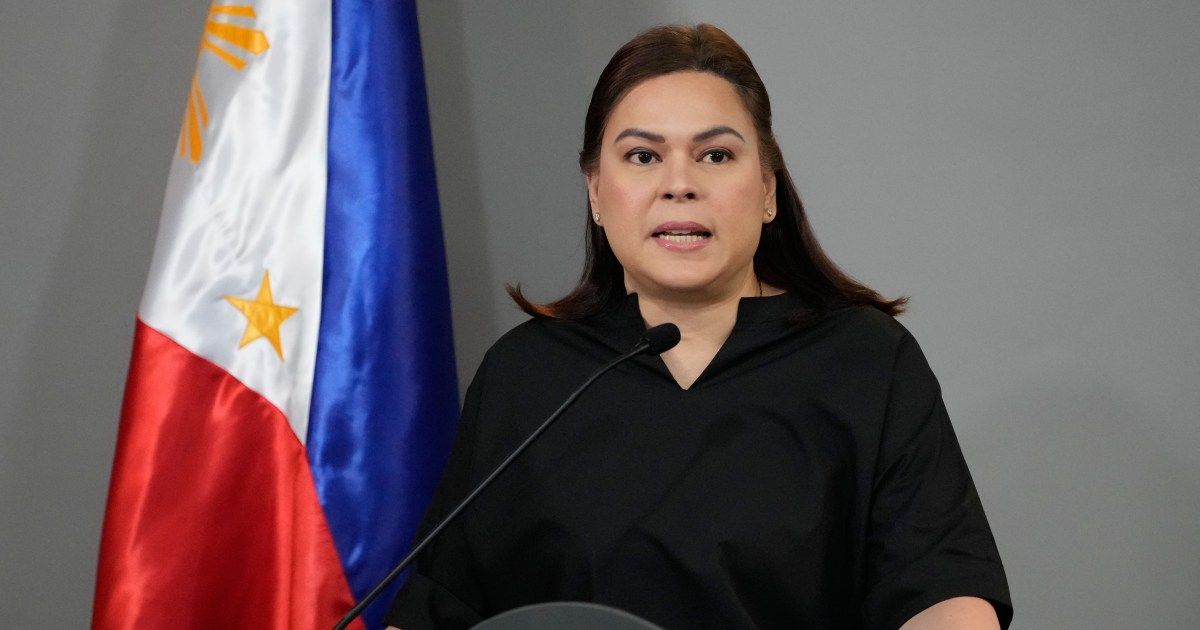

Philippine Vice President Sara Duterte’s impeachment trial on charges of mishandling government funds and making threats against President Ferdinand Marcos Jr has begun after months of heightened political tensions in the country.
In a dramatic turn, Duterte ally Senator Rodante Marcoleta was arrested on a plunder charge shortly before the start of the trial on Monday, throwing support for Duterte in the Senate into doubt.
- list 1 of 3Philippines launches VP Duterte impeachment trial amid political division
- list 2 of 3Security guards face probe after last week’s Philippine Senate shooting
- list 3 of 3ICC prosecutor suspended pending vote on sexual misconduct claims
end of list
Duterte is the first vice president to undergo an impeachment trial. The outcome could determine whether she will be barred from running for president in the next election – and the future political landscape of the Philippines as Marcos looks towards the end of his final term in office.
So why has Duterte been impeached, and why is her trial significant?
Here’s what we know:
Who is Sara Duterte?
Duterte is the daughter of former President Rodrigo Duterte, who is on trial before the International Criminal Court in The Hague on charges of crimes against humanity during his time as president and mayor of Davao City on the southern Philippine island of Mindanao.
In 2022, she agreed to run as vice president alongside Marcos, son of the man who ruled the Philippines for 20 years before his toppling in 1986 during mass protests called the People Power Revolution.
The Marcos and Duterte families are the most powerful clans in the country.
Ultimately, Marcos won the presidency and Sara Duterte became his vice president.
In February, she announced she would run for president in 2028, but if she is convicted in her impeachment trial, she could be prevented from standing for the next election.
Advertisement
Why has she been impeached?
In May, the House of Representatives voted overwhelmingly to impeach Sara Duterte.
The charges against her include two violations of the constitution and betrayal of public trust for misuse of confidential government funds, failure to disclose her wealth, bribery and making death threats against Marcos; his wife, Liza Araneta; and former House Speaker Martin Romualdez. One of the most damning allegations in the complaint against the vice president relates to private bank transactions flagged by the anti-money-laundering agency of more than $110m.
According to the Philippine news outlet Rappler, her trial began at 2pm (06:00 GMT) on Monday and is expected to go on for several months.
Duterte has denied any wrongdoing and has insisted her impeachment is politically motivated.
If her impeachment trial finds her guilty of any or all of the charges, there is a range of possible outcomes. Duterte will be removed from office, but the Senate could also permanently disqualify her from holding any public office, and she could face a separate trial for criminal offences.
On Monday, her lawyer Michael Poa told reporters the defence was prepared to prove the allegations were “baseless”.
She also faced impeachment on similar grounds in February 2025, but at that time, she was able to stop the procedure by petitioning the Supreme Court to declare the move unconstitutional on technical grounds.
How did this all happen?
In May 2022, Sara Duterte and Marcos formed a political alliance and successfully won the presidential and vice presidential elections.
But cracks in their relationship began to appear when legislators in the Senate started investigating her use of government funds.
In June 2024, she resigned from her post as education secretary in the cabinet but remained Marcos’s deputy.
In October that year, Duterte told reporters that her relationship with Marcos had become so “toxic” that she sometimes imagines beheading him. She also confessed that she felt “used” after teaming up with Marcos.
She threatened to dig up the remains of Marcos’s father, the late dictator Ferdinand Marcos Sr, from the national cemetery and dump them in the sea.
The Duterte family also made drug use allegations against Marcos in 2024.
The pair also disagreed over policies relating to the South China Sea with Marcos ordering the navy to stand up to China in the disputed sea in sharp contrast to Rodrigo Duterte’s pro-China policies. Sara Duterte resigned from the cabinet in June 2024.
Advertisement
In November 2024, she made a direct threat to have Marcos assassinated if she were killed.
“This country is going to hell because we are led by a person who doesn’t know how to be a president and who is a liar,” she said in a profanity-laced broadcast on her Facebook page.
“Don’t worry about my safety. I have talked to a person, and I said, ‘If I get killed, go kill BBM [Marcos], Liza Araneta and Martin Romualdez.’ No joke. No joke,” she added.
After this threat, in early 2025, the first impeachment procedure began, and she has since been impeached twice – the first time in February 2025 and then again in May this year.
After hearings in Duterte’s trial are concluded, the Senate will decide if her impeachment case holds any value and will vote whether she is guilty or innocent. A two-thirds majority in the 24-member Senate is required for conviction.
How does the arrest of Senator Marcoleta impact the trial?
Besides the breakdown in her relationship with Marcos, a shift in the balance of the Senate could also impact Sara Duterte’s impeachment trial.
Shortly before her trial began, Duterte ally Marcoleta was arrested on a plunder charge.
The Reuters news agency reported that the Sandiganbayan, an anticorruption court, ordered the senator’s arrest after the Office of the Ombudsman accused him of accepting 75 million pesos ($1.2m) from private donors during his 2025 Senate run in violation of anticorruption laws. It also issued a hold departure order against the senator, preventing him from leaving the country.
He had been due to sit as a senator-judge at the impeachment trial against Duterte. She could now lose a key vote.
“The Senate arithmetic is crucial,” said Alejandro Reyes, adjunct professor at the Department of Politics and Public Administration at the University of Hong Kong. “Conviction requires 16 of 24 senators, so even a Marcos-leaning Senate leadership does not guarantee a guilty verdict.”
The Senate has been divided and unstable for some time, Reyes added, with the recent removal of Alan Peter Cayetano, a Duterte ally, and the election of Sherwin Gatchalian, a Marcos ally, as Senate president.
“That gives the Marcos side more control over the process, but not necessarily enough votes to convict. The arrest of Senator Rodante Marcoleta adds to the sense of escalation,” Reyes said.
He added that the arrest of Marcoleta on a plunder charge just as the trial opens is likely to reinforce the Duterte camp’s claim that its allies are being targeted. “At the same time, it allows the Marcos camp to frame the moment as part of a broader anti-corruption drive. Either way, the trial now sits inside a wider battle over corruption, Senate control and the 2028 succession,” Reyes said.
With the high-stakes impeachment case possibly banning the vice president from holding public office and derailing her ambition to win the presidency in 2028, there are fears of widespread protests, and more than 6,000 police officers and antiriot squads have been sent to guard the Senate.
Advertisement
Reyes told Al Jazeera that the impeachment trial has to be understood as part of the long jockeying for position before the 2028 presidential election.
“President Ferdinand Marcos Jr cannot run again. Sara Duterte, the vice president, who had been Marcos Jr’s running mate before they had a serious falling-out, has signalled her intention to seek the presidency and remains one of the most formidable potential candidates. So while the impeachment process may be constitutional in form, its political effect is clear: It could weaken or even remove the strongest rival before the campaign formally begins,” he said.
The Marcos family and the Marcos coalition expect to remain powerful, but Marcos has not yet shown who he intends to back for president in 2028.
“He has spoken about wanting a ‘like-minded’ successor, a nation builder who understands economics and can continue his administration’s reforms, but he has not publicly endorsed anyone and will want a successor he can trust not to seek retribution or to undermine political ambitions of Marcos clan members,” Reyes added.
He also explained that this political turmoil will impact the Philippines’ economic growth.
“The country is advancing economically, most recently with its move into upper-middle-income status. But its messy politics still carry old burdens: dynastic competition, patronage, corruption, personality-driven mobilisation and weak institutional trust,” he said.
“The Philippines is moving forward, but its governance problems continue to shadow its progress,” he added.
Related News
South African court pauses impeachment process against president
Yemen’s government says Houthi strikes hit residential areas in Marib
US regulators to weigh controversial peptides backed by RFK Jr