
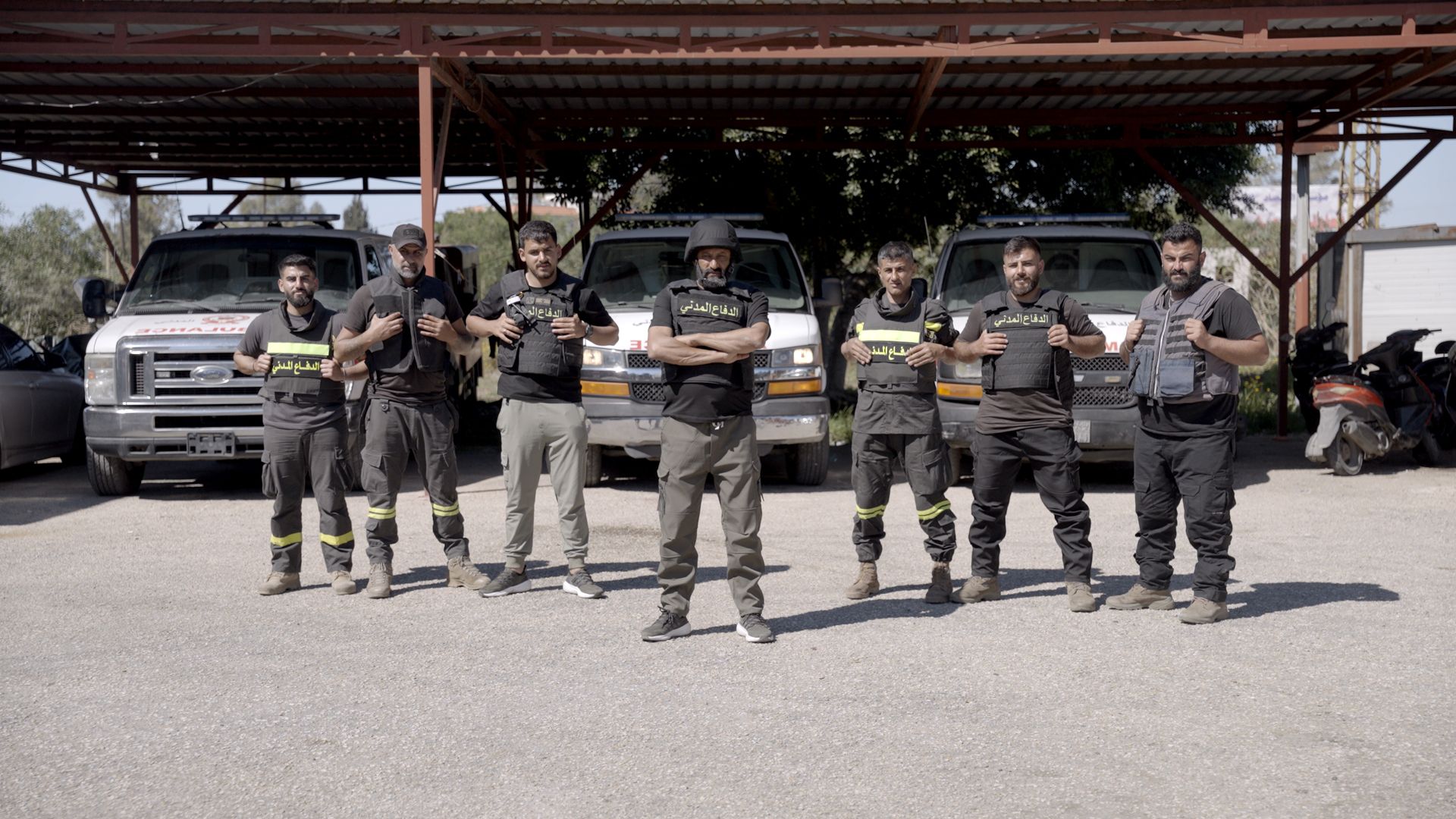

Ali Safiuddin is the head of the Civil Defence in Tyre, and in his life and career as a first responder, he has had to come to terms with life and loss.
Although southern Lebanon is officially covered by a ceasefire, along the “Yellow Line” – the area Israel has claimed as a security zone – there are still frequent bombings and shelling.
- list 1 of 4Lebanese soldiers injured while Israeli troops intrude on southern town
- list 2 of 4Future of southern Lebanon peacekeeping uncertain ahead of UNIFIL phase-out
- list 3 of 4Lebanon passes long-sought amnesty law, a day after death penalty repeal
- list 4 of 4Israeli strikes in south Lebanon a ‘violation of international law’: PM
end of list
“Things are relatively normal,” said Safiuddin on a late June morning in southern Lebanon. “After the ceasefire, the only strikes that have happened are in al-Mansouri and Majadal [two municipalities in Tyre District], along the ‘Yellow Line’.”
“Relatively normal” means that the Israeli military is not directly striking Tyre, the largest city in southern Lebanon. But the war continues on its outskirts, along and in the military zone imposed by Israel that stretches about 10km (6 miles) inside Lebanon’s borders.
Safiuddin is the head of the Civil Defence in Tyre and the subject of a new short film from Al Jazeera Originals, titled The Ones We Couldn’t Save.
Safiuddin’s career in the Civil Defence, rescuing civilians trapped under rubble caused by countless Israeli air strikes, has accustomed him to loss.
During the 2006 war between Israel and Hezbollah, he brought his wife and one-year-old daughter, Lynn, to stay in a shelter underneath the Civil Defence centre, thinking it would be safe. Israel struck the building, killing Lynn. The event continues to haunt him to this day, but also motivates him to continue his mission to save other lives.
“I feel that my daughter, my daughter’s soul, is with me,” he said.
Advertisement
In the film, he remembers the time he saved a girl following the 2020 Beirut explosion, when a stockpile of ammonium nitrate exploded at the city’s port, killing at least 218 people and wounding thousands.
“We pulled out a girl after 18 hours of manual work under three floors. At that time she was about 14 years old. If my daughter were alive, she would have been her age,” he said. “This girl remained alive, so I feel that I’m bringing back my daughter’s soul.”
Other parts of Safiuddin’s job relate to his family. His 18-year-old son, Husein, now serves alongside him in the Civil Defence. But he refers to all of the men under his authority as “sons”.
“Every one of them spent years with me. They lived beside me. I was not merely their station chief, I was their father.”
Safiuddin says he hopes the film will show the world the reality of Israel’s attacks on Lebanon.
“Especially with the assassination of my colleagues, it really showcases the brutality of the war and what Israel is perpetrating – the killing of children, the elderly,” he said.
The recent reduction of Israeli attacks north of the “Yellow Line” has given Safiuddin and his colleagues some respite. But on April 28, an Israeli double-tap strike in the village of Majdal Zoun killed Hussein Ghadbouni, Hussein Sati and Hadi Daher, three of the men from his team.
Israel has repeatedly targeted Lebanon’s first responders and healthcare workers – killing at least 135 of them since the beginning of March, according to the UN. The strikes often occur as first responders arrive at the site of an air strike to search for survivors.
Knowing that they are potential targets has forced the first responders to change the way they operate.
“One ambulance enters the site of the raid, and a second ambulance waits outside, in case something happens to the team,” Safiuddin said.
Daher, one of the three men killed, had been volunteering with Ali’s team since he was 15.
“The loss of this colleague – they are like family, it really affected me,” Safiuddin added. “We have a pact – if anyone dies before the other, we will keep them alive through our mission.”
In Israel’s 2006 war on Lebanon, the Civil Defence headquarters where he works was also targeted. So he is again using the current relative respite to prepare for the next Israeli assault.
“After the war, I’m spending most of my time trying to rehabilitate the Civil Defence centre and to spend time with my colleagues,” Safiuddin said.
“But, whatever the circumstances, we’re ready with what tools we have – we are ready to do anything. I hope that things will not escalate, but whenever duty calls, we will fulfill it.
Advertisement
“I no longer have any fear. I have no fear. I fear for those with me. But I have no fear of war. If I give up on this work, it’s like I’m giving up on my daughter.”
Click here to watch the full film: The Ones We Couldn’t Save
Related News
Why is Pezeshkian urging an end to Iran’s ‘no war, no peace’ status?
Photos: Hope fades in Colombia as teams dig for earthquake survivors
First group of US deportees, out of an expected 1,200, arrive in Liberia