
‘He had a lot of profiles’: The rise of online drug-facilitated rape gangs
 03 August 2026

Warning: This story includes descriptions of sexual assault that some readers will find disturbing.
Zoe Watts’s 16-year marriage to a man she met when she was 17 was abusive. But she had no idea of the depths of his mistreatment until one Sunday.
“He sat me down one evening and told me what he was doing. I think he always had a thing for risky behaviour, and this was part of this cat-and-mouse game he was playing with me,” Watts told Al Jazeera from Devon, England. “It was quite tumultuous, but I didn’t know what he was doing to me.”
Her husband admitted he was crushing sleeping pills into her tea and then taking advantage of her sedated state to take photos and videos. It was only later that she realised she had been raped. In 2022, her now-ex-husband was sentenced to 11 years’ imprisonment.
“He had a lot of online profiles, and that’s where my images [went],” she said.
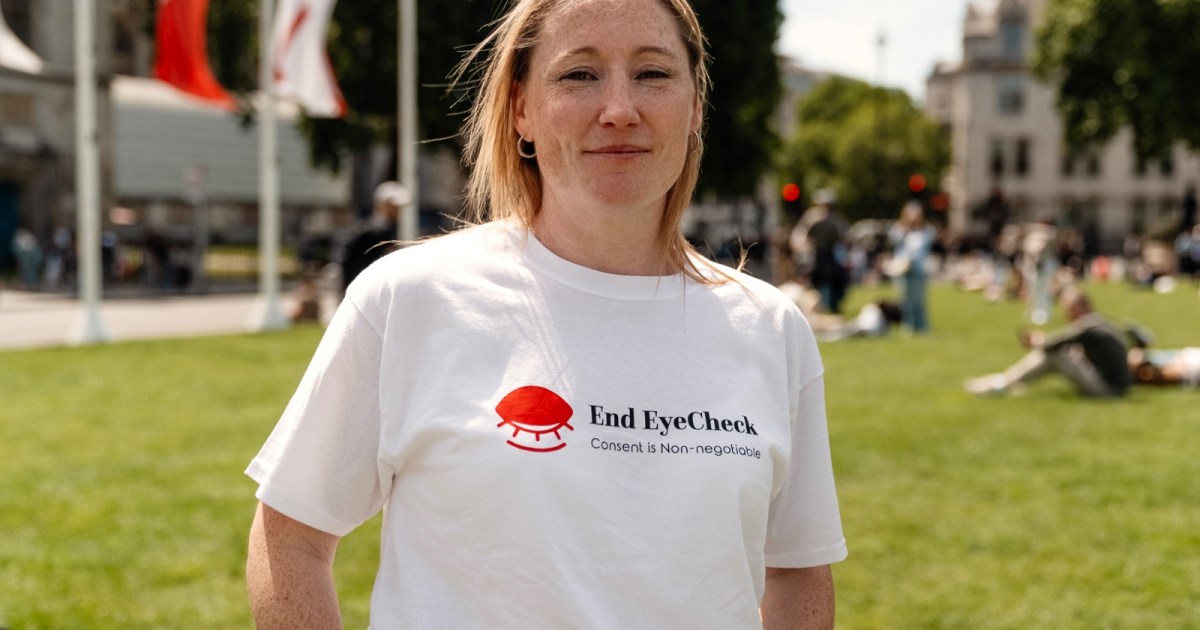
In May, Watts and another survivor, Amanda Stanhope, launched a campaign, #EndEyeCheck, against drug-facilitated sexual assault and its online dissemination.
A subgenre of pornography, in which one of the parties appears to be asleep or otherwise unconscious – possibly knocked out through drugs – caters to an atypical sexual interest known as somnophilia. While some of this is staged using professional or willing performers, some is not, and such videos include so-called “eye checks”: lifting the eyelid of the victim to confirm they are unconscious.
“This type of cybercrime often falls under domestic or intimate-partner violence, which can obscure the other networks and actors that facilitate this kind of violence. Or chalking it up to an individual problem, a few bad apples rather than a series of systemic failures,” Emma Quilty, a research fellow in the ARC Centre of Excellence for the Elimination of Violence Against Women at Monash University in Melbourne, Australia, told Al Jazeera.
Advertisement
“This is similar in some ways to other organised crimes which require platforms upon which to operate and profit, communication and rule enforcement, [as well as] entrenched belief systems [such as] misogyny.”
A group of men was jailed in Germany for drugging and raping women, then sharing the footage in a Telegram group chat codenamed “Driving School”. The crimes mainly took place within the Chinese diaspora; Chinese men in Germany carried out the crimes, and Chinese women in Europe were most of the victims, although the phenomenon is by no means confined to any nationality or demographic.
Britain’s National Crime Agency (NCA) has recently identified 270 members of an international network organising drug-facilitated sexual assault, while Europol’s Project Medusa, which aims to combat drug-facilitated sexual assault, has identified 156 perpetrators and victims from another network.
The phenomenon first received global attention in 2024 with the case of Gisele Pelicot in France. Over nearly a decade, Pelicot’s husband encouraged 72 other men to rape her while she was sedated, recruiting participants online.
In March, an investigation by CNN exposed a so-called “rape academy” operating on a Telegram group named Zzz, and Motherless, a site boasting “where anything legal is hosted forever!” Members of this network discussed tactics, experiences and arranged assaults, in some instances inviting others to take part or paying for a livestream of the rape.
A few members offered supplies of sleep-inducing drugs, for example zolpidem, commonly known by brand names such as Ambien.
Footage of the assaults was shared via group chats and uploaded to sites like Motherless, CNN reported. Meanwhile, in the German “driving school” case, victims were blackmailed into further assaults under threat of having the footage shared.
However, the messaging app and social media platform Telegram stands out as a tool for these networks, according to Quilty, owing to end-to-end encryption which enables anonymity. It has weak content moderation and allows users to pay for goods and services through an internal cryptocurrency system.
The number of people viewing or taking part in violent, illegal or abusive acts is unknown.
However, there are signs these online networks may involve tens of thousands of participants across the globe.
Telegram groups with up to 70,000 members have been identified, while criminal cases have been reported as far afield as Australia, Canada, Ireland, the United Kingdom, Germany, Italy, Spain, China and Poland.
Advertisement
Watts said since starting her campaign, she has been contacted by women from 22 nations.
“It’s an inordinate amount of survivors,” she said. “They’ve all experienced trauma. A lot of them, when it does come out, experience a similar social bias where it’s [seen as] their fault that their partner, the perpetrator, has assaulted them. Which is such a sad story because realistically, if you’re sedated you can’t consent, so I don’t know how it can be blamed on the woman.”
The true number of assaults is likely far greater, as many victims might not report and others do not even know it was happening.
Who does this and why?
Research is scarce, but Quilty pointed to an Australian study of image-based sexual abuse (IBSA) which found that 54 percent of victims reported that their victimisers were male, with most described as a partner or former partner, a family member or a friend.
Quilty added that the networks are predominantly run by men. The glorification of abuse creates a sort of camaraderie, while objectifying and dehumanising women.
Speaking to The Guardian, Dr Juliane Kloess, a senior lecturer in forensic clinical psychology at the University of Glasgow, said the real or perceived anonymity of the internet allows perpetrators to detach themselves from the harmful consequences of their actions.
What is the impact on survivors?
After the matter comes to light, survivors may endure trauma, shame, depression and, since the perpetrator is often close to them, a deep sense of betrayal, necessitating therapy.
The impacts “are well documented” and can include mental health struggles such as anxiety, depression and PTSD, suicidal ideation, social isolation, loss of friends and, in some cases, jobs, and being forced to move to escape the abuser, said Quilty.
Watts, who has four children with her abuser, said her life has been upended.
“We were going to grow old together, raise our children together,” she said. “You don’t expect the person you marry to be the perpetrator. You didn’t choose your family to be ripped apart. The choice is taken away from you. There’s healing to be done, and grieving as well, grieving for what should have been.”
What can be done to end this trend?
In the Pelicot case and others, defendants have argued that they believed they were taking part in consensual sex games, prompting a review of French rape laws and conversations about stressing the importance of consent.
“We need to start taking separate statistics for drug-facilitated rape … so in five years’ time, every country can go to their government and say this crime has had a 3 percent increase [for example]. Currently it’s just registered as another rape rather than an intimate partner drug-facilitated rape.”
Quilty said a new legal approach has been targeting the founders and owners of websites with charges “as an incentive for reducing the ability” for platforms to be used with impunity.
In the Pelicot case, the webmaster of the page used to recruit rapists was charged.
“For survivors, the first thing that we can do is believe them. In my experience, he was innocent until proven guilty, but I was guilty of accusing him until proven innocent, and that was even with his confession,” Watts concluded. “We need to have a bigger education on this type of crime so that women know to look for it within their relationships. I didn’t even think this was possible, that I could be at risk.”
Advertisement
Related News

Photos: Wildfires in France drive 250,000 people from their homes

‘Debilitating’: Hunter Biden speaks out about father Joe Biden’s cancer

Iran war: Top US lawmaker says Republicans can ‘absolutely’ win midterms