
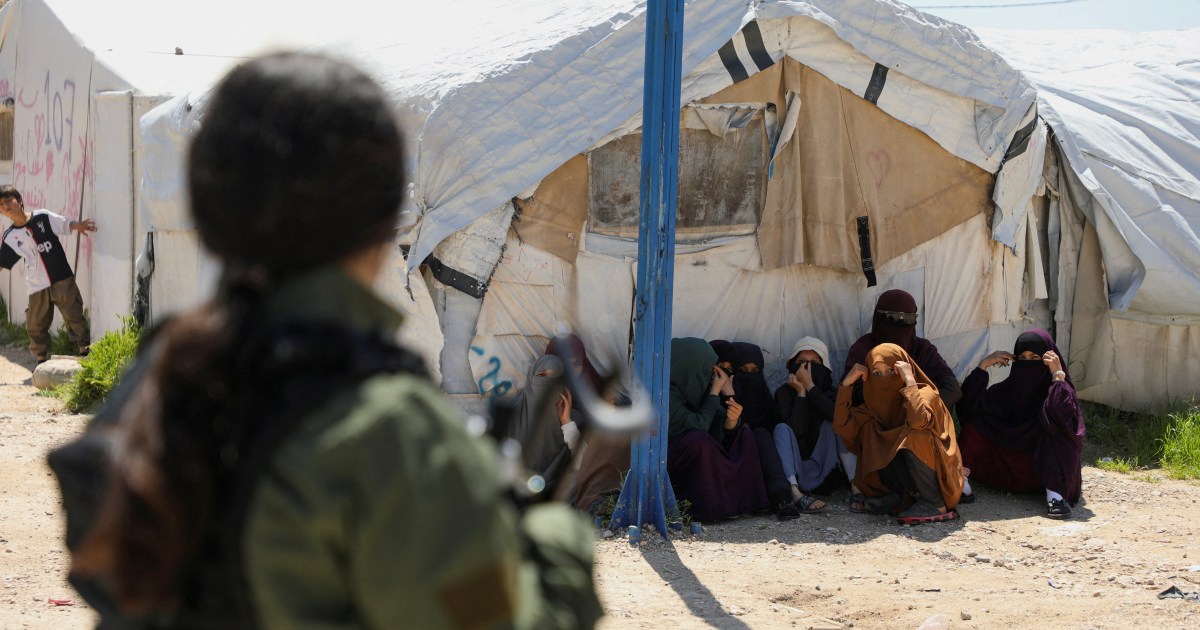

A group of 19 women and children with alleged links to ISIL (ISIS) has returned to Australia, with the government warning that anyone found to have engaged in criminal activity will be prosecuted.
The six women and 13 children arrived from a Syrian refugee camp on Tuesday, with one group landing in Sydney and the other in Melbourne.
- list 1 of 3Austrian pleads guilty to ISIL-planned attack on Taylor Swift concert
- list 2 of 3ISIL-linked Australian women arrested at airports
- list 3 of 3Turkish and Syrian officials detain 10 individuals with alleged ISIL ties
end of list
It is the second cohort of Australian women and children to return from Syria this month. Responding to criticism over their arrival, the Australian government said it had not assisted them in any capacity.
“These are people who have made the horrific choice to join a dangerous terrorist organisation and to place their children in an unspeakable situation,” Minister for Home Affairs Tony Burke said.
Australian women began travelling to Syria to marry members of ISIL in 2012, with some allegedly taken against their will.
At the height of its power in 2015, ISIL controlled territory across Syria and Iraq roughly equivalent in size to the United Kingdom.
Australian Federal Police did not arrest any members of the group upon their arrival but said that investigations were ongoing.
The group’s return has sparked anger in some sections of Australian society.
According to local media, a large police presence was deployed at Melbourne airport, where a scuffle reportedly broke out as the group of women and children was escorted out through a side entrance.
Australia is one of several Western countries that have shown reluctance to repatriate citizens who travelled to the Middle East to join ISIL about a decade ago.
Advertisement
Both France and the UK have expressed opposition to allowing former ISIL members to return.
In 2022, the UN Committee on the Rights of the Child said that France’s failure to repatriate children born to French nationals in Syria violated their right to life and exposed them to inhumane treatment.
Meanwhile, the UK stripped British national Shamima Begum of her citizenship in 2019 on national security grounds.
In February, the Australian government issued a temporary exclusion order against a woman in Syria, preventing her from returning home.
Her child, who was not barred from returning, chose to stay with her.
The order prevents the woman from returning to Australia until February 2028, and her family is currently challenging the decision.
Afzal Ashraf, a visiting fellow at Loughborough University specialising in international relations and security, said the risk posed by people returning from countries including Syria needs to be viewed proportionately.
“There will be some security challenges, because people like this are likely to suffer from issues such as PTSD,” Ashraf told Al Jazeera.
“The fact of the matter is that there are security challenges in Australia and other countries, but statistically speaking, the return of these nationals doesn’t increase that risk very much, while the threat to life from terrorism is far lower than the threat posed by road accidents, for example.”
“That said, these threats can be reduced by providing comprehensive mental health support for returnees and ensuring they are reintegrated into society in a positive way, with follow-up programmes to address any dangerous ideas they may have adopted,” Ashraf said.
“It’s worth remembering that ISIL has killed far more Muslims than Westerners.”
Earlier this month, four women and 13 children arrived in Australia from Syria. Three of the women were arrested upon arrival.
Related News
Iran reviews US proposal to end war as Pakistan steps up mediation efforts
US pausing $14bn arms sale to Taiwan due to Iran war, navy chief says
Mexican officials announce 10 dead in early-morning shooting in Tehuitzingo