


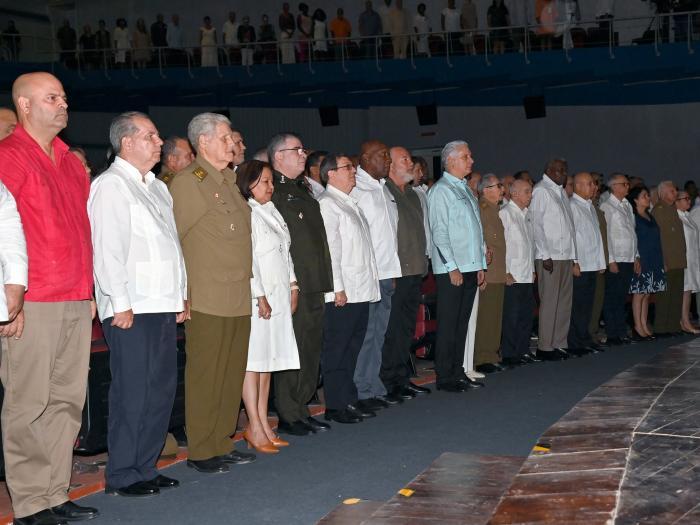
On August 13th, 2026, a century later, History once again opened its gates to celebrate the centennial of Fidel Castro, and present at this national celebration was the most devoted Fidel Castro of all, Army General Raúl Castro Ruz, leader of the Cuban Revolution.
Alongside Raúl, who celebrated the date with the unparalleled affection of a blood brother and the boundless pride of a comrade in arms, the First Secretary of the Central Committee of the Communist Party and President of the Republic, Miguel Díaz-Canel Bermúdez, also presided over the event.
The Karl Marx Theater, the venue for the beautiful political and cultural event commemorating the centenary of the Commander-in-Chief and the closing of the First International Colloquium "Fidel: Legacy and Future," was also attended, in a special capacity, by Rebel Army Commander José Ramón Machado Ventura.
Also participating were members of the Political Bureau, the Secretariat of the Central Committee, other Party, State, and Government leaders, representatives of political, mass, and social organizations, the top officials of the Ministry of the Interior and the Revolutionary Armed Forces, the Commander-in-Chief's family, and close collaborators.
To celebrate Fidel's continued existence, more alive than ever, prominent figures from the fields of culture, sports, science, health, academia, law, diplomacy, agriculture, the Committees for the Defense of the Revolution (CDRs), the Federation of Cuban Women (FMC), and youth from various sectors also gathered, representing the Cuban people.
There, too, were the delegates to the Colloquium, which had been meeting in Havana since the 10th and brought together friends from 63 countries. They were the first to chant a resounding "Fidel, Fidel," which gave way to "It can be heard, it can be felt, Fidel is present." And indeed he is, multiplied in the people, in his ideas, embodied in the Revolution, his greatest work.
In his keynote address, President Díaz-Canel reviewed Fidel Castro's fruitful life. It is the centenary of a warrior, he said, "a rebel, a fighter, a righteous man of Cuba, Africa, Asia, Latin America, and the Caribbean. A righteous man of humanity."
He drew attention to the successful realization of the Colloquium amidst the harshness of the brutal imperial blockade, recognized the men and women who overcame all obstacles to stand with Cuba at this crucial moment, and mentioned with particular emotion the young people, whom he called the Fidel Centennial Generation.
"Fidel is not only from Cuba. Fidel belongs to all revolutionaries of the world who admire his work and share his ideas. Fidel belongs to all of humanity," Díaz-Canel affirmed. To be a Fidel supporter, he asserted, is to define ourselves as permanent anti-imperialist fighters against all injustices in the world.
From Fidel, the president recalled, we learned that we must always uphold three inalienable principles: the country's independence, the Revolution, and the values and achievements that socialism represents. And the economic and social transformations undertaken are moving in that direction.
"When future historians look back in time, searching for Fidel Castro Ruz, they will no longer see just one man," the president emphasized.
They will see millions who, inspired by his exemplary life, earned a place in history, with the unwavering resolve that this nation has demonstrated.
THE LEGACY OF A NATIONAL MAN
It was the children who paid the greatest tribute to Fidel, who is a nation itself, inexhaustible in his actions, an inspiration for today, a guiding light for the future.
The children's theater company La Colmenita once again delved into the essence of things, as only children know how, and gave us a work that synthesized the legacy of a man: sport as a right of the people; science, as the future of the nation necessarily had to be; and heroes, those who give a face to dignity.
The stage was transformed into a pioneer explorer camp, a place the Commander always valued for its usefulness. It came alive amidst sporting glories like Ana Fidelia and Pedro Luis Lazo; scientists like Jorge Berlanga and Belinda Sánchez; heroes like Antonio and Gerardo, and also Elián, for whom Cuba, under Fidel's command, fought fierce battles. And triumphed alongside Raúl.
In Antonio's voice, we heard that beautiful text by Eduardo Galeano that describes human life as "a sea of little flames." And indeed, Fidel, to paraphrase the author, "burned with such passion that one cannot look at him without blinking," and whoever approaches him today, as yesterday, is set ablaze.
Quotes from José Martí, spoken by Belinda, seemed tailor-made for the Commander, who was, without a doubt, the Apostle's best disciple. “If I was of any use before now, I no longer remember: what I want is to serve more,” said the National Hero, and in every word, Fidel found his place, continuing to lead our dreams of justice for Cuba and for the world.
In every definition of the Commander, of his boundless work, that wonderful word that, together with him, Cuba made its banner was ever-present: solidarity. Because from Fidel we learned to share what we have. Under that premise, a small Caribbean nation has reached the most remote places in the name of life, while others bring only death.
Cuba knows how to do it better than anyone: to stand tall, with its head held high and its hand outstretched to help. That is Fidel's Cuba, which continues to work miracles, which, in saving itself, saves others.
A conqueror of the impossible, the Commander was a Quixote, and that is how the young artists described him. Katiuska Blanco, writer and journalist, recounted passages from the leader's childhood in Birán. From that moment on, they recognized their "stuff" and their capacity to fill "the book of their lives with brilliant pages."
La Colmenita spoke of how to face today's challenges with creativity, unity, and intelligence, of the wall that is the blockade—the worst of all, but no stronger than the will to overcome. This conviction, as the Army General also reminded us, stems from "Fidel's enduring teachings," whose legacy, as the Colloquium confirmed, continues to be the most accurate compass.
The unfading friendship between Chávez and Fidel was another highlight amidst a hundred years of history. A moral emerged from the anecdote narrated by the Bolivarian leader: no one was indifferent to the extraordinary personality of the Commander-in-Chief.
As usual, Cuban poetry and music were the guiding thread of the entire performance. The melody of the 26th of July Movement Anthem resonated, right there where Fidel, Raúl, and the other Moncada veterans transformed defeat into victory, and the notes of the National Anthem, which continue to call us to action, even today under threat, and remind us that "to die for the Fatherland is to live."
To celebrate his centennial, the horse arrived at a gallop, widening, as the poet would say, the gates of History. The entire auditorium sang "Happy Birthday" to him, as did Cuba, his great home, led by Raúl, protagonist alongside Fidel of countless glorious chapters.
When the curtain fell, the cry rang out: "I am Fidel," "Cuba is not alone," and the theater erupted in applause. Does anyone doubt that Fidel lives on?