


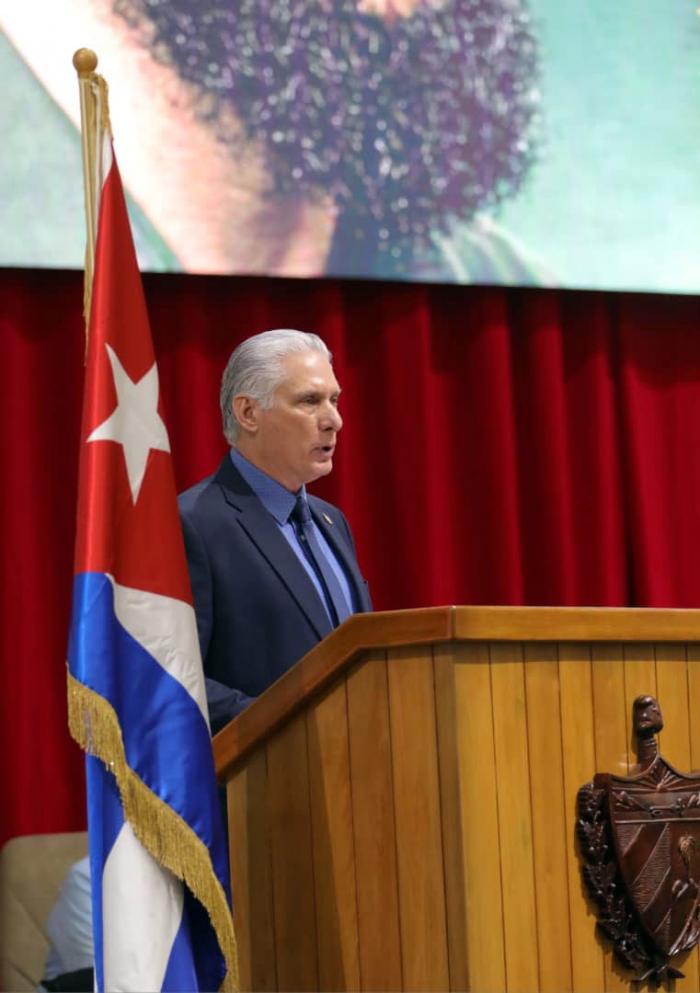
(Shorthand Versions - Presidency of the Republic)
Dear sisters and brothers;
Distinguished academics, intellectuals, artists, social and political leaders, young students, and comrades who have come from the five continents to share this week of profound reflection on the man who marked the 20th century and whose thought illuminates the 21st:
On behalf of the Cuban people and their Communist Party, please accept the most sincere embrace that an island that does not forget its friends can offer.
We are grateful that you have made it your mission to be here, defying distances, disinformation campaigns, and, in many cases, pressure from your own governments.
Your presence in Cuba is an act of courage and consistency, because coming to Cuba today, amidst the intensification of the blockade and imperial hostility, is a gesture of militant solidarity that honors Fidel's legacy.
Congratulations, comrades, Fidel' followers from Cuba and around the world who have gathered to celebrate one hundred years of a life dedicated to the defense of all just causes!
My words are not intended as a lecture. I do not intend to discourse, nor could I, on the life and work of a leader of the moral and ethical stature of the Commander-in-Chief of the Cuban Revolution, Fidel Castro Ruz, the man who refused to be honored with monuments and statues, yet could not prevent millions of Cuban compatriots, compatriots from Our America, and compatriots from around the world from honoring his memory and legacy every day by embracing and multiplying his ideas.
There is no better or more enduring monument than the one you have erected with your courageous presence here, in Fidel's Cuba, on its Centennial!
What I intend to share with you are simply ideas that spring forth with no order other than that imposed by feelings, emotion, and the revolutionary commitment to the privilege of speaking about Fidel.
Studying and embracing with conviction the immense work of the Commander-in-Chief, both in thought and action, is an imperative necessity for all of us who are committed to promoting economic and social transformations that will stop the process of suffocation to which the Cuban Revolution is being subjected, as part of a criminal war that has lasted for more than six decades.
Saving the Cuban Revolution from one of the most serious threats it has faced in 67 years, under aggression of all kinds, is the greatest challenge of our generation, and we are honored to take it on, convinced that we will prevail. This is not an unfounded certainty. We have a history steeped in heroism, a people trained in resistance, and the legacy of a leader who, always at the forefront of that people, transformed setbacks into victories.
Preserving the gains that gave this heroic people the Revolution and socialism, breaking all the sieges that seek to annihilate the nation as collective punishment for its dignity, its resistance, and its decision not to surrender to the most powerful empire in history, is the first tribute we owe to Fidel, born 100 years ago in a country marked by injustice, inequality, and dependency—a painful reality that he vowed to change from his years as a rebellious and outspoken university student.
From the Aula Magna, he descended, transformed into a revolutionary, to light the torches for the Centennial of the Apostle—the same man who, later, still very young, would become the leader of the 26th of July Movement of 1953, which launched an attack against the barracks of a bloody, pro-imperialist dictatorship to begin another Necessary War.
The brilliant lawyer who turned his self-defense into the political program of his Movement, the tenacious prisoner who defeated his jailers by transforming the Presidio Modelo into a school for combatants, the founder of a people's army that defeated in two years a professional army several times its size, the Commander-in-Chief who put Cuba on the world map and filled the peoples of the continent with hope, had already secured his place in history when, at only 34 years old, he shook the United Nations General Assembly with the longest and most momentous speech ever delivered there.
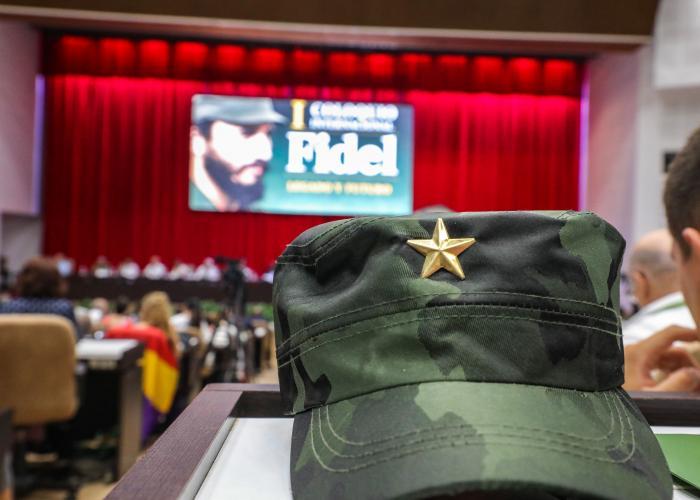
In that impassioned account of our history, Fidel explained to the world the panorama that the triumphant Revolution encountered in Cuba, which the current media-war propaganda machine tries to portray to new generations as the prosperous and dazzling Cuba of before 1959:
Six hundred thousand Cubans with the skills to work were unemployed.
Three million people, out of a total population of just over six million, did not have electricity or any of the benefits and comforts that electricity provides.
Three and a half million people lived in shacks, barracks, and slums without the most basic living conditions.
In the cities, rents absorbed up to a third of family income.
Thirty-seven and a half percent of the population was illiterate.
Seventy percent of children in rural areas had no teachers, and 95 percent suffered from parasitic infections.
Two percent of the population suffered from tuberculosis.
Infant mortality was therefore very high, and the average life expectancy was very low.
Eighty-five percent of small farmers paid rent for their land, amounting to up to 30% of their gross income, while 1.5% of all landowners controlled 46% of the nation's total land area.
Public services, electric companies, telephone companies, a large part of the banking sector, a large part of the import trade, the oil refineries, most of the sugar production, the best land in Cuba, and the most important industries in every sector were owned by American companies and monopolies.
Neither the Cuban Revolution nor Fidel Castro can ever be discussed without acknowledging this reality, this starting point, this state of affairs that demanded the most radical transformation of the 20th century in this part of the world.
One need only review the country's current statistics, even under the terrible restrictions imposed by more than six decades of economic, financial, and commercial blockade and seven months of energy embargo, even amidst harsh blackouts, water shortages, high prices, and other problems that damage the very essence of society: the indicators for health, education, science, culture, and sports remain better than in other countries of similar development.
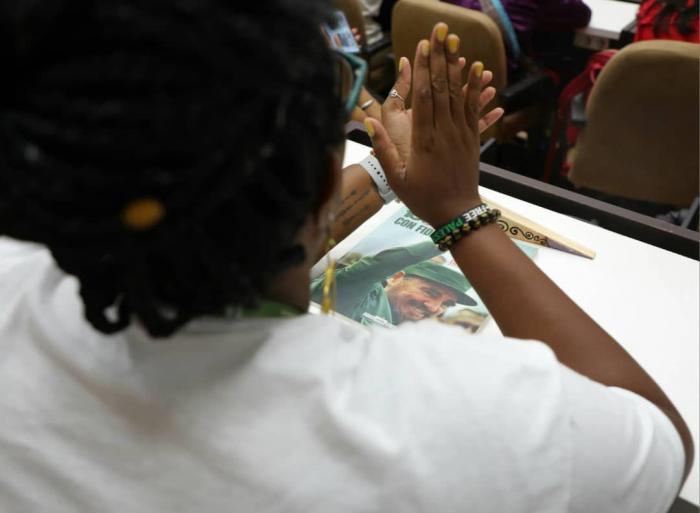
To mention just three: we are the country with the highest rate of doctors per capita, more than 9 per thousand inhabitants; One of the ten countries with the highest life expectancy in the Americas, at 77.7 years, and the one that has contributed the most to the health and education of its population and other nations, according to criteria from the World Health Organization and UNESCO.
The great social and humanitarian work of the Revolution led by Fidel Castro, always under blockade and siege, so radically changed the panorama he described at the United Nations in September 1960 that it will forever make Cuba's return to its colonial and neocolonial past impossible.
It was there that Fidel expressed one of the most accurate ideas about the world's problems, which, instead of being resolved, would worsen with the disappearance of the socialist bloc and the imposition of unipolarity. I quote his historic speech at the UN in 1960:
"Wars, since the beginning of humanity, have arisen, mainly, for one reason: the desire of some to plunder others of their wealth. Let the philosophy of plunder disappear, and the philosophy of war will disappear! Let colonies disappear, let the exploitation of countries by monopolies disappear, and then humanity will have reached a true stage of progress!"
Fidel's legacy challenges us today with more force than ever. I share with you some ideas that I consider fundamental.
What did the Commander-in-Chief bequeath to us? He bequeathed us the certainty that dreams are achieved by defending ideas; he left us the lesson that internationalism is an attitude that should distinguish us; he taught us the conviction that socialism is the only path to save humanity from the abyss.
Fidel was the first to denounce neoliberal globalization as the empire of death, and also the first to raise his voice for a better world for all.
He taught us that the struggle to preserve the environment and the human species is also a socialist battle, that science must be at the service of the people, and that the unity of revolutionaries is more important than any tactical differences.
In Fidel, we find not only a historical leader, but a perpetual school of revolutionary work: to study, analyze, anticipate, listen to the people, and act with boldness and honesty.
Fidel guided Cuba's destiny with a consistency unparalleled in contemporary history. But he was not only a leader and a manager; Fidel was a tireless worker, a lifelong learner, an orator who moved multitudes, a strategist who foresaw the future.
Fidel bequeathed to us a way of thinking and acting. He didn't leave recipes; he left a method. And that method was born from practice, not just from libraries.
When Fidel formulated the five revolutionary laws in his speech of October 16, 1953—agrarian reform, labor rights, urban reform, confiscation of ill-gotten gains, and industrial participation—he wasn't developing a doctrinal program imported from some manual; he was diagnosing the structural ills of an underdeveloped and dependent economy.
That method—rigorous diagnosis, programmatic proposal, and decisive action—was repeated at every crossroads. In the Sierra Maestra, the principle of not waiting for the war to end to begin production linked armed struggle with economic development. In 1960, with the nationalization of the subsoil, he transformed sovereignty into collective ownership. In 1961, at Bay of Pigs, he demonstrated that an armed and conscious people can defeat imperialism.
Fidel understood something that many theorists failed to grasp: that the economy is not an autonomous sphere separate from politics, but rather its material expression, summarized in his formulation: "There is no economy without politics, nor politics without economics."
This idea constitutes a methodological legacy: to think of the economy as the expression of a political project and politics as an instrument of economic transformation. Not to separate them, not to oppose them, but rather to articulate them.
I would also like to elaborate on other legacies.
The legacy of coherence and ethics: Fidel led by example. He did not accumulate wealth, nor did he betray his principles; he lived as he thought and died as he lived. In a world where politics has become a spectacle of hypocrisy, this is a constant challenge to our conscience.
The legacy of intellectual audacity: Fidel was a tireless reader, a man who engaged in dialogue with scientists, economists, artists, athletes, and farmers. He taught us that socialism is not a dogma, but a science under construction, one that must adapt to concrete realities without abandoning its principles. Today, when digital capitalism imposes new forms of alienation upon us, his call to study, study, study resonates as a warning: there is no revolution without knowledge!
The legacy of internationalism: Fidel did not understand the Cuban Revolution as an isolated event. For him, homeland was humanity. That is why he supported the causes of liberation for African peoples and for Palestine, and denounced apartheid and genocide. He raised his voice against the Iraq War and against the blockade and colonial appropriation of any people in the world.
The legacy of revolutionary optimism: Fidel was never a pessimist. In the darkest days, when the socialist bloc was collapsing and the blockade was intensifying, he maintained his faith in humanity and in history. He taught us that revolutionary optimism is not naiveté, but an unwavering conviction in victory.
Fidel's thought and practice of military strategy occupy an important place in his legacy.
In short, we can say that he was a master of guerrilla warfare, which led us to the triumph of January 1st, 1959. A profound student of contemporary military art, he made significant contributions to the conception of the most important military engagements undertaken in our internationalist missions. The Battle of Cuito Cuanavale, personally directed by the Commander-in-Chief, demonstrated his qualities as a military strategist. He conceived the doctrine of the War of the Entire People.
Fidel saw sovereignty not as an achieved state, but as a process that is won and defended on multiple fronts simultaneously: the defense and security of the country, the economic front, the ideological and cultural front, the internationalist and solidarity front, the scientific front, and the front of foreign policy and international relations.
His working system was based, in our opinion, on four principles:
The priority of the political. Every economic decision is a political decision.
The tactical-strategic sequence. Tactics change, but principles do not: sovereignty, social justice, anti-imperialism, internationalism, solidarity.
Popular mobilization as a strategic resource. Discipline and participation imposed from above are fragile; discipline and participation embraced collectively by the people are indestructible.
Innovation under constraint. Scarcity is not just a lack, it is a stimulus for creativity.
Fidel led a generation, the so-called Generation of the Centennial of José Martí, a determined group of women and men inseparable from history, who, from the attack on the Moncada Barracks, the Granma landing, and the Sierra Maestra, shared with him the leadership of the transformative processes of the Revolution. And that generation, comprised of young people with now-historic names—Fidel, Raúl, Che, Almeida, Ramiro, Guillermo, Vilma, Celia, Haydée, Melba, and so many others—connected with the needs and demands of an entire people willing to give their lives for the dignity they had won.
Fidel understood, like few others, the need to combine ideological firmness with tactical flexibility. He taught us that "Marxism-Leninism is not a dead doctrine; it is not a catechism, but a method, a guide, an instrument for concretely resolving life's problems."
As for his qualities as a strategist who anticipated the future, there is no doubt, but neither is there any mysticism in that assertion. A profound student of national and international affairs, which he followed in detail through every possible means, he was also a keen observer of human behavior, thanks not only to his remarkable intelligence, but also to his insatiable pursuit of knowledge and the advances of science and technology. He also possessed a vast culture, nourished throughout his life by fundamental readings of all genres.
The following fragment from a letter Fidel wrote to his sister Lidia from prison on the Isle of Pines is revealing: "My greatest struggle since I have been here has been to insist and never tire of insisting that I need absolutely nothing: I have only needed books and I consider books to be spiritual goods."
That thirst for knowledge, along with his passion for history and the destiny of humankind, accompanied him until the end of his life. He left evidence of this in his Reflections: 484 texts on a wide variety of topics, published between March 28th, 2007, and October 9th, 2016.
Ten years after his passing, it is moving to reread what he intended with them and what he wrote in one of the first, dated June 22th, 2007: "I did not begin this work as part of a pre-established plan, but out of a strong desire to communicate with the main protagonist of our resistance as I observe the stupid actions of the empire."
Here are three components: his need to communicate in the masterful way he did, his respect for the people as the fundamental protagonist, and his critique of the empire.
Under Fidel Castro's leadership, Cuba eradicated illiteracy in 1961 with a campaign that mobilized more than 250,000 volunteers.
Just two years after his victory, he defeated an invasion at the Bay of Pigs (Playa Girón) financed, trained, and escorted by the neighboring empire, inflicting its first major defeat in Latin America.
Cuba built the most advanced universal healthcare system in the developing world.
Cuba sent more than 600,000 healthcare professionals to 165 countries through the International Medical Cooperation Program.
Cuba developed a free education system from preschool through university.
Fidel Castro designed the principles of Cuban foreign policy and built a robust cultural and sporting system, making it a benchmark for the world.
One of the fundamental chapters of his legacy at the continental level unfolded during the most hopeful period in the history of our America when, alongside Hugo Chávez, he led the revival of Simón Bolívar's integration project, which was also José Martí's great dream.
Of course, we are not only talking about ideas. The events that transformed, in a very short time, the relations between the governments and peoples of the most unequal region on the planet, definitively entered the history of the 21st century as defining moments in its subsequent evolution.
In 1998, the Comprehensive Health Program was created, through which Cuba addressed the tragedy of the peoples devastated by hurricanes in Central America and the Caribbean. In 1999, the Latin American School of Medicine was founded, both Fidel Castro's ideas, which demonstrated in practice the universal value of cooperation and solidarity—a path of emancipation unexplored at the time, which would later culminate in ALBA-Petrocaribe, the medical and educational missions, Operation Miracle with its more than 3 million ophthalmological surgeries, the "Yes, I Can" Literacy Program, and the Henry Reeve Contingent, whose extraordinary work in confronting disasters has earned it a nomination for the Nobel Peace Prize.
As you can see, the aforementioned programs, with their clear focus on social justice, are directly related to everything that the new regional far right, orchestrated and directed by Washington, would like to erase from the history of our America with the same ferocity with which the empire is attempting to once again isolate Cuba from its regional environment.
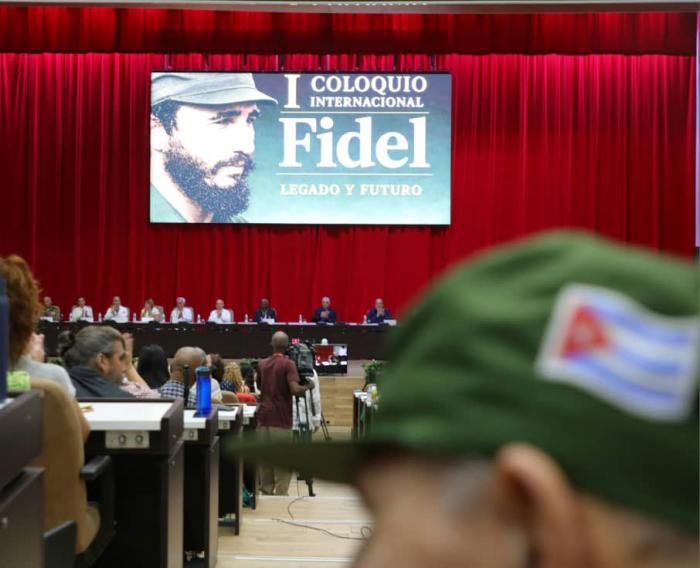
We gather here today, just hours before August 13th, the date on which our Commander-in-Chief would have turned 100, not to celebrate a ritual commemoration, but to fulfill a duty: the duty to think of Fidel not as a figure from the past, but as a strategist ahead of his time. To think of his legacy not as a repository of quotes to be recalled on anniversaries, but as a guide to overcome the challenges we face today, in the real Cuba, in 2026.
We cannot speak of Fidel without looking at the world he studied so extensively and which we have inherited; and the world, as he used to say, is a whirlwind of contradictions. The systemic crisis of capitalism has reached its most acute point: regional wars threatening to spread, a climate crisis that is no longer a prediction but a daily catastrophe, famines caused by financial speculation, forced migrations turning the seas into cemeteries, and a social fracture where the wealth of a few accumulates on the misery of many.
The international order is in dispute. Imperial unilateralism seeks to impose its law by force, but the multipolar world is here to stay. Nevertheless, the empire is redoubling its attacks, seeking new pretexts, fabricating enemies, and destabilizing governments that refuse to submit.
On this global chessboard, Cuba remains one of the prime targets of imperial fury. It is no coincidence that in the year of Fidel Castro's centennial, Washington has intensified its offensive: strengthening the blockade with extraterritorial measures targeting trade and financial relations; arbitrary inclusion on the list of state sponsors of terrorism, a historical irony for a country that has been a victim of state terrorism for decades; Massive media campaigns attempt to portray Cuba as a "failed regime," while remaining silent about our achievements in health, education, culture, science, and sports. To top it all off, they have invented the ridiculous accusation of being a “spy power” or a hotbed of subversion by the so-called radical terrorist left—a label to which all of us here seem to belong—a pathetic and fanciful name, believable only in their twisted minds, but one they use to confuse, justify further punishments, and legitimize their aggression.
Alongside economic and political aggression, they wage ideological and cultural warfare, digital subversion, and the financing of internal mercenaries who, with funds from U.S. agencies, seek to fracture our unity. It is no secret that the United States has allocated millions of dollars to promote “regime change” through social media, NGOs, and platforms that masquerade as "human rights defenders" but in reality serve the geopolitical interests of the empire.
We are not at all surprised by the recent revelations in major US media outlets regarding an increase in CIA operations in Cuba aimed at subverting the internal order. These are not random leaks, as they are presented, but rather part of the U.S. regime's deliberate plan of psychological warfare against Cuba.
In the height of cynicism and perversity, the Secretary of State recently declared that U.S. sanctions against the Cuban regime will only be tightened. "What we are trying to teach them," he said, "is that there are no escape valves."
This is an unabashed admission that a difficult situation exists in Cuba as a consequence of an unprecedented economic war. This statement constitutes an open threat of genocidal extermination against an entire people if they do not submit to the designs of the empire.
On this matter, United Nations experts emphasized that the illegal unilateral coercive measures imposed by the United States against Cuba violate Article 2 of the UN Charter and are part of a broader regime change strategy that encompasses decades of embargo against Cuba.
"The United States government must end all threats and hostile acts against Cuba’s sovereignty and revoke all measures it has imposed on the country that are contrary to international law," the experts said.
They added: "The Security Council and the General Assembly must urgently address these threats as a matter of international peace and security."
There can be no greater act of cynicism than for the perpetrator to try to portray itself as the victim, when its misdeeds have been public and notorious for decades. The United States has no moral authority or right to single out Cuba, which has arguably been the nation most spied on by them and with the largest funds allocated to economic and ideological subversion.
The intensified blockade of recent years is not just an economic measure; it is an undeclared act of war against a people who chose to be free. It is a systematic attempt to subdue, through hunger and despair, a nation that has demonstrated, for more than six decades, that dignity is non-negotiable.
I am not exaggerating when I say that this colloquium is being held at one of the most difficult moments the Revolution has faced, but we are not here to indulge in nostalgia. We are here because Fidel Castro's thought remains the most accurate compass we have to navigate the storm the Cuban people are experiencing! (Applause.) And the storm is real; our people live it every day: in the blackouts that disrupt family life, the workday, and the education of our children and young people; in the inflation that erodes the purchasing power of wages; in the fuel shortages that paralyze the economy and transportation; in the difficulties of affording basic necessities; in the emigration that tears our young people away. We are not here to deny this reality, but to understand it in its true dimension and to find in Fidel's thinking the keys to transforming it.
I'm going to give you some data on the impacts of the blockade on Cuban society.
Particularly in the energy sector: in recent years, with enormous effort, we had recovered more than 1,400 megawatts of power for electricity generation in a group of distributed generation units. These plants are currently not generating power due to a lack of fuel; they run on diesel and fuel oil. If we had those 1,400 megawatts available every day, the troublesome blackouts in Cuba would only last three hours, not twenty or more hours as our people suffer today.
In healthcare, such a sensitive issue, and one in which you are all aware of the full potential of our universal and free system, with opportunities for everyone, with things we know how to do: there are 98,500 patients on the surgical waiting list, including 12,000 children. These are surgeries we can perform in Cuba, but we lack the resources, we lack the energy to power the operating rooms.
There are 34,000 pregnant women for whom we cannot provide enough prenatal ultrasounds during their pregnancies.
There are 67,000 children under one-year-old born in recent months without up-to-date immunizations, even though vaccinations in Cuba and our immunization system were always current.
There are 117,000 adults and 1,200 children with cancer who are not receiving adequate primary treatments, forcing us to resort to secondary or tertiary therapies.
There are 16,000 patients experiencing difficulties accessing the services they need for radiotherapy, 12,400 for chemotherapy, and 3,000 for hemodialysis.
Only 30% of the essential medicines are available, even though we are capable of producing the necessary medications.
The technical availability rate of ambulances is only 22% due to a lack of spare parts.
There is an inability to purchase cobalt-60 sources for cancer treatments, and there are delays in obtaining licenses to release medical supplies at ports, also due to the refusal of international shipping companies, which have been pressured by U.S. imperialism not to bring the goods we need to Cuba.
And as if this weren't enough, we had always maintained infant mortality rates between 4 and 5, which are rates typical of developed countries. However, in recent years, our rate has doubled and is currently over 9.8, representing the deaths of children who could have been saved.
In this meticulously calculated genocide, wherever relief is glimpsed or sought, the enforcers of this ignominious policy will be there to tighten the noose of suffocation.
What has Cuba done in the face of this storm? We have responded with what Fidel taught us: resistance is not passive, it is creative. In the midst of this harassment, we have developed our own vaccines, allowing us to confront the pandemic with sovereignty; we have strengthened agriculture, both urban and suburban, using agroecology to guarantee food despite fuel and fertilizer shortages; we have fortified our defense systems with a people's militia that doesn't need tanks or planes to defend its land, because it defends it with heart and the cohesion of its forces.
We have known how to turn adversity into opportunity. The crisis compels us to be more efficient, more innovative, and more participatory. Our scientists, our teachers, our doctors, our farmers, and our workers have demonstrated that collective intelligence is more powerful than the money of the empire. And, above all, we have not abandoned internationalism. We continue to send medical brigades to the poorest places in the world, sharing our educational and scientific methods; we continue to be the island that builds bridges of brotherhood.
Yes, we have many needs. We are burdened by blackouts, water shortages, inflation, and long lines; But no material hardship has extinguished the flame of solidarity in which Fidel raised us (Applause).
One fact that confirms this is that in the final days of the last academic year, tense and difficult like no other, 30,185 young professionals graduated from Cuban universities, 735 of them from 62 countries who had been trained in Cuba (Applause). And a fact we are proud to share: more than twenty new Palestinian doctors and five American doctors (Applause).
The response of the people, under the leadership of the Communist Party of Cuba, has been firm and creative resistance, unity, the defense of their achievements, and the updating of the economic and social model, without ever renouncing the principles of socialism and without yielding to pressure or blackmail. To achieve this, we are implementing a series of economic and social transformations. This capacity to resist and transform is rooted more firmly than ever in the thought and action of Commander-in-Chief Fidel Castro Ruz.
It is about continuing the construction of socialism on a small island threatened by the greatest imperialism in the history of humanity and completely blockaded, whose state is cut off from all sources of resources, financing, and trade.
Faced with this dilemma, it is necessary to produce and generate wealth to redistribute it with all possible social justice and to preserve the historical and essential achievements of the Revolution in strategic areas such as health, education, culture, science, energy, and communications.
Achieving this will be everyone's task—state-owned and non-state-owned enterprises, along with other forms of economic management that together comprise the Cuban business network—all focused on a single goal: building the prosperous and sustainable socialism that the heroic people of Cuba deserve.
I want to emphasize that this is a process to revitalize the economy, not to establish capitalism; there will be no rampant privatization, the fundamental means of production remain in the hands of the people, and above all, national sovereignty and independence are preserved.
For such a complex process, the Communist Party of Cuba, as the supreme leading force of the State and society, stands as the primary agent responsible for its direction, coordination, and control, and as the vigilant guardian of the interests of the people, the working class, the social achievements, and the social justice that has driven the Revolution since its inception.
Comrades:
Fidel is not the exclusive property of Cubans. Fidel belongs to all those who fight for a better world. And you, participants in this Colloquium, intellectuals and activists who have embraced its thought, have a decisive role to play.
We call upon you to spread the truth about Cuba and all peoples in resistance. In a world where the mainstream media fabricate lies and convenient narratives, you have the responsibility to be spokespeople for the reality that Cubans live: a reality of hardship, yes; but also of achievements, solidarity, and hope.
Every book you write, every article you publish, every lecture you give in your countries is a bulwark against disinformation. The battle of ideas today is being fought in the digital arena against technological illiteracy and new forms of cultural colonization.
You must build effective solidarity networks; it is not enough to deliver speeches of support. Solidarity must be translated into concrete actions: campaigns for the lifting of the blockade, proposals for scientific and cultural cooperation, fair trade projects, and complaints before international organizations.
You must deepen your critical thinking about 21st-century socialism. Fidel left us with open questions, not definitive answers. How do we build popular power in the digital age? How do we reconcile centralized planning with territorial autonomy? How do we confront climate change from a socialist perspective? You, from your respective disciplines, have the mission of providing creative and realistic answers, and you must strengthen the unity of progressive movements.
Fidel was a master at uniting wills, building bridges between diverse sectors, and seeking common ground without abandoning differences.
I call upon all followers and students of his legacy to work for unity, to overcome secondary divisions and concentrate on what is essential: the struggle against capitalism and imperialism.
The Revolution has dedicated its utmost effort to young people and placed its greatest hopes in them. Fidel always trusted in the role of youth in the revolutionary process.
To believe in young people is to see in them not only enthusiasm but also ability; not only energy but also responsibility; not only youth but also purity, heroism, character, will, love of country, and faith in the homeland. It is to have the profound conviction that youth can, that youth is capable, that great tasks can be entrusted to the shoulders of youth (Applause).
It was youth who surrounded Fidel to conceive achievable dreams when the nation needed them. From his long meetings with young people emerged great social achievements: the impetus for the development of art instructors, comprehensive teachers, and social workers. It was the youth who took up arms in the Sierra Maestra, who taught literacy in the mountains, who were the protagonists in the glorious internationalist missions, who built the contingents, who propelled science and technology forward.
Today, in the year of its Centennial, Cuban youth are called upon to forge themselves with the same historical stature. The challenges before us are immense: the economy battered by the blockade, the structural transformations we must implement, the need to produce more food, to achieve the energy transition, to substitute imports, to build a society with greater well-being for all. There is no challenge that the youth cannot face if they set their minds to it.
Comrades:
Allow me to close with a certainty that Fidel bequeathed to us: the future is not written, we have the power to write it.
Yes, the empire is powerful, but history is on the side of the people. Every child who learns to read today in a Cuban school without electricity, every farmer who cultivates using agroecological methods, every scientist who conducts research without patents, every young person who participates in a social movement, every mother who defends her children from violence, is a victory in advance.
Fidel's Centenary is a starting point. It is the moment to recognize that his legacy is not in the past, but in the present and in the future we are building. It is not enough to remember him; we must study him! It is not enough to admire him; we must emulate him! (Applause.)
I would like to thank you again, from the bottom of my heart, for your presence. You are the ambassadors of truth, the witnesses that Cuba does not surrender, the comrades on the journey of a revolution that transcends borders.
In my remarks, I have avoided referring to my personal experiences with him; however, I do want to emphasize that I have been profoundly marked by Fidel's loyalty and his determination to confront imperialism as his life's purpose, his vision of unity, his example of always being present in the most adverse situations without succumbing to pessimism, his sensitivity towards the most needy, his concept of social justice, and the value inherent in his fully developed concept of Revolution.
I want to state, at the beginning of this centennial celebration we share, the enormous commitment of the Party and Government leadership to Fidel's immeasurable work, which we have the responsibility to safeguard from the threatening winds blowing from all sides, fueled by the empire's thirst for conquest and punishment.
I allow myself to conclude as Fidel said more than once: "We are prepared to resist the imperialist blockade with dignity and selflessness for as many years as necessary. If others compromise, if others allow themselves to be bribed, if others betray, Cuba will know how to remain an example of a revolution that does not surrender." (Applause and shouts of: "I am Fidel!")
I repeat: "Cuba will know how to remain an example of a revolution that does not surrender, that does not sell out, that does not give up, that does not kneel!" (Applause and shouts of: "Long live!")
Fidel is a country, Fidel is Cuba! (Applause.)
For Cuba, with Fidel, until victory, always!
Long live Fidel forever! (Shouts of: "Long live!")
Socialism or Death!
Homeland or Death!
We shall overcome! (Exclamations of: "We shall overcome!")
(Applause.)
Related News

Pinar del Río, Manuel Marrero Cruz, authorities, meeting
Message from the Army General to the people of Pinar del Río

A center that contributes to scientific, health, and technological sovereignty At
