



Perseverance, El Salvador, Guantánamo.—"I sail safely on my yacht,/ across the seas of duty,/ each page a chisel with a Mambí handle;/ truth as my motto/ learned from Fidel."
Neither the poet's talents nor those of the farmer he is today had yet emerged in Guajiro Estrada, when the island's media capabilities were 60 years—60 years of revolution—beyond their current reach.
"We didn't have a television in the neighborhood," he recalls. "At home, there was a tiny, clunky radio that miraculously tuned into a station. If a rumor arose about anything, we depended on the possible explanation from a regional newspaper delivered mid-morning by a vendor. The clarification sometimes took a while."
On the evening of October 3rd, 1965, rumors he heard from his parents and neighbors in the Salvadoran community of Perseverancia prompted questions and introspections in Roberto Estrada Pereira (El Guajiro), who was barely 10 years old.
"What does this mean about the Central Committee (of the Party)? And about a new Granma? Where did Che Guevara go?" "Well… if Fidel said it, it must all be true."
With the monologue running through his head, Roberto went to bed that night, and before falling asleep, he decided that the next morning he would be the first in line to get his hands on the newspaper.
He says that, as there was almost always more demand than supply, and those at the back of the line didn't buy anything, "I ambushed the vendor at the entrance to Jobito, about two kilometers before we got here, and offered him 20 cents for the new newspaper he had (Granma, first edition)."
"And why are you so interested, kid?" the man asked.
"I want to know about the (Central) Committee, and where Che Guevara went; also about the new Granma" (without knowing that it was the official name of the Central Committee's official publication); I also want to read what Fidel said."
"Then the vendor," Roberto recounts, "held out a newspaper and said, ‘Here, I’ll give it to you.’ It was none other than the first issue of Granma; October 1965."
The boy ran home, and, sometimes silently, sometimes aloud, "I read, reread, searched for answers, although, to be honest, I didn’t understand the meaning of many of the words."
"Whether it was a speech, an interview, an appearance, or a visit inside or outside of Cuba, Granma always put Fidel right in front of me, that’s why it’s my bible and my compass," El Guajiro Estrada confesses.
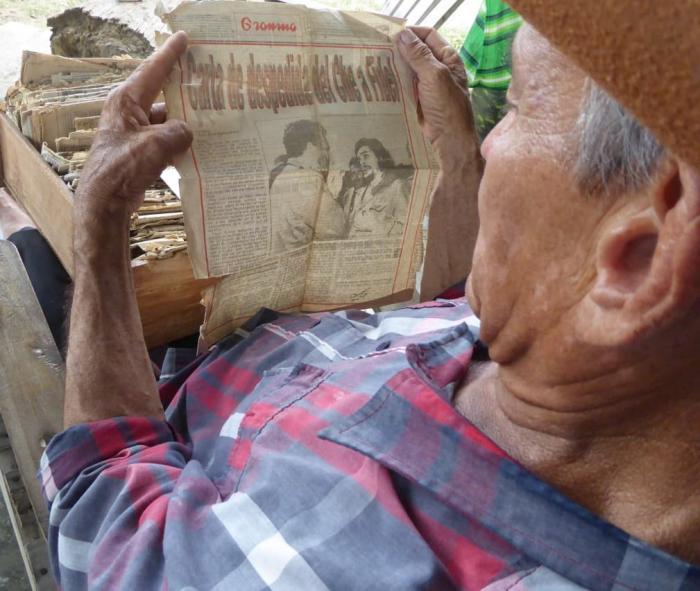
"What I don’t have in my memory of Granma (touching his head with his index finger) I keep in this drawer," he says, showing a stack of old editions of the newspaper.
Memorable events crammed into yellowed, perforated pages with irregular edges—traces of time, some over 50 years old—make up this unique collection in Roberto's home.
Che Guevara's Farewell Letter; the cover of the First Congress of Our Party; Fidel at the closing of a FMC meeting; at the UN and on solidarity trips around the world; also at the farewell to the victims of Barbados…
Some events that stirred joy, others that would provoke pain or shock. All of them, more than pages, are "a treasure."
Granma has a founder/ who is a stormbreaker/, a paradigm of loyalty/, a Quixote, a summit of honor.
"Granma and Fidel go together,/ weapon and guide,/ pages of dignity,/ defeating falsehoods/ symbol and helmsman."
Related News

For Cuba, for the future of socialism, we will continue resisting, working, creating, and ...

State Council approves new decree-laws as part of implementing economic and social transfo...

Díaz-Canel observes innovative energy and construction solutions
