

In the foreground, as if for a documentary of these extreme hours of resistance, is the sum of the faces of the people; And then there are other aspects that undoubtedly inspire admiration, such as the performance of those grassroots leaders who, through their daily dedication, know countless figures in detail, are familiar with situations down to the last name, and have developed such expertise that they are living proof that the pool of leaders is inexhaustible.
This is what this reporter was thinking on Tuesday afternoon, while listening to the explanations offered by the presidents of the Municipal Defense Councils of Regla and Guanabacoa during the visit of the President of the National Defense Council, Miguel Díaz-Canel Bermúdez, to these areas of the capital.
As if under a magnifying glass, these leaders, together with other forces working within the territory, understand the magnitude of the population's demands; they know, as was explained in Regla, that it is essential to ensure that the electricity service is synchronized with the ability to pump water.
Like a map of life, there are numerous priorities: ensuring the defense of the population, optimizing the energy program, guaranteeing food security, and supporting those most in need. This was explained in the overseas municipality of Regla, during a meeting that also included the participation of Roberto Morales Ojeda, member of the Political Bureau and Secretary of Organization of the Central Committee of the Communist Party; Liván Izquierdo Alonso, president of the Havana Provincial Defense Council; Yanet Hernández Pérez, the Governor of the capital; and other leaders.
Regla is the 12th municipality visited by the country's leadership in recent days. In all of them, discussions have generally focused on food production; solid waste collection; actions to support the most vulnerable; the operation of the Community Youth Network; and how all economic actors can become more integrated to help solve the problems affecting citizens.
The need to determine how many people are disconnected from education or employment came to the forefront in Regla. There—where the Ministries of the Food Industry and Justice, along with other agencies and entities, are providing support—President Díaz-Canel emphasized the need to know in detail who is currently unemployed. The president was also briefed on the number of vulnerable citizens identified in the census, the four existing Family Care Systems (SAF), and the quality of their operation.
In both territories, the Community Youth Network was discussed. The truth is that this network, despite its limitations, has managed to accomplish significant things within the community: such as delivering food to elderly people living farthest from a SAF, supporting pregnant women, and developing social activities with undeniable impact.
You have to visit the municipalities, listen to their leaders, or their residents, to understand the oft-repeated truth that no two territories are alike when it comes to challenges, possible solutions, and even customs. They all have common issues, but each has its own particular concerns. Guanabacoa, for example, has 115 housing complexes and more than 10,000 people in vulnerable situations—where the image of elderly people living alone is very common.
And there, alongside these challenges, economic actors are involved in the task of helping with pension payments or strengthening the SAF; and food is being prepared in different formats to reach the most urgently needed areas. The Ministry of Transportation provides support and assistance; and in a recurring issue in the capital, such as solid waste collection, alternatives are being explored, including animal traction.
Towards the end of the afternoon, President Díaz-Canel Bermúdez, speaking from Guanabacoa—the 13th Municipal Defense Council he visited—reflected on the importance of taking full advantage of the autonomy afforded by the 176 economic and social transformations the country is already working on. The president reported—and also stated in Regla—that 80 of these transformations have already had their content approved for implementation, supported by 57 legal norms.
This, he said, opens up multiple possibilities for linking all economic actors, for the more efficient functioning of organizations and entities, and for finding solutions more easily and smoothly to numerous problems for which the president has always encouraged a gradual, step-by-step approach.
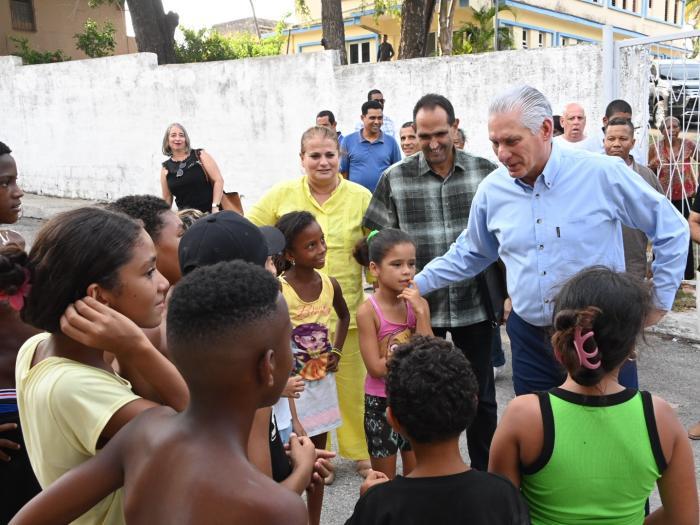
"So much is done every day," the young man who spoke about Guanabacoa to the country's leadership sincerely and sincerely admitted. And we must believe him, because it is a titanic battle for the happiness of the people despite the genocidal siege the island is suffering; it is a heroic struggle for the smiles of those children whom Díaz-Canel greeted on a street corner in picturesque Guanabacoa, with whom he talked about soccer, and with whom he smiled, because the motivation behind all this ongoing work, which envisions future encounters, has a name: it is called living in the land one loves.