
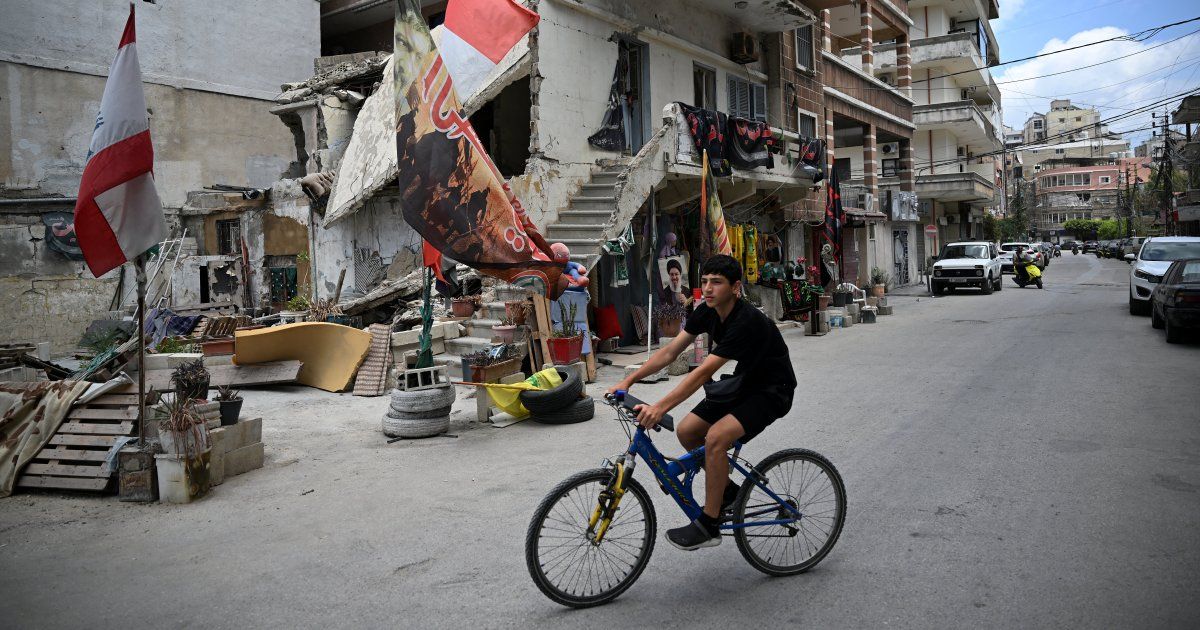

The “deconfliction cell” announced on Monday is meant to strengthen the supposed ceasefire between Israel and Hezbollah in Lebanon.
The mechanism is designed to provide a way for the parties to the conflict to communicate and prevent isolated incidents from spiralling into more intense violence.
- list 1 of 3Lebanon discusses ‘deconfliction’ mechanism ahead of Israel talks
- list 2 of 3Why Iran’s President Pezeshkian is heading to Pakistan after US talks
- list 3 of 3Israeli fire kills two in Lebanon as Hezbollah slams truce ‘violation’
end of list
That is of particular interest to the United States – which has backed the mechanism – and mediators, because Lebanon is arguably the most likely issue to bring down the US-Iran memorandum of understanding, risking a return to all-out war in the region.
Iran has repeatedly made it clear that it will not allow Israel to continue to attack Lebanon without repercussions. Israel has refused to accept any attempt to restrain its ability to conduct strikes in Lebanon, or withdraw from the territory it occupies in its northern neighbour.
The US is attempting to bridge those two positions, signalling that it is not happy with Israeli attacks on Lebanon, while also insisting that the pro-Iranian Hezbollah group disarm – something that the Lebanese government is also pushing for.
However, the push to disarm Hezbollah came before the US-Iran war. Supporters of the conflict in the US and Israel initially promised the overthrow of the Islamic Republic in Iran. But Iran’s ability to negatively impact the global economy with its shutdown of the Strait of Hormuz and its attacks in the Gulf have placed it in an arguably stronger position – and strengthened its ability to withstand efforts to disarm its strongest ally, Hezbollah.
Deconfliction and ceasefire
US Vice President JD Vance has backed the deconfliction cell. His argument is that even as Israel continues to attack Lebanon, killing dozens of Lebanese despite a ceasefire, the scale of the attacks is less than it has been previously. The US, therefore, considers the ceasefire to be a success if the current level of violence is maintained or drops.
Advertisement
“As the president of the United States has himself said, sometimes these ceasefires just mean you’re shooting a little bit less,” Vance said on Monday. “But we wanted to make sure that we had the proper coordination set up so that if there is shooting, if Hezbollah fires at Israel or if Israel responds, if there are other conflicts that arise in the region, we’re actually talking to each other and figuring out how to stop the shooting.”
The US has tried to declare a ceasefire in Lebanon a number of times, but Israel has ultimately refused to stop attacking. Israel has killed at least 4,192 people in Lebanon since the start of the US-Israel war on Iran four months ago. It has been attacking its northern neighbour with varying levels of intensity since October 2023, after Hezbollah fired rockets on northern Israel in the wake of the start of its genocidal war on Gaza.
Direct negotiations between Lebanon and Israel have continued this week in Washington, although Hezbollah is not part of the talks – it officially opposes them.
“It has become clear and confirmed that the rounds of direct negotiations into which the delegation of the Lebanese authorities was driven to Washington were only for it to nod its head and rubber stamp on what the American administration dictates in terms of impositions that confiscate Lebanon’s sovereignty and transfer its political position to the side of those reconciled with the Zionist occupation and its illegitimate entity,” a Hezbollah statement released on Sunday said.
Yet the announcement of the deconfliction mechanism is an indication that the ceasefire is not on the verge of total collapse.
“The deconfliction cell is an indication that things are more serious than one might have imagined in trying to give some reality to this undertaking,” Marc Weller, director of the Global Governance and Security Centre and programme director of the International Law Programme at Chatham House, told Al Jazeera. “It is a very positive step that gives meaning to this provision and seeks to avoid escalation.”
With Israeli troops still present in southern Lebanon, and Israeli officials insistent that they will not give up freedom of movement in the country, the potential for a return to a more intense phase of the conflict is always present. The hope is that the deconfliction mechanism will mean that is avoided.
“The mechanism should help to ensure provocations are not undertaken and if they do, the response remains limited,” Weller said, adding that the US would put pressure on Israel while Iran would do the same with Hezbollah.
Reality of disarmament
And yet, it remains to be seen if deconfliction necessarily also means disarmament. The US and Lebanese government are still calling for Hezbollah’s weapons to come under the state, and there has also been regional backing from Saudi Arabia, Egypt and others to bring that to the forefront.
Advertisement
As Hezbollah’s principal backer, Iran has opposed the group’s disarmament.
“I really don’t think that there [will ever be] a moment called Hezbollah’s disarmament,” Karim Safieddine, a nonresident fellow at the Tahrir Institute for Middle East Policy, told Al Jazeera. “Hezbollah’s capacity today is nothing like its capacity a few years ago, but there will always be a way for it to find arms on a local level because it’s a very organised mass movement.”
Previously, a plan was floated by US Secretary of State Marco Rubio that would include training a special force of Lebanese soldiers who would work to disarm Hezbollah. Analysts and officials have previously warned that such a scenario, however, could cause internal strife.
“This proposal is a non-starter, and I can’t see the Lebanese government in any way accepting to have Lebanese troops trained specifically to fight Hezbollah,” Nicholas Blanford, a nonresident fellow at the Atlantic Council and author of a book on Hezbollah, told Al Jazeera.
Related News
Top Ukrainian officials return Polish awards in WWII dispute

Iran shuts Strait of Hormuz as Israel tests MOU with Lebanon strikes
As Iran and US near a peace deal, Tehran remembers another bloody conflict