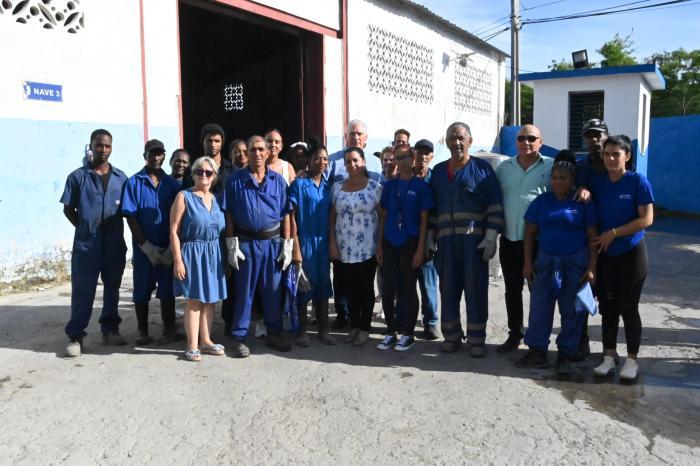



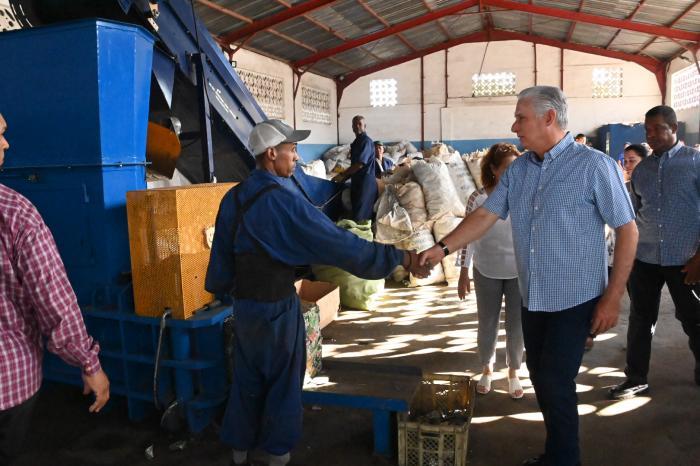
The First Secretary of the Central Committee of the Communist Party of Cuba and President of the Republic, Miguel Díaz-Canel Bermúdez, visited two entities of the Recycling Business Group (GER, in Spanish) this Tuesday, located in the Havana municipality of Regla. There, he learned about the transformations they have implemented to increase exports and revenue, and to contribute to solving one of Havana's main problems: solid waste.
As part of his regular weekly visits to strategic locations that contribute locally to the country's economic and social development, the President first visited the Alfredo Ramonal Basic Business Unit, where non-ferrous waste is processed and sorted.
After touring each of the areas and greeting the workers at their workstations, the Head of State acknowledged how the company has capitalized on the opportunities opening up for the business sector and increased revenue during the most challenging time.
Sadie Jiménez Condés, director of the UEB (Basic Business Unit), explained to the press what they have done differently to achieve results despite the challenge posed by prolonged power outages affecting raw material processing. She also provided details of her conversation with President Díaz-Canel.
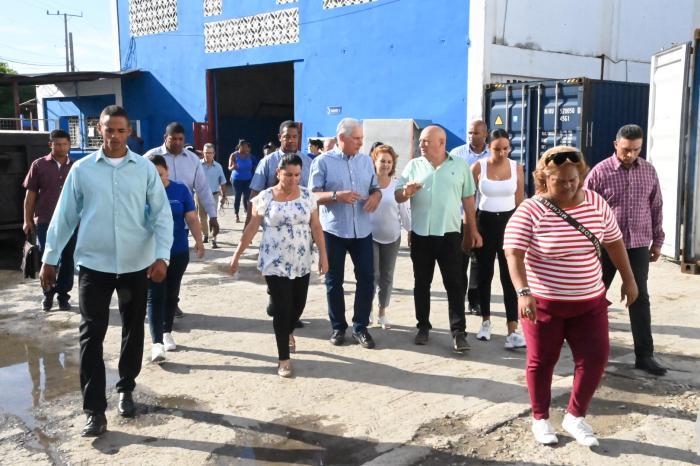
"He was interested," she said, "in how we can produce according to the country’s circumstances. We explained that we have staggered work schedules and electric transportation for the workers. He was very interested in salaries and employee turnover. Here, it doesn’t fluctuate; rather, the workforce is always full, and they are very happy with their salaries, which motivates them to continue."
With an average salary per worker of 40,000 pesos and profits from the UEB (Basic Business Unit) that—through May—exceeded 3,000,000 pesos, the president insisted that with these revenues, it is necessary to refine processes, improve the unit’s conditions, and address workers’ issues such as housing.
The director added that they plan to bring production processes to higher quality standards. "For example, copper will be crushed with a machine we have planned. We are going to provide the can processing plant with electrical autonomy."
The raw materials processed at the Alfredo Ramonal Basic Business Unit (UEB, in Spanish) are sold with added value to the Desequip Company, which handles exports. Following this cycle, President Díaz-Canel continued his tour this Tuesday.
At Desequip, whose mission is the import and export of goods for the Recycling Business Group of the Ministry of Industries, the president received updated information on a new local waste management system recently implemented in Havana.
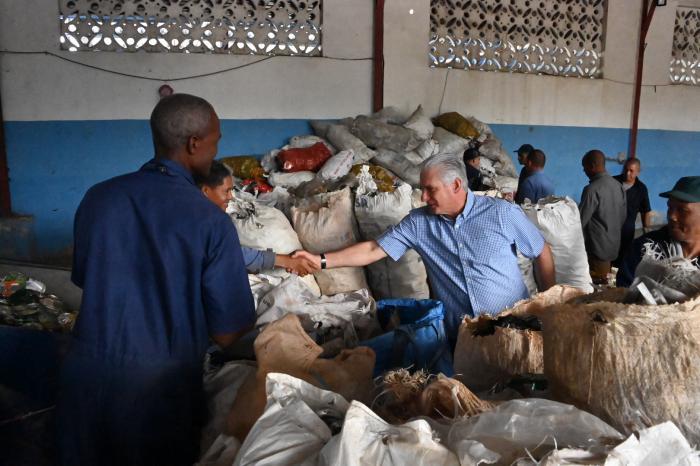
The innovation project, the president was informed, arose from studies conducted by the Ministry of Science, Technology and Environment (CITMA, in Spanish), a result of actions the President outlined the previous year to help improve Havana's deteriorating public hygiene.
Marian Herrera Delgado, a member of the recovery team at the Havana Raw Materials Recovery Company, who was in charge of the presentation to the head of state, explained to the press that the new local waste management system aims to increase recovery through improved process organization without requiring large investments or increasing the workforce.
In the first months of implementation, export revenues have already increased, although there is still much to refine in the process, such as launching a mobile application and increasing the participation of the community and non-state economic actors.
The directors of the Recycling Business Group informed the President that this new local waste management system is expected to be extended to the rest of the country's provinces.
At the end of the meeting, the president emphasized that this innovation, which consists of a better organization of the processes for dumping, collecting, and processing waste, means turning waste into millions of dollars in revenue that the country's economy needs.
He also said that greater organization at the neighborhood level is necessary, so that individuals, businesses, state institutions, and private actors are aware of the contracts, dumping and collection points, and how to move the system toward a waste sorting process. This will allow for adding value to what many see as waste with no further useful life.
This tour by the First Secretary of the Central Committee of the Party of the People's Republic of China of entities within the Recycling Business Group, which is working on transforming solid waste management, is part of his weekly visits to locations linked to food production, the recovery of the electrical system, digital transformation, the energy transition, and electric transportation—strategic areas where the country's progress is determined.