


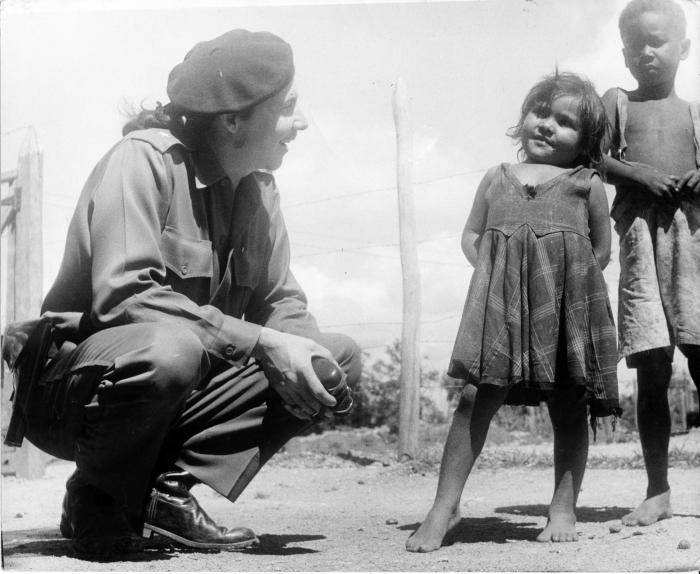
In September 1958, Batista's air force indiscriminately bombed the eastern mountains. Their target was not only the rebels but also the peasantry who supported them wholeheartedly. In one of these criminal acts, a young girl named Ana María Poll was wounded.
Her forehead and one of her legs were bleeding. She was treated in one of the many field hospitals set up in the territory of the Second Eastern Front "Frank País García." Raúl learned of the incident and, together with Vilma, visited the site, held her, and promised that these crimes would end. Since then, every time the Army General visits Mayarí Arriba, he asks for Ana María, who simply loves him like a father.
Those same feelings are expressed in the city of Santiago de Cuba, "where he behaves like any other resident, cheerful and also brave. That's why Cándido Fabré composed those lyrics that warn that those who aren't with Fidel aren't with Raúl," commented Francis Rondón Gómez, who defines herself as "a follower of Fidel and Raúl, those who, together with the people, achieved true independence for Cuba."
Therefore, it is neither risky nor exaggerated to state that there is not a single municipality in the province where the Leader has not been at the forefront of the Revolution. His connection to these lands began in 1939, when, as a young boy, he began his studies at the Dolores School; then came the Moncada attack, his imprisonment in San Luis, the founding of the Second Eastern Front—which liberated many of the towns and cities of Santiago—the proclamation of victory on January 1st, his marriage to Vilma, and a long list of events spanning more than 85 years.
RAÚL'S "SANTIAGO LIFE"
Young Raúl arrived in Birán at Colegio Dolores, a prestigious Jesuit institution, where he studied between 1939 and 1945. Like his brothers Fidel and Ramón, he received a well-rounded education and learned about the then-capital of Oriente province, its history, and how the United States Army had barred the Cuban independence fighters (Mambises) from entering the city after Spain's defeat in 1898.
Eight years later, he returned as part of the Generation of the Centennial of Martí. At the Siboney Farm, on that early morning of Saint Anne's Day in 1953, he didn't back down and led the group that supported the attack on the Moncada Barracks from the Palace of Justice. With the setback complete, Raúl went to the house of Dr. Ana Rosa Sánchez, owner of a pharmacy and a friend of his family, to whom he told about the bloodbath that the henchmen of the tyranny were carrying out.
On the 27th, he traveled to the vicinity of the Algodonal sugar mill and decided, on his own, to head towards Birán. Following the Central Railway, his clothes wet and utterly exhausted, he covered about ten kilometers to the bridge over the San Rafael River, where he aroused the suspicion of some soldiers who took him to the San Luis barracks to be transferred to Palma Soriano.
Then came the trial, the fruitful imprisonment, exile, and the Granma landing. With the beginning of the guerrilla struggle and its consolidation, a Front was created that would honor the memory of Frank País García. With the entry of the 20th-century Mambises into Santiago on January 1, 1959, another stage began in the life of the then Commander of the Rebel Army.
On January 26, in Raúl's own words, "I put on a new guerrilla uniform and went to Vilma's wedding (...) the best and most beautiful thing I've ever done in my life." It was at the Rancho Club, from where a large part of the city can be seen, where his existence was joined to a woman from Santiago who was first in hiding and then joined the Second Front until the defeat of Batista's regime.
From then on, he would inaugurate schools, hospitals, and production centers; visit La Granjita, the Moncada Barracks, and El Escandell; spend time with the people of Palma Soriano; accompany Commander of the Revolution Juan Almeida Bosque on numerous party and defense tasks; be nominated as a candidate for Deputy to the National Assembly of People's Power for the municipality of Segundo Frente; all while promoting the socio-economic development of the province and the beautification of the city proclaimed, in 1984, as a Hero City of the Republic of Cuba.
Two years earlier, as part of Operation Heredia—directed by Raúl Castro—plans were drawn up, among other things, to provide the city with new buildings and spaces. These included what would become the modern Heredia Theater, since, after the fire at the Aguilera Theater and the closure of the Oriente Theater, Santiago had lacked such a facility. Thousands of workdays, under the supervision of the Army General, made its inauguration possible on August 13, 1991.
From Santiago, Raúl convened the Fourth Party Congress, with the objective of saving the Homeland, the Revolution, and Socialism, a feat accomplished in October 1991. In that context, with Fidel at the forefront, he was present at the inauguration of numerous projects.
Whenever possible, he returned to the province, and in December 2007, he and Commander Hugo Chávez Frías made a historic visit to the city. When Hurricane Sandy devastated much of the territory's infrastructure and housing stock in 2012, the support of the then President of the Councils of State and Ministers was constant. "He announced the Revolutionary Government's decision regarding the prices and subsidy levels for construction materials; he also told us about the details of the day Batista's army surrendered at the La Maya barracks and called on us to continue fighting for the people," recounted Israide Mora Osoria.
On a Saturday in 2016, around seven in the morning, the then First Secretary of the Central Committee of the Communist Party surprised the residents of Santiago de Cuba by touring the Enramadas Heritage Corridor: "Those who saw Santiago after Hurricane Sandy can't believe how splendid it is now," the Leader declared from an improvised platform.
In 2019, alongside Díaz-Canel, he inaugurated the Cuba-Vietnam Solidarity Special School, "with a constant concern for the living, studying, and working conditions," commented Iriobis Rodríguez Madariaga, director of the educational institution.
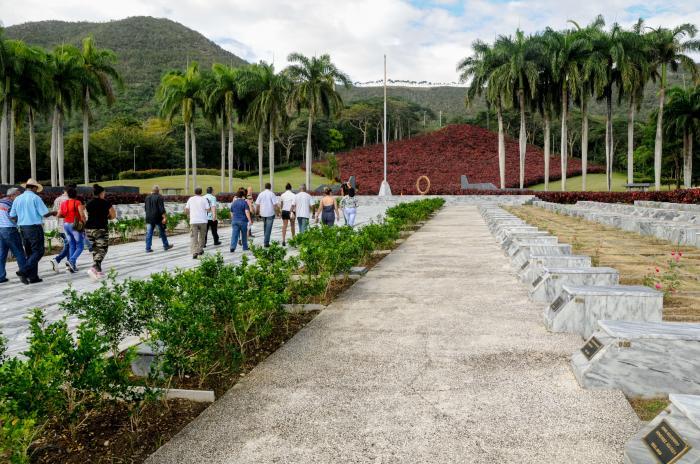
Many people visit the Mausoleum each year where the remains of the guerrilla fighters are interred. Photo: Endrys Correa Vaillant
RAÚL'S FRONT
On March 11, 1958, Raúl carried out the Commander-in-Chief's order to create the Second Eastern Front Frank País García, which functioned "like a small revolutionary state within another," as it covered some 12,000 square kilometers, primarily in the Santiago de Cuba municipalities of San Luis, Songo-La Maya, and Segundo Frente.
"I was one of the seven members of Column 6 who marched from Pata de la Mesa to Piloto del Medio. Throughout that long march, Raúl always encouraged us. He was the first to get up and the last to go to bed." "He has always had an unwavering faith in victory," highlighted First Colonel Alberto Vázquez García, Hero of Labor of the Republic of Cuba and director of the Historical Complex that houses the Mausoleum where the remains of the guerrilla front fighters are treasured, "and those of Vilma, in a monolith that also has a space for Raúl."
As crucial as the combat actions were the creation of the departments of Justice, Rebel Health, Public Works, Treasury, Propaganda and Inspection, Education, and the agrarian and labor bureaus, which, in their respective armed congresses, provided the roadmap for achieving unity and the prelude to what would later become the reality of the Revolution in power.
In nine months and 20 days, 31 military barracks and Rural Guard posts were captured, some 2,000 weapons were seized from the enemy, and 20 field hospitals and medical posts were established, as well as some 400 schools. “It was thrilling to see the insurgents—that’s what we called the rebels—defeat the soldiers who had committed so many atrocities. Raúl and Vilma entered San Luis in December 1958, greeting and embracing everyone. The joy was immense,” affirmed the elderly Henry Reyes Rodríguez.
And, thanks to Raúl's initiative, the municipality of Segundo Frente was created. Mayarí Arriba is no longer a small hamlet with land owned by a few, but a picturesque town with schools, hospitals, and access roads. "It's all 100% the work of the Revolution. He's one of our representatives in Parliament, and in the last elections, he received the most votes," said Pablo Campos Batista.
“He has always instilled confidence in us, reminding us that unity is our greatest strength. He is very kind, enjoys sharing anecdotes and stories, and imparting knowledge to present and future generations with modesty, selflessness, and altruism,” he added.
In his most recent speech—on the occasion of the 65th anniversary of the triumph of the Revolution—he affirmed that “from heroic Santiago de Cuba, we reaffirm that we remain steadfast and ready to charge with machetes, alongside the people and as one more combatant.” I was there, and the unanimous response was: Long live Raúl!