
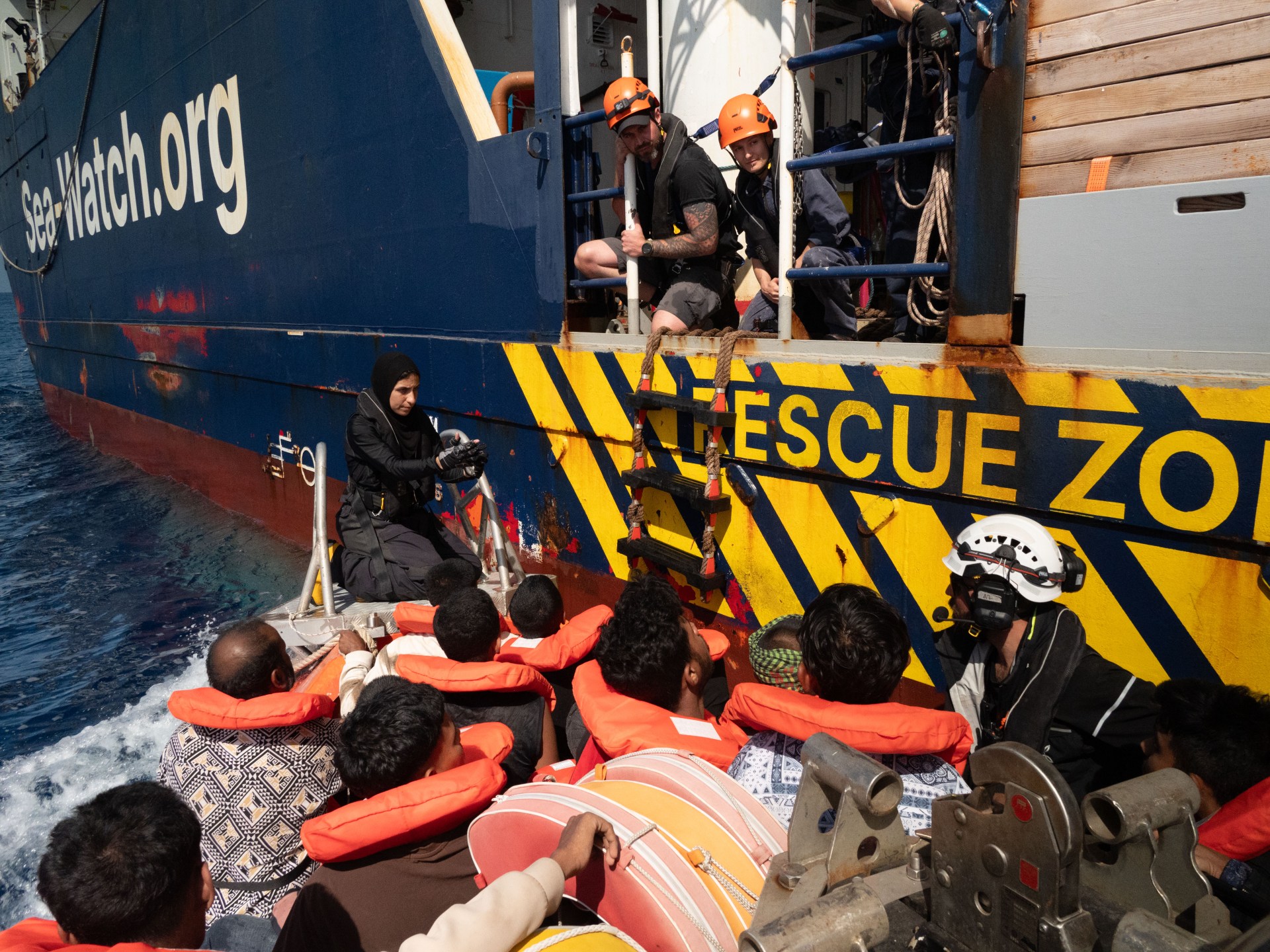

Yasmin Ibrahim Elzanaty, a lawyer from Egypt, was working as a cultural mediator on a rescue ship a week ago, when shots were fired “right next to me” as the vessel sailed in international waters off Libya.
Everyone on board was “terrified”, she told Al Jazeera. “They were shaking … They had only just come out of a s***** situation in Libya. It was really, really bad.”
- list 1 of 4Pope decries migrants and refugees being treated ‘worse than house pets’
- list 2 of 4EU-backed migrant crackdowns in Mauritania fuel fear and deportations
- list 3 of 4Two women die in attempted Channel crossing from France to UK
- list 4 of 4Malaysia rescues 23 migrants after boat capsizes, 14 still missing
end of list
The shots were fired by armed men on a Libyan coastguard patrol boat in waters north of the North African country’s coast at 11am on May 11.
“First, a single shot was fired, followed by a burst of approximately 10 to 15 further shots – without any warning,” according to Sea-Watch, which said the crew and rescued survivors “feared for their lives”.
The crew on board said the coastguard then attempted to seize the German-flagged rescue vessel and force it towards Libya.
“Nobody expects to rescue people and then get shot at. I could see the boat extremely close; it was too close,” said Elzanaty.
Thirty crew members from countries including Germany, France, the Netherlands, the United Kingdom, Ukraine and Egypt were on board, as well as 90 people rescued from a boat in distress, which had departed Libya in the early hours that morning.
As she was the only Arabic speaker on board, Elzanaty negotiated with the attackers.
“Even when we were talking, it wasn’t in a decent way,” she said. “There was no warning. The shots were fired first, and then we started talking.”
In a video shot by a crew member after the boat came under fire, a man can be heard repeatedly saying, “stop, or we will shoot” over the ship’s radio.
Advertisement
“They started telling us to go to Tripoli,” said Elzanaty. “When we refused, they threatened to board the vessel.” She told them that the rescuers were unarmed and peaceful, “but it didn’t matter to them”.
The shooting is an escalation in years-long violence by the Libyan coastguard and one of three armed attacks on NGO rescue ships in the Mediterranean in just 10 months.
In September, armed men on board a Libyan coastguard boat fired at Sea-Watch 5. In August, an SOS Mediterranee-chartered ship, Ocean Viking, came under fire for 20 minutes, with some of the bullets hitting windows at head height.
The Libyan coastguard boat involved in last Monday’s attack is one of several donated by Italy as part of a European Union-funded programme for migration management.
In a media briefing following the shooting, the EU Commission said it planned to continue its support for Libya despite the “unfortunate incident”, defending its work with the country as it had “prevented” further attacks.
On Saturday, Italian authorities opened a criminal investigation into the captain of Sea-Watch 5 for “aiding and abetting illegal migration”.
Julia Winkler, spokesperson for the German NGO Sea-Watch, said the move was “a clear attempt to obstruct” rescue operations, “thereby further reducing the already limited capacity to save lives at sea”.
Shots fired ‘without warning’
The crew issued a mayday alert over the radio and contacted Italian and German authorities to request assistance.
“We received no substantive response, including no clarification as to which authority was operationally responsible,” said Winkler. “The only guidance from the German federal police was a recommendation not to follow the militias to Libya and to continue sailing north.”
Following the shooting, a second Libyan coastguard boat pursued Sea-Watch 5, before eventually leaving the area.
“I was afraid for my life, and for the people we’d rescued,” said Elzanaty. “They had just been pulled out of danger … We gave them hope that they were safe and then 30 minutes later, it was absolute chaos.”
EU to continue support for Libya following attacks
The EU has given more than 400 million euros ($465m) to Libya for “migration-related issues” since 2015 and, alongside Italy, played an instrumental role in establishing the Libyan coastguard in the final years of the Gaddafi regime.
Winkler said it is “absurd and deeply cynical” to claim that Libyan actors are “preventing” violence.
“We have repeatedly called on the European Commission to end its support and funding. Search and rescue organisations have documented 77 extremely violent incidents by Libyan militias [and coastguard] at sea since 2016,” she said.
Advertisement
According to Alamara Khwaja Bettum, executive director of Statewatch, a London-based nonprofit monitoring democratic standards in Europe, the EU’s “willingness to turn a blind eye” to violence signals that the bloc is “happy for the Libyan coastguard to do whatever they want to prevent people seeking shelter in Europe”.
Concerns about the risks of EU-Libya cooperation have reportedly been raised in internal EU communications for at least the last two years.
Last month, an Italian investigative outlet found internal documents from the EU’s IRINI mission in January 2024, which stated that “there is a risk that finances and equipment provided to Libya may not reach the intended recipients, or may be misused in some way”.
Rescuer faces criminal investigation on return to Italy
Italian authorities opened the criminal investigation into the rescue ship’s captain just hours after the vessel returned to the port.
Police officers reportedly boarded the vessel in the port of Brindisi, seizing documents and equipment before taking several crew members to the police station for questioning.
“Italy’s support for Libyan militias and the criminal investigation against our captain are two sides of the same coin,” said Winkler.
She called the latter move a “systematic and deliberate” attempt to block efforts aimed at preventing deaths at sea. More than 34,000 people have died or gone missing while attempting to cross the Mediterranean Sea since 2014.
Bettum said Italy has a history of “harassing those much braver than them” instead of engaging the public in conversations about “the realities of migration and global inequality”.
In 2018, then-Interior Minister Matteo Salvini blocked rescue ships from docking at Italian ports. In 2023, the Piantedosi decree required rescue ships to return only to assigned ports, “wasting precious time and fuel”, Bettum said.
Al Jazeera contacted Libya’s Defence Ministry and embassies in Brussels and London, but did not receive a response.
An EU Commission spokesperson directed Al Jazeera to last week’s media briefing.
‘It made it harder to walk away’
Ultimately, it was a “miracle” no one was injured in the attack, said Elzanaty, and the crew was able to rescue 64 people from another boat in distress while heading north the next day.
“We continued our mission. Thankfully, we were in the right place at the right time,” she said.
Despite the mounting risks to sea rescuers, Elzanaty is undeterred.
“It made me want to sail more,” she said. “No one should be shot at for saving lives at sea. But my sense of responsibility is reinforced even more now. Going through this situation actually makes it harder to walk away, because I saw what people are facing.”
This article was developed with the support of Journalismfund Europe.
Related News

Russian drone hits Chinese ship off Ukraine before Putin visits Xi Jinping
Iran war: Why the BRICS foreign ministers meeting in India matters

Argentina investigates link to deadly hantavirus outbreak on cruise ship