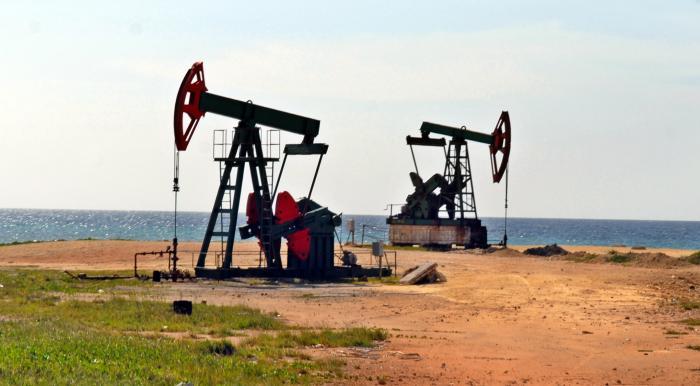



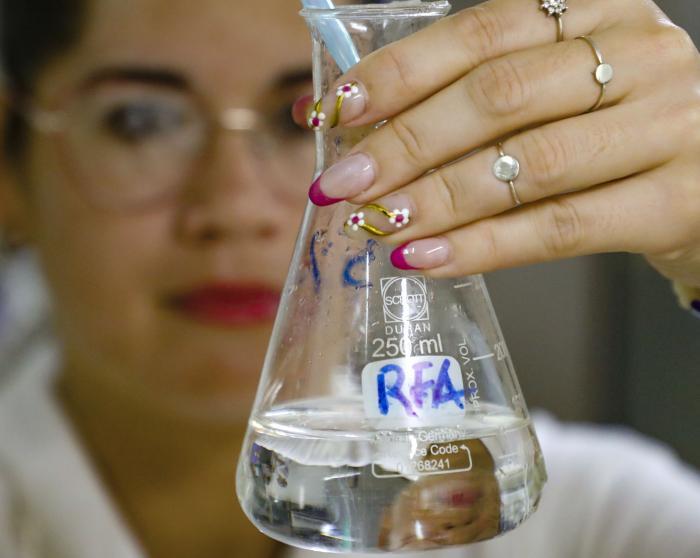
In times when every drop of fuel counts and the tightened blockade aims to stifle every last engine, news is circulating throughout the country that, thanks to the thermal conversion process—developed by Cuban scientists at the Center for Petroleum Research—the properties of the country's heavy crude oil, extracted from the northern region of Cuba, can be improved by reducing its viscosity and, to a lesser extent, its sulfur content.
To understand the magnitude of this qualitative leap, Granma spoke with Rafael López Cordero, senior researcher and advisor to the management of the Center for Petroleum Research (Ceinpet), who clarified that, first and foremost, it is necessary to consider that Cuba extracts a variety of crude oils, each with its own characteristics.
"We have light, heavy, and extra-heavy crudes. However, the country’s largest production, which takes place in the northern region, is of heavy crudes, which have a high content of compounds called asphaltenes. These asphaltenes are what give the crudes their high density and viscosity, as well as a high sulfur content."
–What specific difficulties does this composition cause?
–These compounds complicate the refining processes, but also those of transportation, pumping, and extraction. Because when they are extracted from the wells, they come mixed with water, and surfactants must be used to break these emulsions and recover the crude oil.
"Furthermore, they are so viscous that they are difficult to handle. Solvents must be used to lower the viscosity so they can be pumped through pipelines and fed into the boilers."
López Cordero added that these products come from two sources: the Sergio Soto refinery in Cabaiguán, which processes domestic crude and produces asphalt and a fraction of distillates that serve as solvents; the rest is produced from imported crude oils, which generates heavy naphtha, the same raw material used to make gasoline.
–So, what does the thermal conversion process do?
–First, let's be precise: thermal conversion is an upgrading process, not refining. Refining is the process of obtaining a range of fuels from crude oil—liquefied petroleum gas, gasoline, jet fuel, diesel, fuel oil, asphalt—that meet the quality standards demanded by the market. Thermal conversion improves the physical properties of crude oil. It reduces viscosity, eliminating the need for solvents, and the naphtha that was previously used for dilution will now be used to produce gasoline, significantly increasing the value of the crude.
"It would also lessen the environmental impact by slightly reducing the sulfur content, and if the improved fuel reaches power plants, we save resources and extend the life of the equipment."
In other words, in its non-catalytic form, it improves the fuel for more efficient transport and combustion, but it doesn't directly produce derivatives that meet the required standards.
López Cordero pointed out that this new technology, which is in the pilot scaling phase at the Sergio Soto refinery in Cabaiguán, consists of preparing an emulsion of crude oil in water which, when subjected to controlled heating, favors the transfer processes and allows the crude oil upgrading process to be carried out with greater stability.
–Why was the Sergio Soto refinery chosen to house the pilot plant?
–The Sergio Soto refinery processes domestic crude and has auxiliary facilities such as steam, treated water, and electricity, as well as trained operating personnel experienced in handling heavy crude. It's the ideal location because you don't have to start from scratch. You integrate the plant into an existing system. Furthermore, they have the crude oil already in their tanks; it wouldn't need to be transported specifically.
–What exactly will be done at that plant?
–The pilot plant isn't for producing oil, but for gathering data. The goal is to obtain engineering parameters: to determine temperature ranges, injection rates, and how these factors influence product quality. Then, with these parameters, we can design larger-scale modular units, intended to be located at the wellheads of the oil fields.
In this regard, López Cordero explained that this innovation is one of the Center's research lines, "which has been underway for several years and was put on hold due to various factors. But the intensified blockade and the shortage of solvents and naphtha are real, and we have to rely on our own resources."
Although these advances don't solve everything immediately, they represent a firm step toward making the most of what we have. And that in itself is progress toward energy sovereignty.