
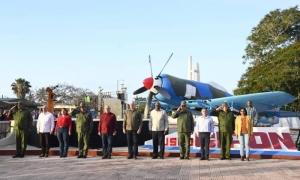

PLAYA GIRÓN, Ciénaga de Zapata.— First, the command to "Attention." Then, the National Anthem played; and to pierce the cool morning air of this Sunday, April 19th, the Last Post in a ceremony honoring the heroic: there, on the large plaque where the names of the martyrs of Bay of Pigs are engraved, just meters from the Museum, white flowers were placed; the first one by the President of the Republic of Cuba, Miguel Díaz-Canel Bermúdez.
In that area of Matanzas province—where Cuba achieved the first major defeat of imperialism in the Americas—the commemoration of the 65th anniversary of the Bay of Pigs Victory took place on April 19th. It was a moment to remember that on the same day in 1961, the country awoke to find its people ready to fight; and that in less than 72 hours, the revolutionary forces—represented by the workers', peasants', and students' militias, the Rebel Army, artillerymen, police officers, soldiers, pilots, tank crews, and doctors—with Fidel Castro at the helm, defeated the mercenary invasion.
That extraordinary event was commemorated this Sunday, in a ceremony also attended by Political Bureau members Salvador Valdés Mesa, Vice President of the Republic; Roberto Morales Ojeda, Secretary of Organization of the Central Committee of the Communist Party; and Army Corps General Roberto Legrá Sotolongo, First Deputy Minister of the Revolutionary Armed Forces (FARs) and Chief of the General Staff.
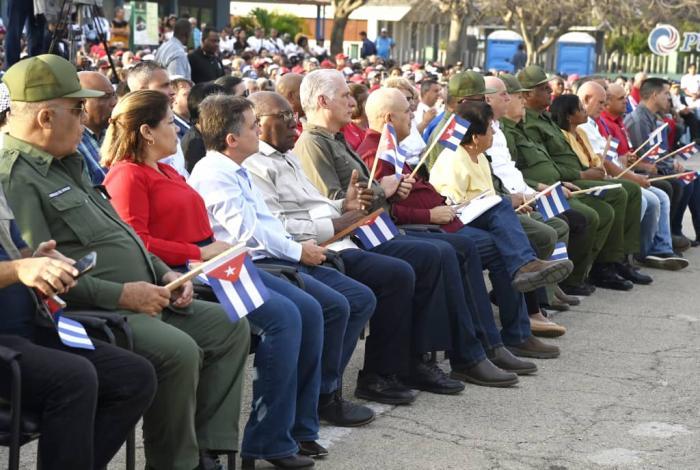
Also present were leaders from the Communist Party, the State, the Government, the Union of Young Communists (UJC), mass organizations, the Association of Combatants of the Cuban Revolution (ACRC), the FARs, and the Ministry of the Interior (Minint). Alongside the people of Zapata swamp were the highest-ranking Party and Government officials in the province of Matanzas. And still fresh from the emotions of the 5th International Patria Colloquium, key figures from that important solidarity event were also in attendance.
From the very beginning, the day was filled with beautiful artistic performances: The strains of Silvio Rodríguez's song "Fusil contra fusil" filled the air, performed by the singer-songwriter Silvio Alejandro Rodríguez; and the Korimakao Community Artistic Ensemble, the Revoluttion Performance Company, young people from the National Dance School, and the actor Denys Ramos took to the stage.
Major Yadian Daniel Medina of the Revolutionary Armed Forces (FARs) added his voice on behalf of the new generations. He spoke of the eternal glory that our heroes and martyrs deserve; he referred to the people of his birth—a people who "reaffirm their determination to be free and independent"—and he amplified the denunciation that "imperialism is determined to destroy the Revolution by all means."
Commenting on the defeat the empire suffered in April 1961, Yadian reflected that the invaders hadn't accounted for one thing: "Our people's determination to defend their Revolution."
The young man spoke about the U.S. blockade, now, he said, focused on preventing fuel from reaching the island. But he also recalled the epic resistance of a people who know all too well what it would mean to lose their Revolution. And among other ideas, he shared with everyone Fidel Castro's conviction that a people transformed into an army can never be defeated.
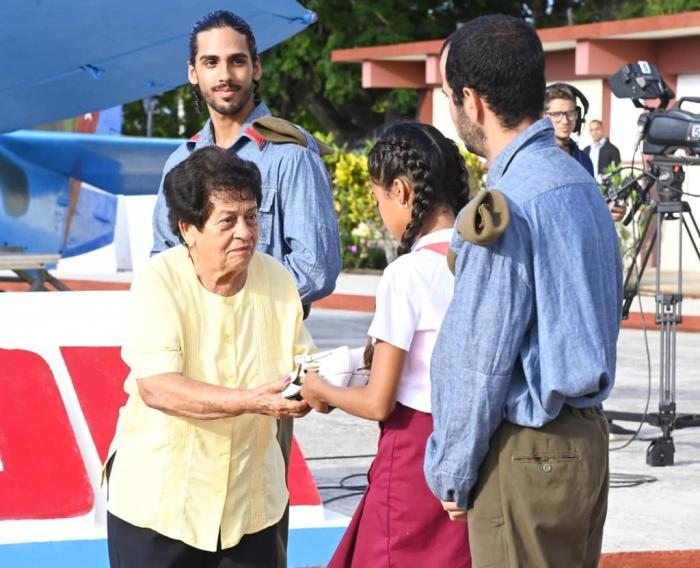
The poem Elegía de los zapaticos blancos (Elegy of the Little White Shoes), by Jesús Orta Ruíz (El Indio Naborí), was performed by musicians from the Korimakao Community Artistic Ensemble. The moving story was interwoven with José Martí's play "Abdala," performed by the University Theater Group of Havana. This served as a prelude to the words of Elianis Martínez Pérez, a young first-grade teacher at the Félix Edén Aguada Elementary School, who reminded everyone that, before January 1st, 1959, the Zapata swamp was a forgotten corner of the island.
She denounced the damaging effects of the imperial blockade. The siege, she said, aims to make us surrender through hunger and exhaustion. From her tireless work as a teacher, she emphasized that the empire has not given up on destroying Cuba's freedom and independence; and that the best way to show gratitude for all the humanist work of the Revolution is to study and work diligently.
On the very ground where the Island achieved its 1961 Victory, two talented Cubans, Nelson Valdés and Mayito Rivera, sang "Te doy otra canción" (I Give You Another Song). And once again, dance accompanied the moment.
The keynote address at the ceremony commemorating the 65th anniversary of the Bay of Pigs Victory was delivered by Comrade Roberto Morales Ojeda:
"Once again, Bay of Pigs call us together. This was not just a battle: it was the irrevocable will of the people that they would never kneel before imperial power. Here, in April 1961, the decision to be free was sealed with blood and courage. A victory that is both present and a commitment to the future," the Political Bureau member declared. He emphasized:
"Sixty-five years have passed since, on these very sands, mercenaries in the service of the most powerful nation in history believed they could crush the nascent Cuban Revolution in a matter of hours."
They came with the misguided and doomed idea that they would find a divided people ready to surrender. They were wrong; they ignored, just as they do today, our unequivocal conviction of independence or death. In less than 72 hours, the invaders were defeated.
Morales Ojeda emphasized that the victory at Bay of Pigs was the perfect synthesis of two inseparable forces: a people transformed into a militia, and a leader with the vision of a great strategist who knew how to embody the will to fight.
"Around 1,200 aggressors were taken prisoner. Almost the entire combat-ready mercenary force, not including fatalities." The party leader emphasized that "Bay of Pigs was the moment when the defense of our sacred land merged with a social project and a collective identity. That extraordinary triumph," he said, "constitutes a permanent declaration of national dignity, a demonstration that Cuba is prepared to respond to any aggression."
"In those days of glorious epic, the unity that gave birth to the Communist Party of Cuba was sealed, and this is symbolically recognized."
At another point in his speech, the Secretary of Organization of the Central Committee of the Communist Party of Cuba affirmed that, "since the beginning of the Revolution, the transformations undertaken have been based on a policy of justice and constant concern for the people’s problems. In the months leading up to the invasion, for the first time, land was transferred to its rightful owners with the Agrarian Reform Law; healthcare became a right for all; and the Literacy Campaign, the most significant cultural achievement in revolutionary history, was underway, among other accomplishments."
"All of this work, taken together, unleashed the hatred of imperialism, which had spent months, even years, studying how to destroy the dangerous example that this nation represented for its interests."
In a report detailing numerous imperialist aggressions, Roberto Morales Ojeda denounced that "they cut off our credit lines; they closed the doors to the source from which the country imported oil; they deprived us of our sugar quota; they imposed a fierce economic blockade; they organized sabotage, acts of piracy, and counterrevolutionary groups; they tried to assassinate the leaders of the Revolution on multiple occasions. They tried everything, and everything failed."
COLLECTIVE SENTIMENT OF THE RESISTANCE
"The current circumstances of our daily lives are harsh. We know it. We face economic difficulties, enormous challenges, supply shortages, and material limitations—the vast majority of which are a consequence of the blockade—but we do not surrender to such challenges, however insurmountable some may seem. The Revolution does not collapse, nor will it ever collapse," asserted Roberto Morales Ojeda.
That will—reflected the member of the Political Bureau—was ratified by more than 50,000 Cubans at the patriotic event on April 16, commemorating the 65th anniversary of the Proclamation of the Socialist Character of the Revolution, where a national and international movement was called for to carry the truth about Cuba to every corner of the planet.
"We know," he emphasized, "that the enemy does not abandon its sinister plans. The economic, commercial, and financial blockade has intensified, now transformed into an inhumane energy siege that seeks to suffocate us. The media campaigns, disinformation, diplomatic pressure, threats, sanctions—this entire arsenal—is being used against us today with the same ferocity and the same frustration as more than six decades ago."
"Now, as then, unity and firmness are the pillars that cannot be weakened. The urgency of vindicating Cuba and reinforcing the convictions we defend is clearer than ever." That is the essence captured in the Declaration of the Revolutionary Government Bay of Pigs is today, and forever, published in the Granma newspaper this Friday, in support of the words of the First Secretary of the Central Committee of the Communist Party of Cuba.
"And it is also this collective sentiment of rejection of the threats, and of defense of our sovereignty, that has been made abundantly clear in the appeal issued by Cuban revolutionary civil society organizations, which, together with the Cuban Association of the United Nations, have raised their voices so that solidarity, the sense of justice, and Cuba’s reasons for standing up may spread throughout the world."
The party leader, invoking the legacy of the Bay of Pigs veterans, called "from today and in the coming days for people to sign in support of this appeal, which will constitute a powerful demonstration of backing against the genocide that the blockade represents, and of our people’s profound desire to build a prosperous future and live in peace."
Morales Ojeda also spoke about the war we do not want, but which, if it occurs, we will face with the irrevocable conviction of a people transformed into a huge hornet's nest against the invader,” he emphasized: "We reaffirm our commitment to continue the work that has always identified the Cuban Revolution and that is also palpable in this place today."
Toward the end of his remarks, the member of the Political Bureau stated that "Bay of Pigs was not just another battle" and that, as Fidel affirmed, "it was the first great defeat of imperialism in the Americas, and that made it a symbol."
"Bay of Pigs is still relevant today, because victory is built every day in the defense of the Homeland, in the effort to overcome the complex electricity situation, working to increase renewable energy sources, in food production, raising the quality of services, and confronting speculative prices, indiscipline, illegal activities, and manifestations of corruption."
"Today's battle is to overcome difficulties, for the gradual recovery of the economy, and for the improvement of Cuban socialism. And this battle, like that of Bay of Pigs will win with unity, with awareness, with creativity, and with work. Cuba wants peace and promotes peace, but it knows no fear."
Morales Ojeda emphasized that “the nascent Revolution, which the imperialists sought to annihilate in 1961, did not advocate war, nor did it pose a threat to the American people.”
"Even so, it was attacked, it defended itself, and it triumphed. Today, the solid and humanist Revolution is also not a threat to the American nation, nor does it seek war. But just as then, we will know how to defend ourselves, convinced that we will also triumph."
"Faced with any aggression, as in the Bay of Pigs invasion, we will prevail," stressed the Secretary of Organization of the Central Committee of the Communist Party of Cuba.
Then came a special moment: "La Victoria," a song by Sara González, was performed by Annie Garcés. Amidst dancing, standing on a tank and holding a vibrant Cuban flag, the young woman moved everyone with her voice, in an artistic performance that exuded both beauty and strength.
As part of the ceremony this Sunday at Bay of Pigs, every Cuban present inscribed their name in a large book, thus beginning the popular movement "My signature for the Homeland," which will spread throughout the island as part of the actions denouncing the blockade and the measures of encirclement and economic strangulation against the Cuban people.
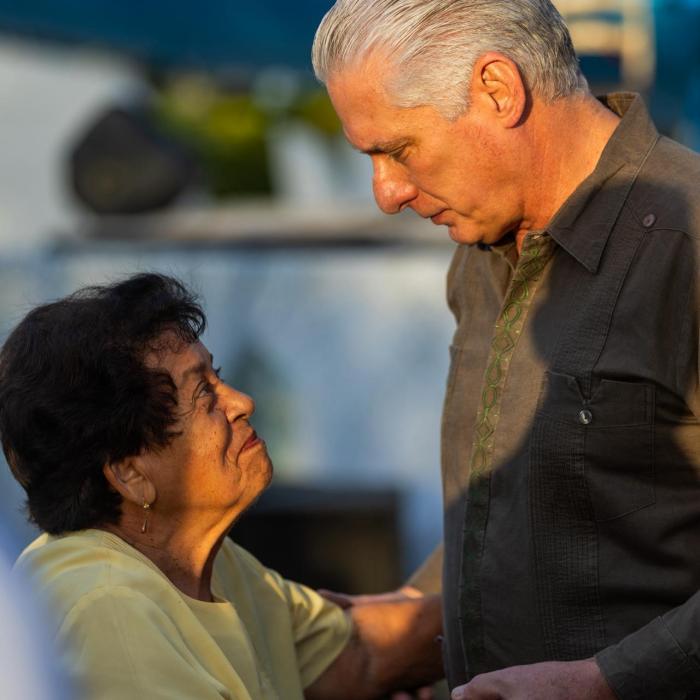
A special detail seemed to link those hours of 1961 with the present: among the crowd was Nemesia, a woman who lives and resists, and whom we all know. She was the little girl who dreamed of white shoes, the one who experienced the terror of war firsthand. She, with her dreams pierced by bullets, was immortalized in the verses of Indio Naborí, in the elegy to the little white shoes. And with her, the poet paid tribute, forever, to the strength of an entire people.