
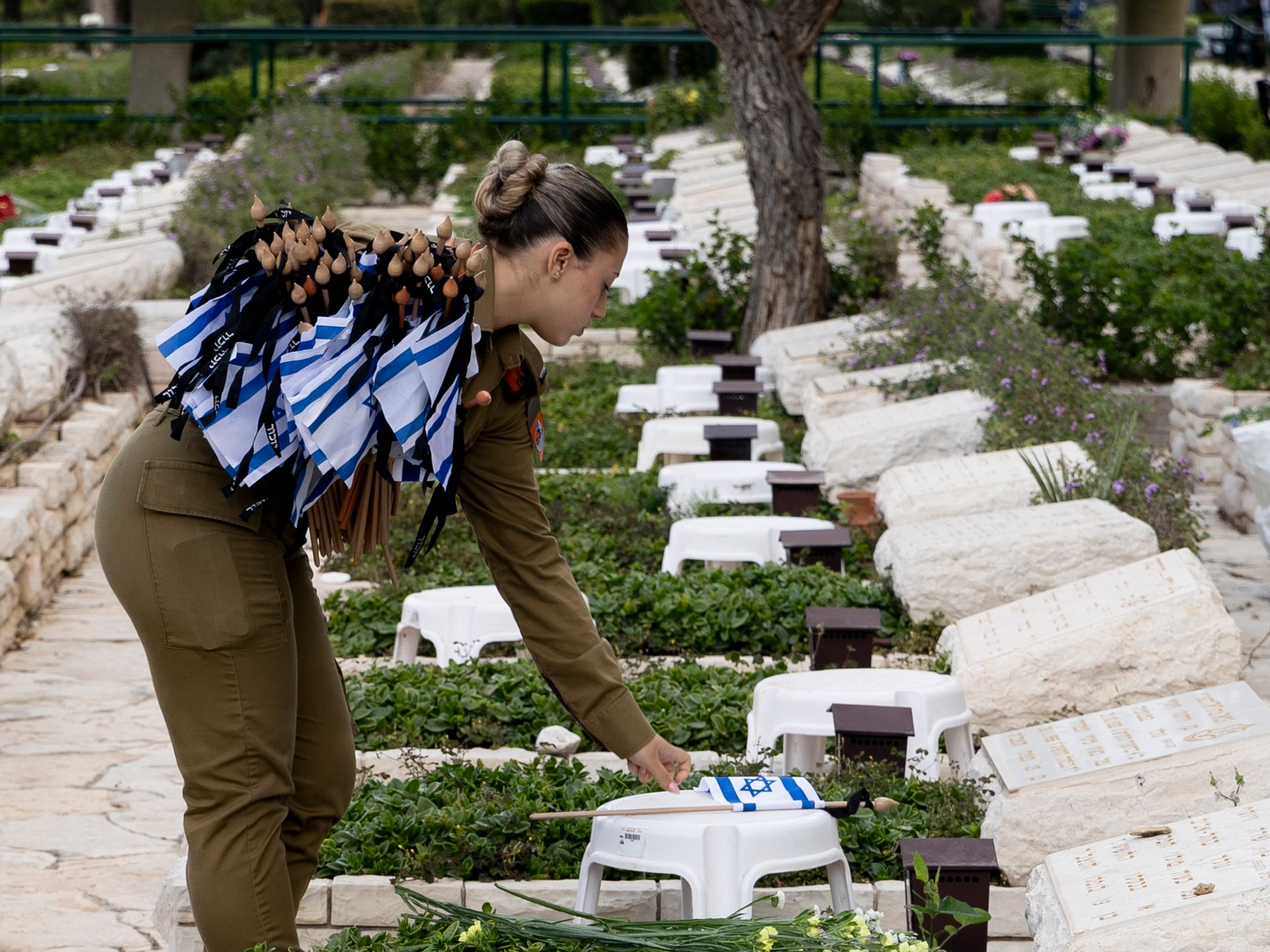

With the sounding of a siren at 8pm on Monday, Israel begins the commemoration of Memorial Day, remembering soldiers killed since the establishment of the first Jewish settlements in Palestine in 1860, through Israel’s many wars with its neighbours and attacks on Palestinians, up to those who died enacting its genocide in Gaza.
The day is observed every year on the 4th of Iyar on the Hebrew calendar – corresponding this year to the evening of April 20 and the day of April 21. Traffic stops, silences are observed, wreaths are laid, places of entertainment are closed, and, on television, normal programming is suspended – replaced by the names of Israelis killed in the 166 years since settlement is regarded as having begun – 88 years before the Nakba, and the ethnic cleansing of 750,000 Palestinians on Israel’s official founding as a state.
- list 1 of 4‘Vengeance for all’: How Iran’s Lego videos won narrative war against Trump
- list 2 of 4Israeli ministers celebrate re-establishment of Sa-Nur West Bank settlement
- list 3 of 4As barbed wire blocks kids from class, Palestinians stage ‘Freedom School’
- list 4 of 4The EU must not wait till Israel starts executing Palestinians
end of list
This year, the list will include the names of 25,644 soldiers as well as 5,313 civilians. Not featured anywhere will be details of the hundreds of thousands of Palestinians killed over the same period.
In last year’s commemoration, Israeli Prime Minister Benjamin Netanyahu went to pains to cast the events of the day against the background of the Hamas-led attack of October 7, 2023, which killed 1,139 Israelis, without reference to the more than 72,000 Palestinians Israel went on to kill in Gaza during its two-year war on the besieged enclave.

“From disintegrating Rafah to the high peak of Mount Hermon [Syria’s Jabal al-Sheikh], our sons and daughters are not willing to accept what the monsters did when they attacked us,” Netanyahu said.
Advertisement
“They are determined to do justice with the perpetrators of the massacre and the horrors, and even in these very moments, they endanger themselves to create the conditions that will allow the return of all of our hostages and victory over our enemies,” Netanyahu added, maintaining a narrative of sacrifice in the face of existential threat that has characterised much of his political life.
In recent years, according to critics, those narratives of sacrifice and threats have consolidated into a nationalism with little patience for questions or dissent, one that has underpinned Israel’s violent expansion into the occupied West Bank and cast aside any concerns over international law or norms in Gaza.
Contested past
“Memorial Day is a particularly tough time for those demonstrating against the wars,” 18-year-old Allon Rivner, one of a growing number of young Israelis refusing to serve in the military, told Al Jazeera from northern Israel. “There’s an expectation that the day should only be about the Israeli dead, so people don’t like it when you try to talk about Palestinians.
“I’m currently volunteering and have been asked to talk to some younger people today about what Memorial Day means,” Rivner explained, saying that he had already been criticised over his plans to include Palestinian deaths among the Israeli ones in his presentation. “That’s just one example. There are more. I think people just don’t like the idea that these soldiers might have died for nothing. Look, my grandmother’s brother was killed in the 1973 war, and I have no problem saying he died in vain. All of these deaths are in vain.”

Annual attempts to mark Memorial Day in a manner that acknowledges the tens of thousands of Palestinians killed have suffered in the face of official resistance and right-wing threats. In the past, governments have attempted to ban Palestinians from attending the joint Israeli-Palestinian memorial ceremonies, while activists from across Israel’s growing network of right-wing groups have threatened such ceremonies and those who attend.
This year, the event has been reduced to being held online.
“For Palestinians, this day is a tragedy. This is why we have a very different vision of it,“ said Hassan Jabareen, the founder of Palestinian legal rights organisation Adalah. “For Israelis, it’s a day of remembering their soldiers, but for Palestinians, Memorial Day and the day that follows it, Independence Day, just bring back memories of the Nakba.”
Advertisement
Radicalised future
Complaints are increasing that Memorial Day is becoming more politicised as Israel’s far-right and settler communities play an increasingly vocal role in government. During a pre-Memorial Day speech in the occupied West Bank, Israel’s far-right Finance Minister Bezalel Smotrich warned that the fighting would only halt after “hundreds of thousands” of Palestinians had been successfully displaced from Gaza and that Syria had been partitioned.
These were not the goals of a specific government, but rather constitute the “consensus of a people who desire life” and “the final picture of a campaign that was forced upon us”, Smotrich said of the series of conflicts that Israel has embarked on since 2023, which have directly and indirectly killed hundreds of thousands of people and now – with the consequences of the war with Iran – threaten the global economy.

“It’s been getting more right wing and more political since the current coalition came to power in 2022,” said Nimrod Flashenberg, a spokesperson for Mesarvot, an association supporting Israelis who, like Rivner, refuse military service. “It’s always been fraught, but it’s definitely getting more so.”
Flashenberg noted that officials have chosen to honour Rabbi Avraham Zarbiv as a torchlighter in this year’s Independence Day ceremony, as someone who has contributed to Israel. Zarbiv lives in an illegal settlement in the occupied West Bank and gleefully films himself driving bulldozers to destroy Palestinian homes.
“[That] tells you all you need to know,” Flashenberg said.
Related News
Hegseth says US blockade to continue, ready for new attacks on Iran energy
Russia’s Lavrov visits China as US pressures Iran with Hormuz blockade
US judge blocks Justice Department bid to seize voter data in Rhode Island