


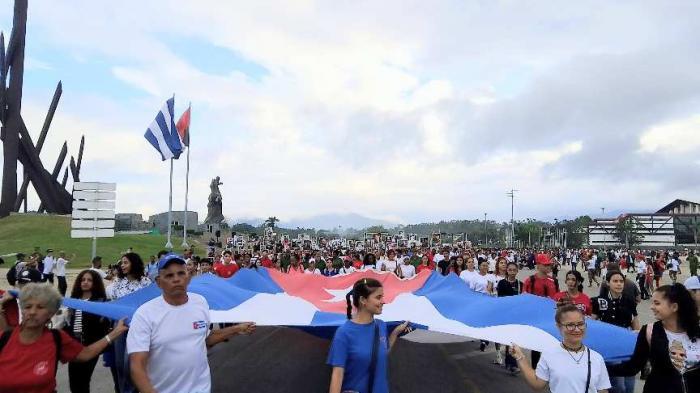
Santiago de Cuba.–" Let's march for Fidel, for the Revolution, and for Cuba," were the words of young Adriano Giro Mustelier addressed to the people of Santiago who marched from the Antonio Maceo Grajales Revolution Square to the Santa Ifigenia Heritage Cemetery to commemorate the ninth anniversary of the burial of Commander-in-Chief Fidel Castro Ruz's ashes in the emblematic cemetery.
The crowd marched down Patria Avenue, which leads to the National Monument, "and we do so because Fidel and his example are more necessary today than ever," a university student who participated "as a child in the march that inaugurated these heartfelt tributes with the cry of 'I am Fidel' told Granma.
People of all ages, to the sound of the March of July 26 and patriotic songs, made it clear that, in the midst of recovery after Hurricane Melissa and the intensified blockade, the Revolution remains firm and supports the brotherly Venezuelan people, who are facing the new aggressions of U.S. imperialism with dignity.
FIDEL, BETWEEN THE BRUSH AND THE FEELING
The 18 canvases that make up the exhibition Siempre Alejandro (Always Alejandro) by Nelson Domínguez, winner of the National Prize for Plastic Arts, on display in the Cinco Palmas room of the Fidel Castro Ruz Center, can be described as stunningly beautiful. The exhibition invites us to think once again about the Commander-in-Chief, through the tones and strokes of an artist who carries him in his heart.
From the paintings, the faces of the eternal leader of the Cuban Revolution speak to us. From them emerges his imposing figure alongside José Martí (Soul Mate) or Raúl (The Brothers); or in contact with other motifs of obvious allegories, such as the horse, the windmills, the children, or the books.
The artist was more interested in the scene than the movement, he tells us, and he shows us this in pieces such as Cinco Palmas, Fidel Guerrillero (Guerrilla Fidel), La Guerra Necesaria (The necessary war), and Fidel en la Sierra (Fidel in the Mountains). "These are works in which I am searching for my Fidel. The purpose was not to make a portrait, but an interpretation. These are not definitive works, but studies, with the aim of perhaps creating something of greater scope."
Juan Martín Soler, curator of the exhibition, explains to the audience in the room, which includes many children, that in each of the pieces, Nelson is showing us the Fidel he had the opportunity to meet when the Revolution was brewing in the mountains, and with whom he later shared important and unforgettable moments.
Alejandro always invites us to evoke and remember a Fidel who belongs to all times.