
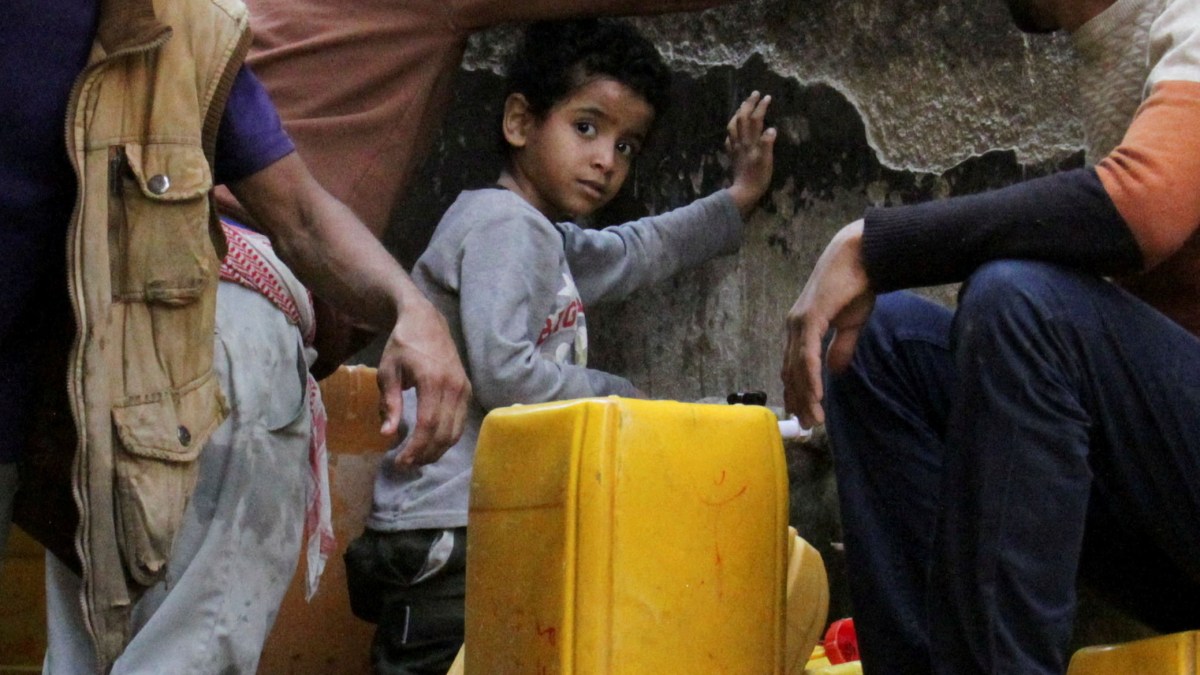

Taiz, Yemen – Qaid al-Sharaabi waited three days before it was his turn to receive a tanker of clean water.
But the delay is not the only problem. He says he now has to pay more – the result of the Houthi siege on Taiz, in southwestern Yemen.
Recommended Stories
list of 3 items
- list 1 of 3Saudi Arabia says Houthi attack damaged Riyadh tower
- list 2 of 3Saudi coalition hits 60 Houthi military sites; Taiz sees ‘fierce battles’
- list 3 of 3How the Houthis fund war effort and tighten grip on Yemen
end of list
“This is the second time since the siege began a month-and-a-half ago that I’ve had to pay twice the price for a water tanker,” al-Sharaabi told Al Jazeera. “I’m afraid that if things continue like this, more residents will resort to using unsafe water.”
The United Nations children’s agency (UNICEF) says that water production in Taiz has nearly halved, while more than 800,000 people are reported to be cut off from humanitarian assistance.
The crisis has left the city reeling, even as government soldiers try to defend it, in the latest round of fighting to hit the area since the war in Yemen started in 2014.
Hospital administrators are warning of a public health disaster, while government officials are unsure how much longer they will have the funds needed to carry out even limited services.
Taiz, Yemen’s third-largest city, has long suffered from severe water shortages.
But, according to Wafiq al-Aghbari, director-general of Taiz governorate’s Local Water and Sanitation Corporation, the crisis “intensified in 2015, with the first siege imposed on the city by the Houthis, and continued to worsen year after year, as the suffering of the city’s residents grew”.
He said the crisis has deepened since the Houthis laid siege to the city again in October, after they made advances against government forces in the countryside around Taiz.
Advertisement
Before the war started in 2014, al-Aghbari explained, Taiz received about 20,000 cubic metres (700,000 cubic feet) of water per day from six large wellfields, which had supplied the city and its immediate surroundings for years.
But only one of those wellfields is inside the city limits, and before the war, it had only been used in emergencies.
By 2015, Taiz had lost access to all five of its external wellfields, which had either fallen under Houthi control or were on the front lines, leaving the city reliant on its emergency wells.
But work in the past few years to dig additional wells and rehabilitate existing sources had brought daily production capacity up to 5,000 cubic metres (175,000 cubic feet) – still just 14 percent of the city’s estimated daily needs.

Tightening siege
The Houthi encirclement of Taiz in October led to the Iranian-backed group seizing control of Hadhran al-Dhabab, an external wellfield that had been partially restored in August 2025.
The situation has led to the water corporation losing 3,200 cubic metres (112,000 cubic feet) of daily production capacity – 1,200 cubic metres (42,000 cubic feet) after pumping stopped from the Hadhran al-Dhabab wellfield, and a further 2,000 cubic metres (70,000 cubic feet) after wells inside the city stopped operating because of a shortage of diesel. The corporation is now able to produce only 1,800 cubic metres (63,180 cubic feet) a day from the emergency wells that it can still operate.
Al-Aghbari said the consequences of the siege had extended beyond the widening gap between water supplies and demand.
Funding and supplies for the city’s charitable water distribution points, known as “sabeel”, have also been disrupted, because of shortages of fuel and water.
According to al-Aghbari, the subsidised distribution points had previously provided up to 1.5 million litres (396,000 gallons) of fresh water a day, alongside a further 1 million litres (264,000 gallons) of untreated water.
“The water corporation has entered a major financial crisis as a result of the loss of most international and local funding for its operations, at a time when the corporation is also under immense pressure because of the growing shortfall in meeting local water needs,” al-Aghbari said.
He added that this was especially problematic because more residents cannot afford to buy commercially-supplied water as a result of the worsening economic situation, and become more dependent on the free water distribution points.
Advertisement
The owner of one commercial water tanker, who did not want to give his name for security reasons, said that prices had risen sharply at the beginning of the siege, from 18,000 riyals per tanker (about $12 at parallel market rates) to 30,000 riyals (about $20).
He continues to try to pick up water from the Hadhran al-Dhabab wellfield, but said that the process had become difficult.
“[That is] because of the consequences of the siege, including the inspection procedures imposed by the Houthi group … which last for hours,” he said. “Sometimes we are prevented from entering and remain outside the city for more than a day, on the grounds that there are risks because of heightened military and security tensions.”
The Houthis have denied responsibility for the closure of roads into Taiz. Human Rights Watch has said that residents, aid workers, and UN officials had blamed the armed group for shortages in the city.
Contaminated water
The consequences of the siege have gone beyond its humanitarian and economic impact, with serious implications for public health, according to Dr Abdulqawi al-Shamiri, the director of Taiz’s al-Taawun Hospital.
He warned of “serious health disasters because of the interruption of safe water supplies that residents used to obtain from groundwater fields outside the city”.
Al-Shamiri said water from the emergency wells within the city had “long been unfit for human use, as a large proportion of it has become contaminated, or is hard water containing high concentrations of salts”.
He explained that the contamination was the result of sewage mixing with water because of poorly maintained sewage networks, and rubbish dumped in streets and floodwater channels. The Houthis, al-Shamiri said, have prevented waste from being transported to a landfill outside the city.
According to an internal report from the governorate’s Cleaning and Improvement Fund, close to half of the city’s rubbish is going uncollected.
Residents are contracting illnesses such as cholera and acute diarrhoea as a result, Al-Shamiri said.
“The rubbish quickly decomposes into extremely dangerous bacteria and chemicals that increase the existing contamination of the city’s well water, making it unfit for human use,” al-Shamiri said. “Unfortunately, however, most people are being forced to use it under the current circumstances because of the difficulty of accessing clean, safe water.”
Related News

Why is China resisting a nuclear treaty with the US and Russia?
Xi Jinping says Taiwan’s ‘complete reunification’ with China will happen
Syria considering entry into Mecca defence pact, says foreign minister