
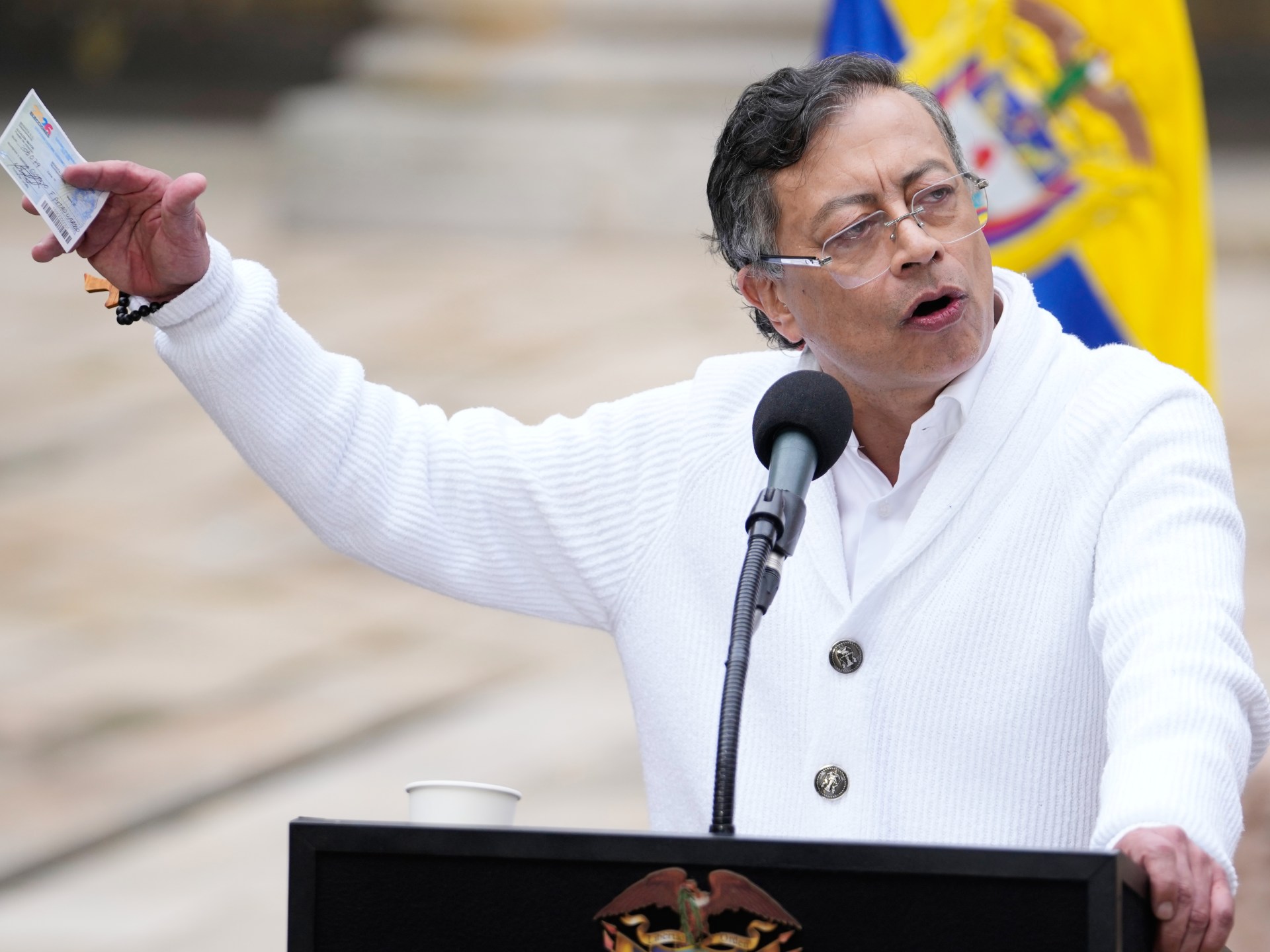

Colombia’s outgoing leftist president, Gustavo Petro, has alleged electoral fraud after preliminary results from a presidential run-off saw his handpicked candidate lose by a small margin.
In a barrage of posts on the social media site X on Monday, Petro alleged that the opposition bought votes and Israel and the United States interfered to help opposition far-right candidate Abelardo de la Espriella win.
- list 1 of 4The myth of white Argentina still shapes the nation
- list 2 of 4US military chief Hegseth warns Cuba against acquiring military arms
- list 3 of 4Continuity or change? What to know about Colombia’s run-off election
- list 4 of 4US kills 3 in strike on alleged drug smuggling boat in Eastern Pacific
end of list
Petro has refused to recognise the results and has called for an investigation by the judiciary.
The president, who was barred by the constitution from running for a second term, was Colombia’s first leftist president, putting him at odds with the US.
His administration is praised for reforms that boosted social spending, raised the minimum wage and redistributed land to poorer families. Petro also cut ties with Israel over Israel’s genocidal war on Gaza and distanced himself from US President Donald Trump’s administration.
However, critics said his refusal to accept the election results risks inflaming political tensions – and violence. Here’s what we know:

What are the election results?
The first round of the presidential election was held on May 31. Neither of the two leading candidates – Abelardo de la Espriella of the right-wing Defenders of the Homeland movement and Senator Ivan Cepeda of the ruling Historic Pact – secured at least 50 percent of the vote, leading to a run-off on Sunday.
Advertisement
De la Espriella narrowly won with 49.66 percent over Cepeda’s 48.7 percent, according to preliminary results released on Monday by the National Registry, which manages vote numbers.
The razor-thin difference amounts to less than 1 percent of the vote and represents one of Colombia’s closest elections.
Trump-backed de la Espriella, 47, is to take office on August 7. The criminal lawyer is a multimillionaire who campaigned on tougher security and anti-leftist policies. He also has US citizenship.
De la Espriella’s win is part of a recent trend of Latin American countries electing far-right, populist leaders who are pro-Trump. Argentina’s Javier Milei, Honduras’s Nasry “Tito” Asfura, El Salvador’s Nayib Bukele and Costa Rica’s Laura Fernandez Delgado all have close ties to the Trump administration.
Why is Petro alleging fraud?
Petro took to X to denounce in a series of posts what he said was voter fraud committed with the help of Israel and Prime Minister Benjamin Netanyahu.
Petro said there was evidence of manipulation of Form E-14, the official, handwritten tally of sheets filled out by poll workers at each voting station.
The form is a physical record of the vote count and is meant to prevent electoral fraud. It is filled out by hand, and digital scans are also uploaded to the National Registry’s portal for public auditing. If found to have errors, parties may request a recount.
Petro alleged that foreign actors accessed the National Registry’s website and rewrote voting data on some E-14 forms.
“Today we have evidence of a change in IP addresses of several servers of the national registry,” he posted.
“This means that the software was compromised and others wrote data for polling stations and voting posts. The only entity in the world capable of doing that is the state of Israel,” Petro added without providing evidence of Israel’s alleged involvement.
Petro said his party had requested a “technical audit” of the voting software before the elections and asked authorities to retrieve the digital footprints of all digitally transmitted documents to avoid modification. He claimed those requests were ignored.
The outgoing president shared videos of what he alleged captured the “premeditated” modification of E-14 forms. He also claimed the manipulation was done “from the offices of the Bautista brothers”.

Who are the Bautista brothers?
Petro was referring to Thomas Greg & Sons, an influential private logistics and security printing firm that runs Colombia’s electoral infrastructure. Until recently, it also printed Colombian passports.
Advertisement
It is run by brothers Fernando and Camilo Bautista Palacio. The duo was convicted of bank fraud in the US in the 1980s.
Thomas Greg & Sons, which was founded by their father, Gregorio, has been contracted by the National Registry for more than a decade to manage election logistics, preliminary vote counting and vote-tallying software.
Petro in April accused the Bautista brothers of negotiating a deal with de la Espriella that would see them secure the presidency for the far-right candidate in return for clinching passport printing contracts once more.
At the time, de la Espriella refuted the claims, and his lawyers threatened Petro with a lawsuit.
Attorney General Gregorio Eljach has dismissed the allegations and told reporters there is “no evidence of fraud” with more than 99 percent of the votes counted.
De la Espriella, meanwhile, has so far not responded directly to Petro.
Yes, de la Espriella has consistently voiced support for Israel and campaigned in Colombia’s Jewish community, making pro-Israel promises and saying his government would “defend Judeo-Christian principles”.
He pledged to reverse Petro’s 2024 decision to cut ties with Israel and has promised to relocate the Colombian embassy to Jerusalem.
Netanyahu congratulated de la Espriella on Monday, saying: “I look forward to working with you to strengthen the bond between Israel and Colombia.”
How has the US reacted?
In his posts, Petro also blamed Trump for interfering in the elections by publicly endorsing a candidate and thus swaying voters.
Trump endorsed de la Espriella on his Truth Social platform weeks before the run-off.
Trump and US Secretary of State Marco Rubio also congratulated de la Espriella on his preliminary win, and Trump took credit for the far-right candidate’s victory.
“He was in 10th place. I endorsed him, and he won the election. He called me last night and thanked me for the endorsement,” Trump told reporters at the White House on Monday.
Rubio wrote on X: “The Trump administration looks forward to working closely with your incoming administration to advance regional security cooperation, end illegal immigration to the United States, and strengthen our economic ties.”
Petro has invited Trump to make a statement on the electoral fraud allegations.
“I formally invite President Donald Trump to speak,” Petro wrote, adding that the US president bears responsibility for “having supported a candidate and not the freedom of the Colombian people”.
What is the US-Colombian relationship like?
Although both countries have close trade ties, diplomatic relations have often been strained over drug trafficking policies and relations with Israel, among other issues.
But relations essentially collapsed under the Trump and Petro administrations.
Petro in January last year refused to allow US migrant deportation planes to land in his country and said on X that the US “cannot treat Colombian migrants like criminals”.
In October, the US sanctioned Petro, his family and key officials in his government based on unproven allegations of involvement in the drug trade.
Advertisement
In January this year, the US military abducted leftist Venezuelan President Nicolas Maduro from his Caracas home after the Trump administration accused him of “narcoterrorism”.
Related News
Ukraine says it hit missile electronics plant in western Russia
Petrol shortages and ‘oil rain’ bring Russia-Ukraine war home to Moscow
US export ban on Anthropic’s AI models further strains alliances