
US Supreme Court allows Texas to use redrawn district map for 2026 midterms
 04 December 2025
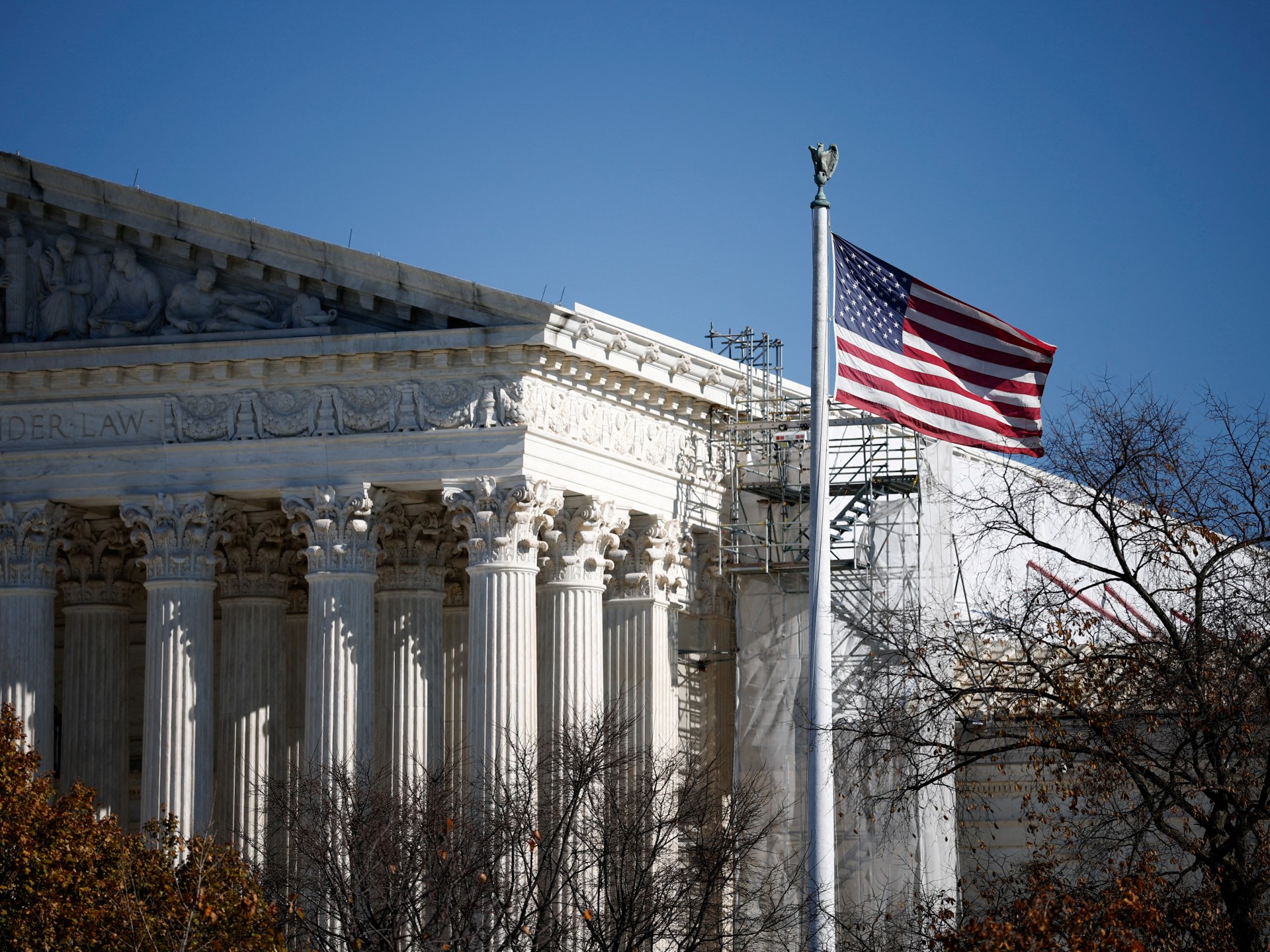

The United States Supreme Court has ruled that the southern state of Texas may proceed with using a controversial map of congressional districts designed to favour Republicans in the 2026 midterm elections.
Thursday’s decision was split along ideological lines, with the court’s six conservative justices giving the new map the go-ahead and the three liberal ones joining together in dissent.
- list 1 of 3Trump administration joins lawsuit against California’s redistricting maps
- list 2 of 3Tennessee special election results: What we know about Matt Van Epps’s win
- list 3 of 3US Supreme Court blocks order on likely racial bias in new Texas voter map
end of list
The ruling lifts a lower court’s order from November that had blocked Texas from using the new congressional map. The lower court had found that Texas had “racially gerrymandered” the districts, in violation of the US Constitution.
But Texas quickly filed an emergency appeal to the Supreme Court, urging quick action to overturn the hold.
After all, it argued, campaigning for the midterm races in November 2026 is already underway, and candidates need to understand where their constituents lie.
In a brief, unsigned order, the conservative majority found that Texas was likely to prevail “on the merits of its claims”.
It also cited court precedent that “lower courts should ordinarily not alter the election rules on the eve of an election”. Doing otherwise, the order said, would cause “irreparable harm” to the state.
The map in question has set off a nationwide scramble to redesign congressional districts ahead of the all-important midterm races.
Thursday’s Supreme Court ruling is likely to fuel further attempts to redraw maps in favour of one party or another.
A nationwide trend
The controversy started in June, when reports emerged that President Donald Trump was pushing Texas state legislators to adopt a new congressional map, one that would help Republicans scoop up an extra five seats in the US House of Representatives.
Advertisement
Texas is considered one of the largest Republican strongholds in the country, given its large population. Currently, the state has a whopping 38 seats in the House, 25 of which are occupied by Republicans.
But the Republican majority overall in the House of Representatives is narrow: The party holds only 220 of the 435 total seats.
Democrats are therefore seeking to flip the chamber in the 2026 midterms, when every congressional district holds a new election. Strategists on the left see Trump’s wilting poll numbers as an opening to make gains.
Just this week, the research firm Gallup found that the Republican president’s approval rating had dropped five points to 36 percent, marking the lowest point of his second term.
But Trump and his allies have pushed back. One of their strategies has been to promote partisan redistricting, a process sometimes called gerrymandering.
The trend started with the Texas effort. Despite being outnumbered in the state legislature, Democrats tried to stop the process, even leaving the state entirely to avoid voting on the new congressional map.
But ultimately, they were forced to return. And in August, the Texas state legislature passed the new districts.
That triggered a kind of redistricting arms race across the country, with Republicans and Democrats in other states seeking to redraw their maps to angle for more congressional seats.
In September, Republicans in Missouri passed a new gerrymandered map, and in October, North Carolina followed suit. Both states are expected to earn Republicans one additional House seat a piece.
Then, in November, voters in California approved a ballot initiative championed by Democratic Governor Gavin Newsom that would suspend the state’s independent election commission and replace its work with a new partisan map.
That effort was designed explicitly to neutralise any gains by Texas Republicans: The new California map is intended to nab Democrats five additional House seats.
A legal dilemma
But partisan redistricting has long been controversial in the US, with voting rights advocates warning that it disenfranchises minority communities.
Gerrymandering, however, is not strictly illegal.
Normally, states draw new congressional districts once every decade, to reflect demographic changes in the US census. After all, the number of representatives each state has is a reflection of its overall population, and as the number of residents grow or shrink, the number of districts must change accordingly.
In many states, it’s up to the legislature to draw those new congressional maps, and the decisions are often partisan affairs.
Advertisement
While the Supreme Court has acknowledged that partisan gerrymandering can threaten democracy, it has ruled that federal courts cannot determine if legislatures have gone too far in redrawing their maps.
There is, however, one exception: Gerrymandering on the basis of race is off-limits. The US Constitution and the Voting Rights Act of 1965 both contain protections to ensure voters are not divided and disenfranchised based on their race.
That’s how Thursday’s case — Greg Abbott v the League of United Latin American Citizens — ended up before the Supreme Court.
In November, in a two-to-one decision, the US District Court for Western Texas sided with plaintiffs who argued that the new Texas map was explicitly designed to dilute the power of Black and Latino voters in the state.
The court pointed to statements made by Trump administration officials and Texas Governor Greg Abbott, seeming to target congressional districts with non-white majorities.
But the Supreme Court on Thursday ruled that the district court had “failed to honor the presumption of legislative good faith”. It also described the statements referenced in the lower court’s decision as “ambiguous” and “circumstantial evidence”.
Right-wing Justice Samuel Alito went a step further, arguing that it was difficult to disentangle what was legal gerrymandering and what was race-based discrimination.
“Because of the correlation between race and partisan preference, litigants can easily use claims of racial gerrymandering for partisan ends,” Alito wrote.
If the motive behind the new Texas map was simply race-based, Alito asserted that it was up to the plaintiffs to show how a partisan map would differ from a race-based one.
Race to the midterms
Republican politicians quickly applauded Thursday’s ruling as vindication for their efforts.
“We won! Texas is officially — and legally — more red,” Governor Abbott wrote on his social media.
“The Supreme Court restored the congressional redistricting maps passed by Texas that add 5 more Republican seats. The new maps better align our representation in D.C. with the values of Texas.”
Texas Attorney General Ken Paxton, meanwhile, highlighted his efforts in defending the Republican map.
“In the face of Democrats’ attempt to abuse the judicial system to steal the U.S. House, I have defended Texas’s fundamental right to draw a map that ensures we are represented by Republicans,” he said in a statement posted online.
“Texas is paving the way as we take our country back, district by district, state by state.”
But in a stinging dissent, Justice Elena Kagan questioned whether her colleagues on the Supreme Court had thoroughly considered the evidence.
She contrasted the lower court’s approach with what she described as the high court’s hasty one.
“The District Court conducted a nine-day hearing, involving the testimony of nearly two dozen witnesses and the introduction of thousands of exhibits. It sifted through the resulting factual record, spanning some 3,000 pages,” Kagan wrote.
Advertisement
“And after considering all the evidence, it held that the answer was clear. Texas largely divided its citizens along racial lines to create its new pro-Republican House map, in violation of the Constitution’s Fourteenth and Fifteenth Amendments.”
The district court, Kagan pointed out, also explained its reasoning in a lengthy 160-page decision.
“Yet this Court reverses that judgment based on its perusal, over a holiday weekend, of a cold paper record,” she said. “We are a higher court than the District Court, but we are not a better one when it comes to making such a fact-based decision.”
Despite the legal setback, the plaintiffs in Thursday’s case and other advocates have pledged to continue their fight against Texas’s redistricting efforts.
“Voters are supposed to choose their politicians — not the other way around,” Texas state Representative James Talarico, a Democrat, said in a statement after Thursday’s ruling.
“No matter what Donald Trump or his hand-picked Supreme Court throw our way, we’re going to keep fighting.”
The Trump administration itself is in the midst of a court challenge against California’s partisan redistricting efforts. Those proceedings remain ongoing.
Related News

Deadly floods and landslides continue to plague Southeast Asia

Sabrina Carpenter condemns ‘evil’ use of her music in White House video

What is bamboo scaffolding and how did it worsen the Hong Kong fire?
