

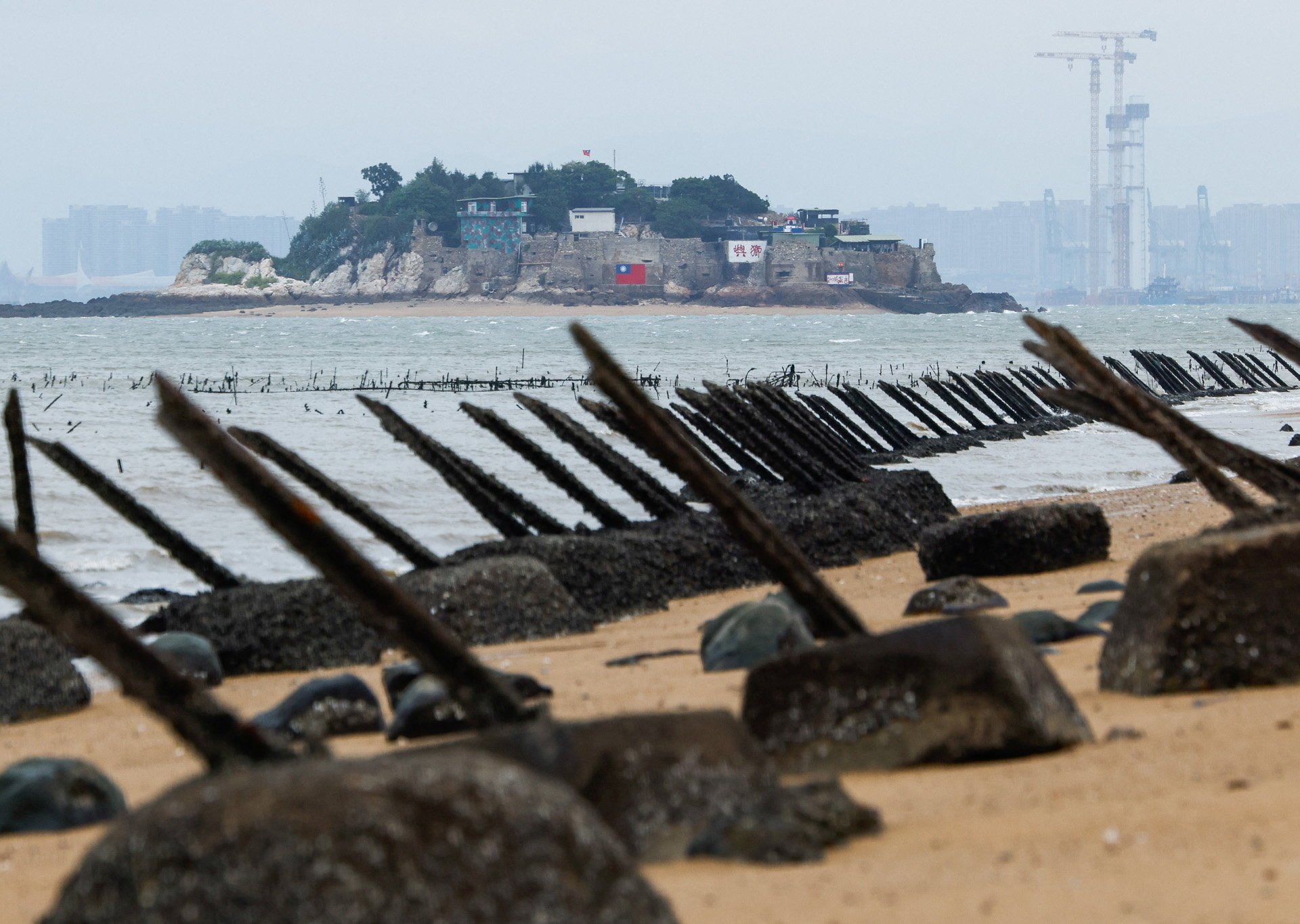

United States intelligence agencies say that China is pursuing its longstanding goal of taking control over Taiwan, but they do not expect Beijing to launch an invasion by next year, according to their latest threat assessment.
“The [intelligence community] assesses that Chinese leaders do not currently plan to execute an invasion of Taiwan in 2027, nor do they have a fixed timeline for achieving unification,” according to the 2026 Annual Threat Assessment of the US Intelligence Community, which was released on Wednesday.
- list 1 of 4Qatar expels Iranian attaches after LNG facility strike
- list 2 of 4Saudi FM warns Iran that patience in Gulf not ‘unlimited’ amid attacks
- list 3 of 4Three women killed in occupied West Bank missile attack
- list 4 of 4‘Does America have a plan? Israel has a plan. Does America know?’
end of list
The year 2027 has been considered an unofficial deadline in Washington for when the Chinese People’s Liberation Army (PLA) will have capabilities in place to launch an invasion of Taiwan, but US intelligence said such a timeline does not mean Beijing will launch an attack.
“Beijing almost certainly will consider a variety of factors in deciding whether and how to pursue military approaches to unification, including PLA readiness, the actions and politics of Taiwan, and whether or not the US will militarily intervene on Taiwan’s behalf,” the report said.
The PLA has been making “steady but uneven progress” and it has at times “increased the scope, size, and pace of operations around Taiwan” with military drills and operations, but there are still too many risks for Chinese leadership, the report adds.
Despite the often harsh language from Beijing about Taiwan, US intelligence also believes that Chinese leadership still “prefers to achieve unification without the use of force, if possible,” the report said.
Advertisement
A Chinese military onslaught against the island would also cause wider economic disruptions as Taiwan is the world’s top computer chipmaker and about one-fifth of global trade passes through the Taiwan Strait, the report said.
“Even without Washington’s involvement, US and global economic and security interests would face significant and costly consequences, with tech supply chains disrupted and investor fear across markets,” the report said.
“In addition, a protracted war with the US risks unprecedented economic costs to the US, Chinese, and global economies,” it said.
‘Xi Jinping doesn’t have a fixed timeline’
The US does not formally recognise Taiwan’s government, but it has pledged to help Taipei defend itself under the 1979 Taiwan Relations Act and subsequent policies, including substantial arms sales and military training for Taiwan’s military. But Washington has remained deliberately vague about whether it would commit troops should China act against the island.
Bonnie Glaser, managing director of the Indo-Pacific programme at the German Marshall Fund of the United States, said she agreed with the US intelligence assessment.
“Xi Jinping doesn’t have a fixed timeline for reunification and prefers to achieve that goal without using force,” she said.
Glaser also said the recent anticorruption “purges” of senior officers in the PLA – a point not mentioned in the report – made a Chinese military option for Taiwan unlikely in the next few years.
Chinese President Xi Jinping has removed or likely removed about 100 high-ranking officers since 2022 in an anticorruption sweep, according to the US-based CSIS China Power Project.
Kitsch Liao, a cyber and military affairs consultant for Taiwan’s Doublethink Lab, told Al Jazeera that the 2030s are a potentially more dangerous timeframe for Taiwan.
“The 2030s is the consensus of the intelligence community, and it’s based on capability not intent,” he told Al Jazeera.
Beijing claims democratic Taiwan as a province and has pledged to annex it by 2049 – the 100-year anniversary of the People’s Republic of China – through either peaceful or forceful means.
China considers Taiwan’s centre-left government to be “separatists” and says involvement by the US and other countries is “foreign interference” in domestic Chinese affairs.
Related News

Death toll surpasses 1,000 in Lebanon as Israeli bombardment continues

ICC prosecutor opens probe into Belarus over deportations to Lithuania
US civil rights group documents ‘broad attack on Muslim life’ in 2025