US Energy Secretary Chris Wright touts oil production on Venezuela visit
 11 February 2026
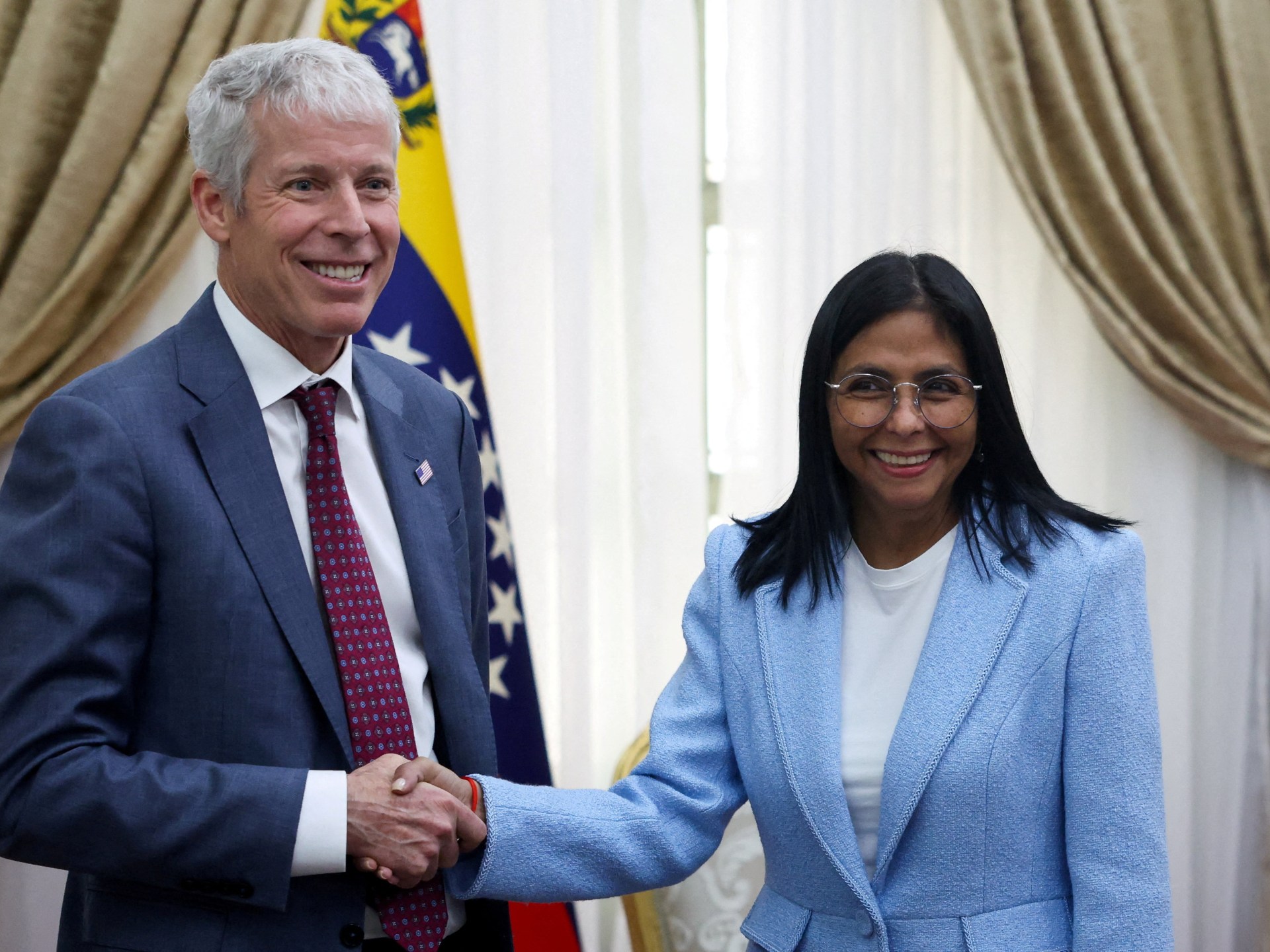

United States Energy Secretary Chris Wright has visited Venezuela to meet with interim President Delcy Rodriguez, as his country pushes forward with plans for more foreign oil investment in the region.
Wednesday’s meeting marked the first time a member of President Donald Trump’s cabinet has visited Venezuela.
- list 1 of 3Oil and US oversight: How is Venezuela’s interim government surviving?
- list 2 of 3US seizes Venezuela-linked oil tanker in Indian Ocean
- list 3 of 3Beyond pressure: What is the Trump administration’s endgame in Cuba?
end of list
Overall, it was a rare instance of a high-level US official visiting the South American country, given the fractious ties Washington has had with Venezuela’s socialist government.
But Wright struck an optimistic note as he spoke at a news conference with Rodriguez that was broadcast on Venezuelan state television.
“It is an honour to stand here with you today and to be among the tremendous people of Venezuela,” Wright said.
He then proceeded to acknowledge the tensions in recent decades between the two countries.
But Wright hinted at change under the Trump administration. He also indicated the US president would take a hemisphere-wide approach to his campaign slogan, “Make America Great Again”.
“Our countries share a long history. It has gone through different chapters, as all relationships do,” Wright said.
“But I bring today a message from President Trump. He is passionately committed to absolutely transforming the relationship between the United States and Venezuela, part of a broader agenda to make the Americas great again.”
A new era of expansion
Trump has repeatedly outlined his vision for a new era of “manifest destiny“, a 19th-century doctrine that champions US expansionism.
Advertisement
Already, he has quipped about implementing the “Donroe Doctrine”, his version of the Monroe Doctrine, a 19th-century foreign policy platform that designates the entire Western Hemisphere as the US’s sphere of influence.
Part of that push has been to bring countries throughout the Americas in line with US policy, whether through economic pressure, diplomatic efforts or military action.
An example of the latter came on January 3, when Trump authorised an early-morning military operation to attack Venezuela and abduct its then-leader, President Nicolas Maduro.
The Venezuelan leader and his wife, Cilia Flores, were then transported by military aircraft to New York. They are expected to stand trial on drug-trafficking charges in March.
In his first remarks after the military operation, Trump asserted that the US would “run” Venezuela.
He has since recognised the interim leadership of Maduro’s former vice president, Rodriguez, though he has threatened a “second wave” of military action if she fails to comply with his demands.
Claiming Venezuela’s oil
Trump has also made sweeping claims to Venezuela’s oil industry.
In his initial speech following the military operation, Trump reiterated claims that the country’s petroleum resources belonged to the US, as a result of early oil exploration from companies like Exxon Mobil.
Trump argued that Venezuela’s efforts to nationalise its oil industry amounted to the “largest theft of property in the history” of the US.
“Venezuela unilaterally seized and sold American oil, American assets and American platforms, costing us billions and billions of dollars,” Trump said. “They took all of our property. It was our property. We built it.”
He emphasised that his country, not Venezuela, should control the local oil reserves, though international law states otherwise.
Multiple international resolutions and covenants outline that nations have permanent sovereignty over their own natural resources.
“We built Venezuela’s oil industry with American talent, drive and skill. And the socialist regime stole it from us during those previous administrations,” Trump said on January 3.
Since then, Trump has announced that Venezuela has turned over nearly 50 million barrels of oil to the US. That oil, Trump explained, is slated to be sold at market price for the benefit of both the US and Venezuela.
“That money will be controlled by me, as President of the United States of America,” Trump wrote online.
He also indicated he had tasked Wright to carry out the planned sale.
Advertisement
A presidential overstep?
But Trump has faced backlash for his aggressive approach to Venezuelan oil. Critics have pointed out that the US Constitution puts the power to manage money with Congress, not the president.
Then there is the question of whether this oil was legally acquired from Venezuela in the first place, as Republican Congress member Thomas Massie pointed out last month.
“Selling stolen oil and putting billions of dollars in a bank in Qatar to be spent without Congressional approval is not Constitutional,” he wrote on social media.
“Only Congress can appropriate money. The President can’t legally create a second Treasury overseas for his own piggy bank.”
The criticism continued on Wednesday. While Wright visited the Rodriguez administration, Democrats in the Senate introduced the Venezuela Oil Proceeds Transparency Act, designed to force a nonpartisan audit of the recent oil proceeds.
One of the bill’s sponsors, Adam Schiff of California, criticised Trump’s preoccupation with Venezuelan oil and questioned his motives for attacking Venezuela and its surrounding waters.
“For months, the Trump administration claimed that its military operations in the Caribbean were about stopping drugs, but the objective is now abundantly clear: this was about seizing Venezuela’s oil and lining the pockets of the oil industry,” Schiff said in a statement.
Chuck Schumer, the top Democrat in the chamber and the bill’s co-sponsor, echoed Schiff’s call for greater transparency.
“The American people deserve to know what’s happening with the money received from these Venezuelan oil payments and where – and to whom – they are going,” Schumer said.
An upbeat meeting
But the controversy in the US did not dampen the upbeat meeting Wright had with Rodriguez.
Wright’s visit was the first of its kind for Venezuela. Under Maduro, Trump did send a special envoy, Richard Grenell, to the country in January 2025 to negotiate for the release of US prisoners.
Grenell’s negotiations with Maduro, however, ended in October, as the Trump administration ramped up pressure on the Venezuelan government.
Since Maduro’s removal, the US Department of State has deployed a mission to Caracas, as the two countries work to reestablish diplomatic ties. The US has signalled it will soon reopen its embassy in Venezuela, which has been closed since 2019.
But no US official as senior as Wright has visited the country in years.
Rodriguez, meanwhile, has led an effort to comply with Trump’s demands. On January 29, she signed into law a reform bill that would allow for increased privatisation in Venezuela’s nationalised oil industry.
On Wednesday, she and Wright appeared together on the steps of the Miraflores presidential palace in Caracas to present a summary of their meeting.
Wright pledged that Venezuela would see a “dramatic increase in Venezuelan oil production”, as well as a boost in the use of its other energy resources. He also promised “to bring commerce, peace, prosperity, jobs, opportunity to the people of Venezuela and in partnership with the United States”.
Advertisement
“These are not just words or ambitions,” he added. “We have very specific plans and very specific actions already.”
Related News
Condemnation as Israel moves to expand powers in occupied West Bank
UN nuclear watchdog discusses Ukraine nuclear safety risks
US judge rules Luigi Mangione won’t face death penalty in CEO killing case