

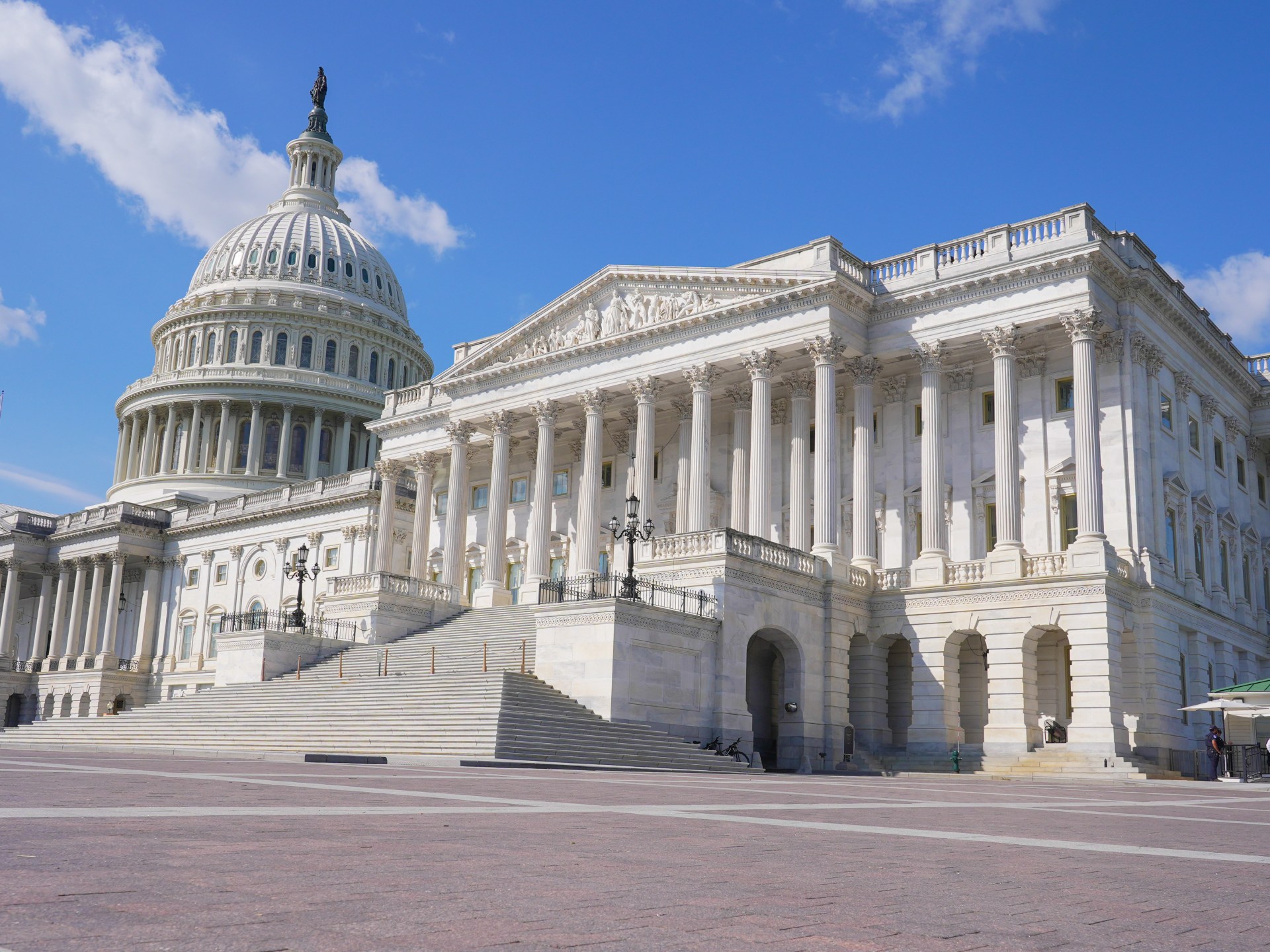

The United States is accelerating the global weakening of the rule of law, according to a new report that found nearly half of the indicators used to measure American democracy have fallen to their lowest levels in 50 years.
In the report released on Tuesday, the International Institute for Democracy and Electoral Assistance (International IDEA) describes the US as the “most prominent example and accelerator” of the trend, warning that its democratic erosion is having consequences far beyond the country’s borders.
- list 1 of 4Republican midterm convention wraps up in Dallas, Texas: Key takeaways
- list 2 of 4Mehdi Hasan: Disrupting democracy’s decline
- list 3 of 4What the US militarisation of Latin America could look like
- list 4 of 4Who is Trump trying to exclude from 2030 US census and why does it matter?
end of list
“President Donald Trump quickly amassed power in the executive branch and wielded it to further a narrow set of personal goals and pursue retaliation against perceived enemies,” the report stated. “In that environment, which is marked by constricted space for both public expression and institutional checks on power, resistance is increasingly unsafe.”
Globally, around 57 percent of countries declined in at least one key indicator of democratic performance between 2020 and 2025. Judicial independence has fallen to a 36-year low, while credible elections are at their lowest level in 30 years.
But the report singles out the US because of both the scale of its decline and its outsized global influence, arguing that its retreat from democratic norms has strained multilateral institutions and emboldened authoritarian leaders elsewhere.
“The results have been far-reaching, undermining the rule of law domestically and internationally and testing long-standing alliances and multilateral cooperation,” the report stated.
Advertisement
It pointed to Brazil and Serbia as examples, saying the aftermath of Brazil’s 2022 election, when Jair Bolsonaro sought to remain in power after losing the presidency and his supporters later stormed government buildings, “echoed” the aftermath of the 2020 US election. In Serbia, officials cited Trump’s claims of mismanagement at USAID to justify raids on civil society organisations.
“For decades, the rule of law both domestically and in the international order has underpinned the resilience of democracies,” International IDEA Secretary-General Kevin Casas-Zamora said. “Now, the rapid decline of democracy in the USA is weakening judicial independence and fragmenting the international system — threatening democracy around the world.”
The US recorded seven statistically significant declines between 2020 and 2025, including in access to justice, freedom of expression, press freedom and judicial independence. Except for free political parties, the other six are now at their lowest levels in the dataset’s history.
On press freedom, International IDEA cites cuts to funding for public broadcasters NPR, PBS and the US Agency for Global Media, as well as “ad hominem attacks on journalists, particularly women, and lawsuits against media organisations such as The New York Times, The Wall Street Journal, and the BBC”.
Universities have also come under pressure.
“Executive measures affecting funding and academic freedom in universities, including efforts to influence accreditation and hiring processes, provide a further example of the decline in Freedom of Expression,” the report said, citing the withholding of federal funds from Harvard and Columbia.
The report calls the Trump administration’s use of the immigration system the “starkest example” of declining access to justice. It points to 137 Venezuelans sent to El Salvador under the 1798 Alien Enemies Act, saying many had little or no established connection to the Venezuelan Tren de Aragua gang and were denied the chance to properly challenge their removal in court.
The report also warns that the broader erosion of democracy comes with consequences for global security, finding that some forms of democratic decline are associated with a greater risk of violent conflict. There were 65 violent conflicts in 2025, the most recorded since the Uppsala Conflict Data Program’s series began in 1946, including a record eight conflicts between states.
Related News

New tiger cat species identified in Bolivia, first in over a century

Poland, Ukraine accuse Russia of ‘escalation’ after strikes near border
What’s in Iran’s seven-day plan to reopen the Strait of Hormuz?