
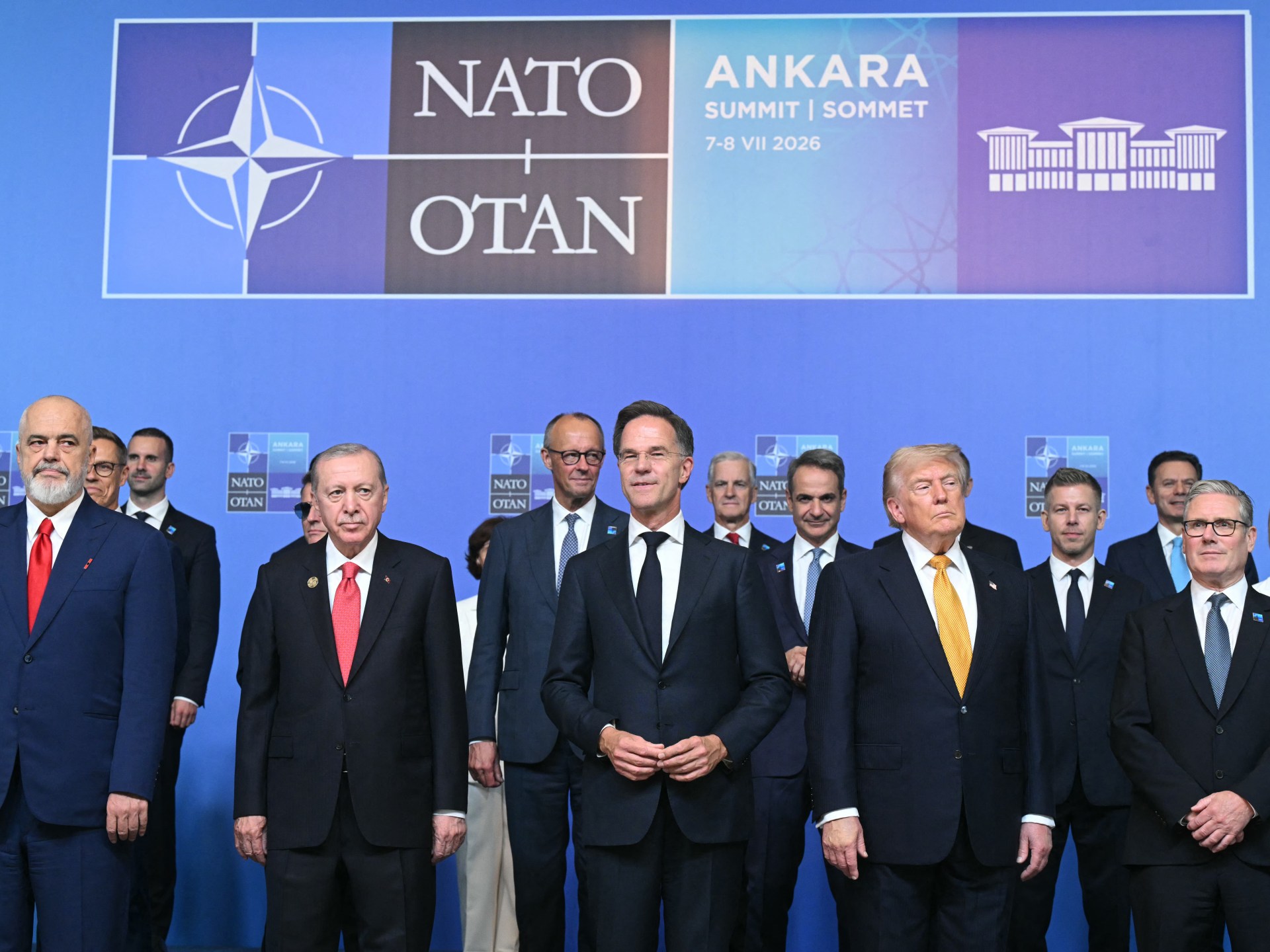

NATO concluded a two-day summit in Turkiye’s Ankara on Wednesday afternoon, with members discussing defence budgets and support for Ukraine, but with simultaneous talk of unity and discord underscoring an uncertain path ahead for an alliance that has been the bedrock of the West’s security architecture for more than 75 years.
While allies appeared aligned on several key issues, United States President Donald Trump used the summit to criticise NATO partners over defence spending, including Spain, on which he imposed a trade embargo.
Despite this, Trump described the summit as “tremendously successful”.
“It was amazing, actually,” he told reporters. “The unity in that room was incredible, really a love, it was sort of pretty wild.”
Here are key developments at the summit — some demonstrating consensus, others revealing fissures.
Leaders agree to increase defence spending, Ukraine aid
In their summit declaration, NATO leaders reaffirmed their “ironclad commitment” to the mutual assistance clause enshrined in Article 5 of the alliance treaty.
In earlier years, that commitment was a given, its mention in a summit declaration a pro forma nod to the founding document of the alliance. But Trump has repeatedly questioned the worth of the alliance, accused NATO members of “not being there” for the US when it needed them — such as during the war on Iran this year — and left open the possibility that Washington might not come to the defence of allies if they come under attack.
Against that backdrop, the summit declaration would serve as a reassuring promise from the US, by far the world’s largest and most powerful military.
Advertisement
Meanwhile, European leaders showcased their surging defence spending at the summit as they looked to convince Trump they are making good on a pledge to ramp up budgets and take more responsibility for their own security.
The commitments included “more than $50 billion in new procurements”, according to the NATO declaration.
Trump has long said Europe should spend more on defence, and his administration is pushing Europeans to take primary responsibility for the conventional defence of the continent.
However, NATO data shows that only five of its 32 members are projected to meet the alliance’s goal of spending 3.5 percent of their gross domestic product (GDP) on core defence in 2026.
At the summit, 32 NATO heads of state also pledged 70 billion euros ($80bn) in assistance to Ukraine.
“The NATO member states have generated a show of unity over Ukraine on this occasion. They have all rallied to the notion that Ukraine is successfully stemming Russia’s creeping advance,” Jolyon Howorth, emeritus professor of European politics at the University of Bath, told Al Jazeera.
“But there is little unity, either within Europe or between the Atlantic partners, as to the way forward with Ukraine. That is unlikely to change even when Trump finally leaves the White House.”
Trump cuts off trade with Spain, threatens Greenland
Trump spoke of “love” in the room, but there was no love lost for Spain, as he issued an order for a trade embargo on Wednesday. He asked Treasury Secretary Scott Bessent to “cut off all trade … including visits” with the country amid tensions over defence spending.
The Treasury Department, Commerce Department and the Trade Representative’s office will work to present Trump with “a menu of Spanish products that may be embargoed in the coming days”, a US official told the Reuters news agency. The comments suggest a trade ban could be partial.
Also on Wednesday, Trump told reporters: “I’m not happy with NATO because of what they did with Greenland, and I’m not happy with NATO because of the fact that they didn’t want to help us with the number one state sponsor of terror, that’s Iran.”
Trump’s escalating attacks on Spain, coupled with his renewed threats to acquire Greenland – an autonomous territory of Denmark – are exposing possible fractures in NATO’s cohesion.
“NATO has always struggled with the issue of unity. Its member states have different interests arising from history and geography,” Howorth said. “Spain and Denmark are currently – for different reasons – in Trump’s crosshairs. This is a serious problem for the Alliance’s unity.”
Advertisement
Trump lifting sanctions off Turkiye
On the other hand, Trump said on Tuesday he would lift sanctions on Turkiye and would soon decide on resuming F-35 jet sales.
The statement came as Trump met Turkish President Recep Tayyip Erdogan on the sidelines of the summit in Ankara.
The pivot came after the US booted Turkiye from the F-35 programme after Ankara acquired Russian S-400 air defence systems in 2019. It also imposed sanctions under the Countering America’s Adversaries Through Sanctions Act (CAATSA).
“We’re going to be taking the sanctions off,” Trump told reporters.
Sitting next to Erdogan, Trump said he would soon determine the sale of F-35s to Turkiye.
“That’s a decision we’re going to make … it’s a great plane, the best plane by far and it’s certainly something we will consider,” Trump said.
His meeting with Erdogan came as Israeli Prime Minister Benjamin Netanyahu has increasingly pressured the US not to resume F-35 sales to Turkiye.
Besides the Turkiye development, Trump also approved the sale of Tomahawk cruise missiles to Germany, Chancellor Friedrich Merz said on Thursday, despite doubts that a planned deployment of the missiles would go ahead.
British and Dutch forces will be equipped with new amphibious transport ships under a 2.4 billion-pound ($3.2bn) maritime partnership signed, according to the United Kingdom.
“Combining the UK’s industrial expertise with The Netherlands’ design and sea-faring experience to deliver first-rate platforms for our elite amphibious forces, this partnership will strengthen NATO,” British Prime Minister Keir Starmer, who attended the NATO summit, said in a statement on Tuesday.
How united is NATO overall?
“Above all, the ‘unity’ between the US and Europe has always depended crucially on the Europeans believing and trusting that the US would stand with them in the event of an existential threat,” Howorth said.
He added that Trump has “knowingly destroyed” this trust.
“Whatever he may say at any given moment, nobody can believe that he will not subsequently change his mind. That unpredictability further undermines unity. The challenge now is for the Europeans to remain united in their quest for autonomy from the US through and via NATO.”
Related News

Top French court upholds assisted dying law, rejects teen social media ban

Pakistan-administered Kashmir elections and protests – all you need to know
Why extreme heat is much more dangerous for the elderly than we realised