



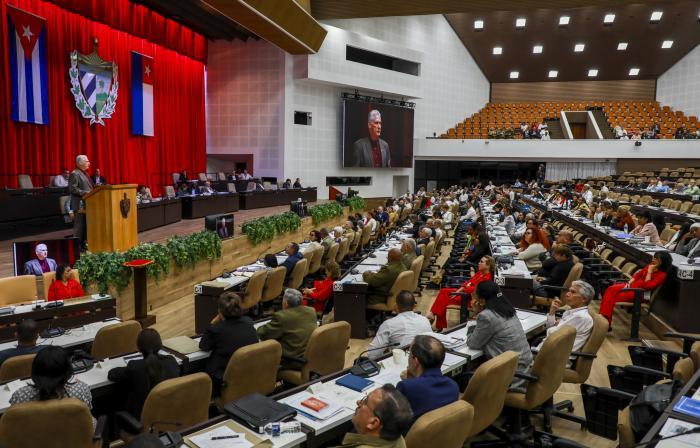
Army General Raúl Castro Ruz, leader of the Cuban Revolution, attended the fifth regular session of the National Assembly of People's Power, in its 10th Legislature, which met on Thursday.
The First Secretary of the Central Committee of the Party and President of the Republic, Miguel Díaz-Canel Bermúdez, critically highlighted the current state of the national economy, "an accumulation of distortions, adversities, difficulties, and mistakes of our own, exacerbated by an extremely aggressive external blockade."
He assured, however, that "there is no room for resigned management of the crisis," and highlighted the capabilities, especially of the National Assembly, to face the moment "with a sense of urgency, serenity, realism, and commitment."
Regarding the Government Program to correct distortions and revive the economy—presented by the Prime Minister and debated by Parliament—he instructed that "it cannot continue to be a reference document: it must become the mandatory roadmap for all agencies, companies, and territories."
For each complex problem facing the country, he directed that the response be "greater creativity, greater discipline, greater control, and a relentless fight against the burdens that hold us back: bureaucracy, indolence, and corruption."
He recalled that the Party's Central Committee, at its most recent plenary session, established a working method: "macroeconomic stabilization, correction of distortions, and a boost to production, not as slogans, but as a system of concrete decisions, with deadlines and responsible parties."
On macroeconomic stability, the Head of State stated that "it is not a technocratic luxury; it is a condition for wages to be worthwhile, for the market to function, not for its own sake, but to guarantee a sustainable social policy."
Regarding the Economic Plan for 2026, he said that it is a plan of offensive and readjustment, but not a technical adjustment: "it is a revolutionary necessity to perfect socialism under construction, to make it more prosperous, sustainable, and fair.
Regarding the continuing major threat posed by the U.S. government, he highlighted the relentless economic aggression against Cuba and, in the regional context, referred to the hostility towards Venezuela, the result of a doctrine that seeks to impose arbitrary will and domination through threats, coercion, and even direct aggression.
During the session, the Economic Plan and the State Budget Law for 2026 were presented, debated, and approved.
The General Law on Science, Technology, and Innovation was also approved.
The law introduces modern concepts to boost innovation in the economy; it promotes the creation and development of Technology-Based Companies (TBC) and High-Tech Companies (HTC), science and technology parks, interface companies, and foundations. It establishes tax and financial incentives, as well as an incubation regime for new companies.
A Science and Innovation Financial Fund will be created, fed by a 10% contribution from the profits tax of TBC's, parks, and other dynamic structures.
This law makes local governments, with the support of universities and CITMA, responsible for promoting territorial innovation systems and consolidating scientific hubs.
When presenting the updated Legislative Schedule, the new Minister of Justice, Rosabel Gamón Verde, explained that since the Constitution of the Republic came into force in 2019, 58 laws and 130 decree-laws have been approved, for a total of 188 higher-level legal norms.
In 2025, laws were passed on the General Regime of Misdemeanors and Administrative Sanctions; the Cuban Sports System; the Code on Children, Adolescents, and Youth; the Civil Registry; Constitutional Reform; the State Budget for 2026; Science, Technology, and Innovation; Exceptional Reduction of the Current Term of Office of Delegates to Municipal Assemblies of People's Power.
During the 6th regular session, deputies elected José Luis Toledo Santander as secretary of the National Assembly of People's Power and the Council of State, following the resignation of Homero Acosta Álvarez as deputy.
Litza Elena González Desdín, president of the University Student Federation, was also elected as a member of the Council of State.
The deputies elected Oscar Manuel Silvera Martínez, former Minister of Justice, as president of the People's Supreme Court.
The National Assembly approved President Díaz-Canel's proposal to appoint Rosabel Gamón Verde as Minister of Justice.
Eight new deputies also took office during the session, expanding popular representation in the highest organ of state power.
Related News

The unity we need today is that of those who argue strongly, but march together

The youth of Latin America and the Caribbean deserve to have books in their hands, not jus...
Foreign currency transactions: a necessary step to strengthen the national economy
