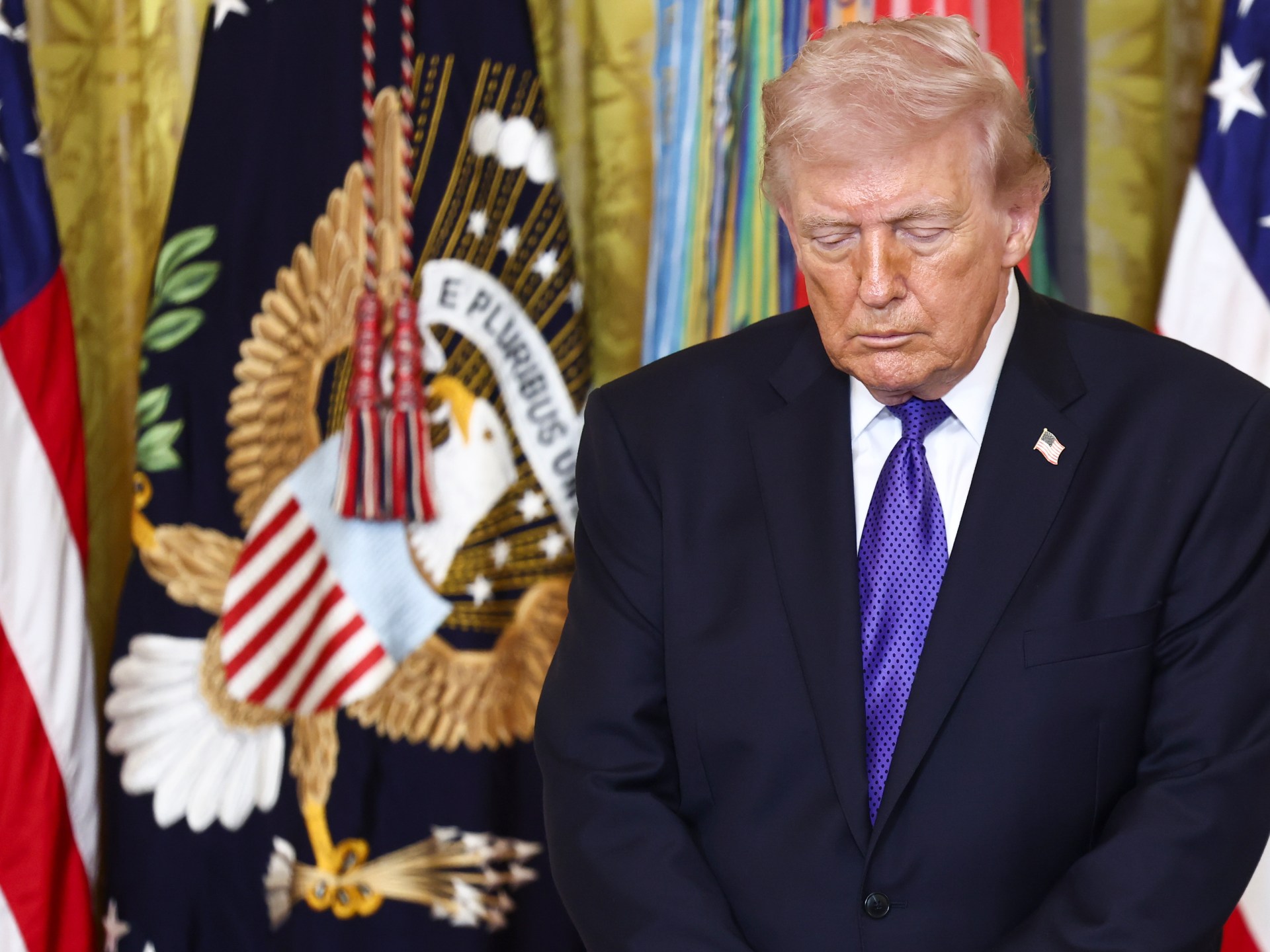

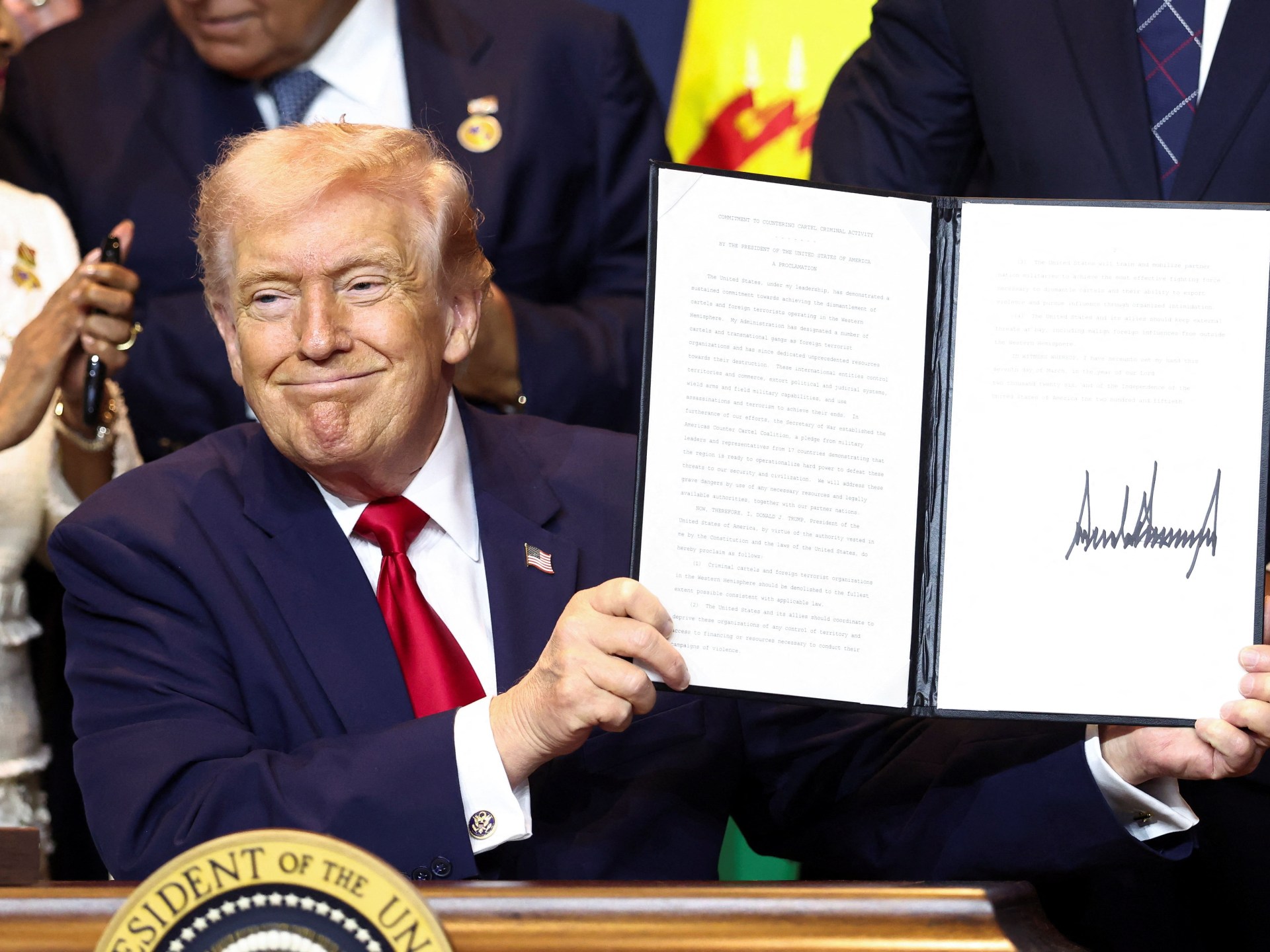

At the inaugural “Shield of the Americas” summit in South Florida, United States President Donald Trump announced the creation of what he calls the Americas Counter-Cartel Coalition: a group of a dozen politically aligned countries committed to fighting drug trafficking.
But as he signed a declaration to cement that commitment, Trump signalled that it came with the expectation that cartels would not be confronted with law enforcement action, but instead military might.
- list 1 of 3US issues limited licence for Venezuelan gold following high-level visit
- list 2 of 3Cuba announces fifth death after shootout with Florida-tagged speedboat
- list 3 of 3US downplays reports Russia gave Iran intel to help Tehran strike US assets
end of list
“ The only way to defeat these enemies is by unleashing the power of our military. So we have to use our military. You have to use your military,” Trump told the audience of Latin American leaders.
“You have some great police, but they threaten your police. They scare your police. You’re going to use your military.”
Saturday’s summit was the latest step in a larger foreign policy pivot under Trump.
Since taking office for a second term, Trump has distanced himself from some of the US’s traditional allies in Europe, instead forging tighter partnerships with right-wing governments around the world.
The attendance at the Shield of the Americas summit reflected that shift. Right-wing leaders, including Argentina’s Javier Milei, El Salvador’s Nayib Bukele and Ecuador’s Daniel Noboa, were among the guest list.
But notably absent was top-level leadership from Mexico, the US’s biggest trading partner, and Brazil, the largest country in the region by economy and population.
Both Mexico and Brazil are led by left-wing presidents who have resisted some of Trump’s more hardline policies.
Advertisement
The growing rift between the US and some of its longtime partners was a feature in the brief remarks delivered by US Secretary of State Marco Rubio, who praised attendees for their cooperation.
“They’re more than allies. They’re friends,” Rubio said of the leaders present.
“At a time when we have learned that oftentimes an ally, when you need them, maybe may not be there for you, these are countries that have been there for us.”
Secretary of Defense Pete Hegseth, meanwhile, reiterated his view that criminal networks and cartels pose an existential crisis for the entire Western Hemisphere, which he described as sharing the same cultural and religious roots.
“ We share a hemisphere and geography. We share cultures, Western Christian civilisation. We share these things together. We have to have the courage to defend it,” Hegseth said.

A military-first approach
Latin America is one of several areas where Trump has launched military operations since returning to office in January 2025.
His rationale for authorising deadly operations in the region has centred primarily on the illicit drug trade.
Trump has repeatedly argued that Latin American criminal networks pose an imminent threat to national security, through the trafficking of people and drugs across US borders.
Experts in international law have pointed out that drug trafficking is considered a criminal offence — and it is not accepted as justification for acts of military aggression.
But the Trump administration has nevertheless launched lethal military strikes against alleged drug traffickers in Latin America.
Since September, for instance, the Trump administration has conducted at least 44 aerial strikes on maritime vessels in the Caribbean Sea and eastern Pacific Ocean, killing nearly 150 people.
The victims’ identities have never been publicly confirmed, nor has evidence been publicly released to justify the deadly strikes.
Some families in Colombia and Trinidad and Tobago have stepped forward to claim the dead as their loved ones, out on a fishing expedition or travelling between islands for informal work.
In Saturday’s remarks, Trump justified the attacks by arguing that cartels and other criminal networks had grown more powerful than local militaries — and therefore necessitated a lethal response.
“Many of the cartels have developed sophisticated military operations. Highly sophisticated, in some cases. They say they’re more powerful than the military in the country,” Trump said.
Advertisement
“Can’t have that. These brutal criminal organisations pose an unacceptable threat to national security. And they provide a dangerous gateway for foreign adversaries in our region.”
He then compared cartels to a disease: “They’re cancer, and we don’t want it spreading.”

A ‘nasty’ operation in Venezuela
In late December and early January, Trump also initiated attacks on Venezuelan soil, again defending his actions as necessary to stop drug traffickers.
The first attack targeted a port Trump linked to the gang Tren de Aragua. The second, on January 3, was a broader offensive that culminated in the abduction and imprisonment of Venezuela’s then-leader, President Nicolas Maduro.
On Saturday, Trump reflected on that military operation, which he characterised as an unmitigated success.
Maduro is currently awaiting trial on drug-trafficking charges in New York, though a declassified intelligence report last May cast doubt on Trump’s allegations that the Venezuelan leader directed drug-trafficking operations through groups like Tren de Aragua.
“America’s armed forces also ended the reign of one of the biggest cartel kingpins of all, with Operation Absolute Resolve to bring outlaw dictator Nicolas Maduro to justice in a precision raid,” Trump told Saturday’s summit.
He then described the military operation as “nasty”, though he underscored that no US lives were lost.
The early-morning raid, however, killed at least 80 people in Venezuela, including 32 Cuban military officers, dozens of Venezuelan security forces, and several civilians.
“We went right into the heart. We took them out, and it was nasty. It was about 18 minutes of pure violence, and we took them out,” Trump said of the operation.
Trump has since held up Venezuela as a model for regime change around the world, particularly as it leads a war with Israel against Iran.
Maduro’s successor, interim President Delcy Rodriguez, has so far complied with many of Trump’s demands, including for reforms to the country’s nationalised oil and mining sectors.
Just this week, the two countries re-established diplomatic relations for the first time since 2019, under Trump’s first term as president.
In Saturday’s remarks, however, Trump reiterated that his positive relationship with Rodriguez hinged on her cooperation with his priorities.
“She’s doing a great job because she’s working with us. If she wasn’t working with us, I would not say she’s doing a great job,” he said.
“In fact, if she wasn’t working with us, I’d say she’s doing a very poor job. Unacceptable.”

‘We’ll use missiles’
Trump did, however, express consternation with other presidents in the Latin American region, accusing them of allowing cartels to run amok.
“Leaders in this region have allowed large swaths of territory, the Western Hemisphere, to come under the direct control” of the cartels, Trump said.
Advertisement
“Transnational gangs have taken over, and they’ve run areas of your country. We’re not going to let that happen.”
He even delivered an ominous warning to the summit’s attendees: “Some of you are in danger. I mean, you’re actually in danger. It’s hard to believe.”
Many of the leaders in attendance, including El Salvador’s Bukele, have launched their own harsh crackdowns on gangs in their countries, employing “mano dura” or “iron fist” tactics.
Those campaigns, however, have elicited concerns from human rights groups, who have noted that presidents like Bukele used emergency declarations to suspend civil liberties and imprison hundreds of people, often without a fair trial.
Still, Trump dismissed alternative approaches in Saturday’s speech. Though he did not mention Colombia by name, he was critical of efforts to negotiate for the disarmament of cartels and rebel groups, as Colombian President Gustavo Petro has sought to do.
Instead, he offered to deploy military might throughout the region.
“We’ll use missiles. If you want us to use a missile, they’re extremely accurate — pew! — right into the living room, and that’s the end of that cartel person,” Trump said.
“A lot of countries don’t want to do that. They say, ‘Oh, sure. I’d rather not have that. I’d rather not have it. I believe they could be spoken to.’ I don’t think so.”

A call to ‘eradicate’ Mexico’s cartels
One country he did single out, though, was Mexico. Trump suggested that it had fallen behind other countries in the region in its efforts to combat crime.
“We must recognise the epicentre of cartel violence is Mexico,” he said.
“The Mexican cartels are fueling and orchestrating much of the bloodshed and chaos in this hemisphere, and the United States government will do whatever’s necessary to defend our national security.”
Since the start of his second term, Trump has pressured Mexico to step up its security efforts, threatening tariffs and even the possibility of military action if it does not comply.
Mexican President Claudia Sheinbaum has responded by increasing military deployments throughout the country.
In February 2025, for instance, she announced 10,000 soldiers would be sent to the US-Mexico border. For the upcoming FIFA World Cup, her officials have said nearly 100,000 security personnel will be patrolling the streets.
Just last month, her government also launched a military operation in Jalisco to capture and kill the cartel leader Nemesio Oseguera Cervantes, nicknamed “El Mencho”. She has also facilitated the transfer of cartel suspects to the US for trial.
But Trump reemphasised on Saturday his belief that Sheinbaum had not gone far enough, though he called her a “very good person” and a “beautiful woman” with a “beautiful voice”.
“I said, ‘Let me eradicate the cartels,'” Trump said, relaying one of his conversations with Sheinbaum.
“We have to eradicate them. We have to knock the hell out of them because they’re getting worse. They’re taking over their country. The cartels are running Mexico. We can’t have that. Too close to us, too close to you.”

‘Last moments of life’ in Cuba
Trump also used his podium to continue his threats against Cuba’s communist government.
Since the January 3 attack on Venezuela, Trump has increased his “maximum pressure” campaign against the Caribbean island, which has been under a full US trade embargo since the 1960s.
Advertisement
His administration severed the flow of oil and funds from Venezuela to Cuba, and in late January, Trump announced he would impose steep economic penalties on any country that provides the island with oil, a critical resource for the country’s electrical grid.
Already, the country has been struck with widespread blackouts, and the United Nations has warned Cuba is inching closer to humanitarian “collapse”.
But Trump framed the circumstances as progress towards the ultimate goal of regime change in Cuba.
“As we achieve a historic transformation in Venezuela, we’re also looking forward to the great change that will soon be coming to Cuba,” he told Saturday’s summit.
“Cuba’s at the end of the line. They’re very much at the end of the line. They have no money, they have no oil. They have a bad philosophy. They have a bad regime that’s been bad for a long time.”
He added that he thinks changing Cuba’s government will be “easy” and that a deal could be struck for the transition of power.
“Cuba’s in its last moments of life as it was. It’ll have a great new life, but it’s in its last moments of life the way it is,” Trump said.
But while Trump’s remarks largely focused on governments not represented at the summit, he warned that there could be consequences even for the right-wing leaders in attendance.
Trump’s “Shield of the Americas” coalition comes as he seeks to bring the whole of Latin America in line with US priorities. It’s a policy he has dubbed the “Donroe Doctrine”, a riff on the 19th-century Monroe Doctrine, which claimed the Western Hemisphere as the US’s sphere of influence.
To Trump, that means ousting rival powers like China as they seek to forge relationships and economic ties with Latin America. Trump has even mused about retaking the Panama Canal, based on his allegation that the Chinese have too much control in the area.
“As these situations in Venezuela and Cuba should make clear, under our new doctrine — and this is a doctrine — we will not allow hostile foreign influence to gain a foothold in this hemisphere,” Trump said.
He then made a pointed remark to Panama’s president, Jose Raul Mulino, who was in the audience.
“That includes the Panama Canal, which we talked about. We’re not going to allow it.”
Related News
Japan to install missiles near Taiwan: Are China tensions set to spike?
Analyst says interest in Epstein files plummeted after war on Iran launched
BBC criticised for nixing ‘Free Palestine’ tribute from BAFTA coverage