
The youth of Latin America and the Caribbean deserve to have books in their hands, not just in display cases
 18 December 2025


Dear Ambassador Miguel Díaz Reynoso;
Comrades from the leadership of the Party, the Government, the State, the Revolutionary Armed Forces, the Ministry of the Interior, and our mass and social organizations;
Dear Abel;
Dear friends;
Dear young Cubans:
When I was invited to speak at the launch of this Project 25 for 25, from Cuba, simultaneously with a similar presentation by our beloved President Claudia Sheinbaum, from the Zócalo in Mexico City, I immediately said yes, for three reasons:
First, the initiative came from a sister nation to which we owe a great deal and which we love. Second, it involves printed books, with well-known authors and works, as well as others that we would love to read. And third, although it could also be the first reason, it is designed for young people between the ages of 15 and 30 from various countries in our America.
So thank you for the opportunity, dear Claudia, Paco, Ambassador, and Abel; thank you also to the team at Casa de las Américas who embraced this cultural event as their own.
As a trained engineer, I am passionate about technology and enjoy the tremendous advances that are taking place every day in the digital world, but I have never been able to shake my love for printed books or the thrill of reading, eagerly turning the pages to absorb the knowledge they contain.
I think there is nothing like a good book to unleash the imagination. And if it is a printed book, then the pleasure of reading is added to that of treasuring ideas and phrases with which you identify so deeply that you mark them in those books that age alongside you, full of notes.
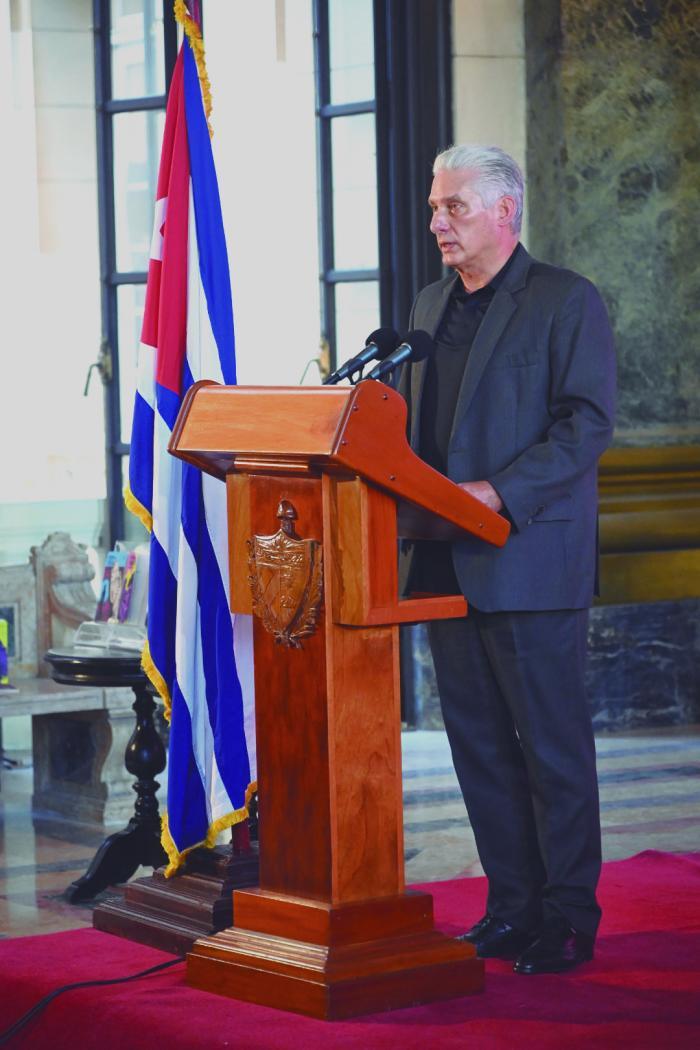
We must thank the Government of Mexico, its President, and particularly Paco Ignacio Taibo II, who knows Cuba so well and to whom we owe so many good books, for including us in this beautiful project.
It is an act of justice to the Cuban Revolution and its historic leader, Commander-in-Chief Fidel Castro Ruz, who coined an emblematic phrase expressing the unwavering desire to promote reading as a fundamental source of knowledge: "We don't tell the people: believe! We tell them: read!"
From that desire, one of the first cultural institutions of the Revolution was born on March 31, 1959. I am referring to the National Printing House, whose first book was none other than Miguel de Cervantes Saavedra's The ingenious gentleman Don Quixote of La Mancha, with illustrations by Pablo Picasso and Gustavo Doré. That printing press, directed by Alejo Carpentier, a genius of our literature, also printed the primers and basic texts of the great Literacy Campaign, which in less than a year turned Cuba into a territory free of illiteracy and, forever, into a nation passionate about reading and always thirsty for knowledge.
Those who lived through the excitement of those days say that when the Literacy Campaign was being prepared, Fidel promised in a public speech to reward those who became literate and wrote a letter to the Ministry of Education in their own handwriting. The prize was a book on the history and geography of Cuba and some notions about the world.
Many highlight the Commander-in-Chief's tireless battle to constantly elevate the culture of the people as a fundamental step on the road to development, but undoubtedly he also did so as a way of bringing everyone closer to the extraordinary pleasure of reading, as an act of human emancipation through knowledge. "Being educated is the only way to be free," said José Martí, and Fidel worked tirelessly to make that precept a reality in the national consciousness from the first year of the Revolution until his physical departure.
Gabriel García Márquez, Nobel Prize winner for literature and one of the authors of Project 25 for 25, with a work dedicated to the Cuban epic in Africa, as the Ambassador explained, had a special friendship with Fidel, which stemmed from their shared love of books and is very well captured in the audiovisual presentation shown here.
I have gone on at some length in my remarks, assuming the stated purpose of Project 25 for 25 to bring young people closer to a love of reading, not just as a school obligation.
You should know that leaders such as José Martí and Fidel Castro managed to acquire an encyclopedic culture that dazzled their contemporaries, thanks to books. Fulfilling its dreams, the Cuban Revolution has never ceased to stimulate literary creation and production, from the National Printing House, which became the Cuban Book Institute, to the highly revolutionary provincial publishing houses and the book campaigns and fairs that, over time, have become authentic celebrations of books and reading throughout the Cuban archipelago.
As I have been told, one of the objectives of Project 25 for 25 is to compete for some of the time that young people today devote almost entirely to social media, video games, and short audiovisual content, much of which is increasingly banal and simplistic, by offering them a truly uplifting alternative. It is not, of course, a question of prohibiting recreational activities, but of opening up new ways for the acquisition of knowledge and showing that literature can be fun and emotionally intense, until reading becomes an attractive option and not a school obligation.
This collection can undoubtedly have a significant impact on young people in Latin America and the Caribbean, especially in terms of access to books and contemporary and 20th-century Latin American literature, by removing one of the biggest barriers to reading in less developed countries: the cost of books and the lack of well-stocked libraries. The fact that the project is free opens up the possibility for teenagers and young people in some countries who have never been able to buy a book by a Latin American author to physically hold them in their hands and share them with their peers.
Reviewing the selection of works and authors, it is exciting to encounter the dazzling Latin American literature of the second half of the 20th century, an unquestionable success in connecting our youth with stories, languages, and conflicts that are very much our own, which explain who we are and strengthen Latin American identity from a historical memory with many points of contact, which should also encourage a deeper and more comprehensive reading of human rights.
Another indisputable success, consistent with the project's own policy of free access, is the distribution strategy in schools, universities, cultural centers, reading rooms, and all kinds of related collective spaces, promoting its extension and reach.
For all these reasons, I am deeply honored to give the starting signal for the launch in Cuba of Project 25 for 25, a bridge of paper and ink that unites the youth of our America.
Mexico and Cuba share a centuries-long history of struggles for independence, social justice, and the dignity of our peoples, during which a culture of so many and such diverse links flourished that in many cases it is impossible to differentiate what went from Mexico to Cuba and what went from Cuba to Mexico, and this is especially true of boleros.
I believe that with this act and this remarkable collection, we honor that shared history of culture, solidarity, hospitality, and rebellion. These books that Mexico is placing in the hands of Cuban youth today give continuity to that deep and heartfelt dialogue that has lasted for so many centuries.
Project 25 for 25 was born out of a simple and powerful conviction: the youth of Latin America and the Caribbean deserve to have books in their hands, not just in display cases. They deserve stories that speak of their neighborhoods, their pains, their hopes; voices that dare to question, to imagine other possible and better worlds.
Each book in this collection invites us to look at the region's past and present with fresh eyes. These pages tell stories of dictatorships and resistance, love and loss, anger and tenderness. They are books written by Latin Americans who dared to say "no" to injustice and "yes" to the dignity of their peoples.
Thank you, sisters and brothers, for including us in this project. By launching it here, we recognize Cuba's place in the political and cultural history of the continent, but we are also investing in its future: in the young people who today study, work, create, and resist on this island.
These books arrive in Cuba to engage in dialogue with its own literary tradition, with its poets, its storytellers, its teachers, its professors, and its reading mediators.
That is why this message is, above all, for you, young Cubans:
Take these books and read them alone; yes, but also share them aloud, discuss them, critique them. Let each book pass from hand to hand until the paper wears out but the ideas multiply.
Reading is not a luxury or a school punishment; it is a right and a form of freedom. Each page is a question that no one can answer for you. Each story is an opportunity to imagine how you want the world you are going to live in to be.
Today, as we launch this campaign in Cuba, we make a call:
To schools and universities, to turn these books into workshops, reading groups, and spaces for critical dialogue.
To libraries and cultural centers, to bring them to those who have never owned a book.
To families, so that they can accompany their children on the adventure of reading.
And, above all, to young people, so that they can make this collection their own and turn it into part of their own history.
The history of Latin America and the Caribbean has often been written from outside, in other languages and with other interests in mind. Today, with this collection, you are being given a part of history told by your own peoples. These are books that make you think.
On behalf of the Cuban Party, Government, and people, particularly its youth, please convey, my dear Ambassador, our heartfelt gratitude to your Government and your people, first and foremost to our beloved President Claudia Sheinbaum and to our great friend and fervent journalist and writer Paco Ignacio Taibo II, whose works dedicated to Cuba are among the best of our literature.
Thank you for this generous initiative, which will allow thousands of young people and teenagers to access fundamental works of universal and Latin American literature free of charge.
Thank you, Mexico, for sharing with us the transformative power of books!
Thank you very much (Applause).


